Japanese Automakers Face Sharp Sales Decline in China
A case study on how legacy hardware giants fail to compete when software and AI become the primary product differentiato
30-Second TL;DR
What Changed
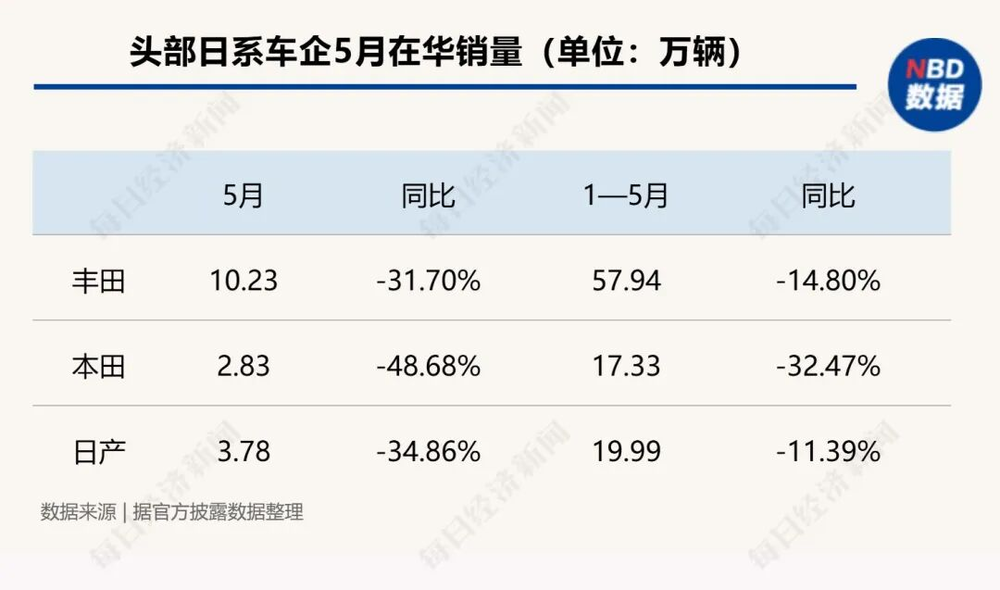
Toyota, Honda, and Nissan saw double-digit sales declines in China in May 2026.
Why It Matters
The decline of legacy automakers in China signals a permanent shift toward software-defined vehicles, forcing traditional firms to pivot toward local AI and autonomous driving partnerships to survive.
What To Do Next
Monitor the integration progress of Momenta and Pony.ai technologies in Toyota's upcoming '铂智' series to evaluate the effectiveness of legacy-to-AI pivots.
Key Points
- •Toyota, Honda, and Nissan saw double-digit sales declines in China in May 2026.
- •Japanese brand market share in China dropped to 10.5% from a 17% peak in 2023.
- •Core issues include slow EV/hybrid transition and lack of localized intelligent cockpit/driving features.
- •Toyota is partnering with Momenta and Pony.ai to accelerate local smart driving integration.
Deep Insight
AI-generated analysis for this event — not the original article.
Enhanced Key Takeaways
- •The Chinese government's 'New Energy Vehicle' (NEV) subsidy policies have been aggressively phased out for internal combustion engine vehicles, disproportionately impacting the legacy portfolios of Japanese automakers.
- •Japanese manufacturers are facing a 'price war' initiated by BYD and Tesla, which has compressed profit margins to levels that make traditional dealership models in China financially unsustainable.
- •Data indicates that the average age of Japanese brand car buyers in China has risen significantly, signaling a failure to capture the younger, tech-savvy demographic that favors domestic brands like NIO and XPeng.
- •Toyota has initiated a massive restructuring of its R&D center in China (IEM by TOYOTA) to grant local engineers more autonomy, moving away from the traditional 'top-down' decision-making process from Japan.
- •Nissan has announced a strategic pivot to focus exclusively on 'New Energy' vehicles for the Chinese market by 2027, aiming to launch multiple localized EV models to stem the current market share hemorrhage.
Competitor Analysis
- Japanese Automakers (Toyota/Honda/Nissan)
- Primarily ICE/Hybrid
- Domestic EV Leaders (BYD/NIO/XPeng)
- BEV/PHEV (High-density batteries)
- Japanese Automakers (Toyota/Honda/Nissan)
- Legacy/Basic connectivity
- Domestic EV Leaders (BYD/NIO/XPeng)
- Advanced AI/Voice/OTA updates
- Japanese Automakers (Toyota/Honda/Nissan)
- Premium/Fixed
- Domestic EV Leaders (BYD/NIO/XPeng)
- Aggressive/Dynamic (Price War)
- Japanese Automakers (Toyota/Honda/Nissan)
- Declining (10.5%)
- Domestic EV Leaders (BYD/NIO/XPeng)
- Rapidly Expanding
- Japanese Automakers (Toyota/Honda/Nissan)
- Partner-dependent (Momenta/Pony.ai)
- Domestic EV Leaders (BYD/NIO/XPeng)
- In-house/Full-stack development
| Feature/Metric | Japanese Automakers (Toyota/Honda/Nissan) | Domestic EV Leaders (BYD/NIO/XPeng) |
|---|---|---|
| Powertrain | Primarily ICE/Hybrid | BEV/PHEV (High-density batteries) |
| Software/Cockpit | Legacy/Basic connectivity | Advanced AI/Voice/OTA updates |
| Pricing Strategy | Premium/Fixed | Aggressive/Dynamic (Price War) |
| Market Share Trend | Declining (10.5%) | Rapidly Expanding |
| Autonomous Driving | Partner-dependent (Momenta/Pony.ai) | In-house/Full-stack development |
Technical Deep Dive
- Toyota is integrating the Momenta 2.0 autonomous driving solution, which utilizes a data-driven approach to handle complex urban traffic scenarios in China.
- The new localized intelligent cockpits are shifting toward Qualcomm Snapdragon Cockpit Platforms (SA8295P) to support high-performance AI processing and multi-screen interaction.
- Honda's 'e:N' architecture is being re-evaluated to incorporate more localized battery supply chains, specifically utilizing CATL's latest CTP (Cell-to-Pack) technology to improve energy density and cost efficiency.
Future ImplicationsAI analysis grounded in cited sources
Timeline
- 2023-01Japanese market share in China reaches a historical peak of 17%.
- 2023-08Toyota announces the establishment of IEM by TOYOTA to centralize R&D in China.
- 2024-04Toyota officially partners with Pony.ai and GAC to mass-produce robotaxis.
- 2025-03Nissan announces a strategic shift to prioritize EV development for the Chinese market.
- 2026-05Japanese brand market share in China hits a record low of 10.5%.
Weekly AI Recap
Read this week's curated digest of top AI events →
AI-curated news aggregator. All content rights belong to original publishers.
Original source: 虎嗅 ↗
This is a summary, not the original. Read the source, or get the weekly briefing.
The weekly digest
One email a week. Unsubscribe anytime.