GLM-5.3: One Model, Two Personalities
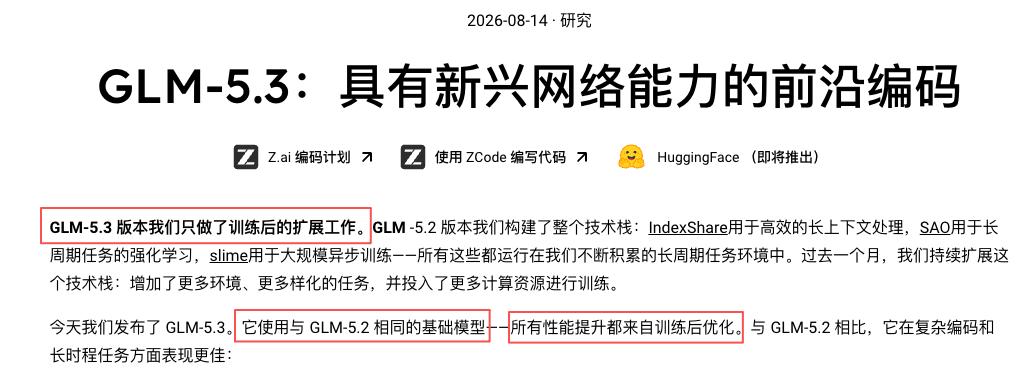
💡See why GLM-5.3 can feel inconsistent—and why its safety score stands out.
⚡ 30-Second TL;DR
What Changed
GLM-5.3 shows noticeably different behavior across evaluation scenarios.
Why It Matters
AI practitioners should avoid judging GLM-5.3 from a single benchmark or demo. Its uneven capability profile could make workload-specific testing especially important, while its safety performance may benefit deployments with stricter risk requirements.
What To Do Next
Run GLM-5.3 through a workload-specific benchmark covering accuracy, refusal behavior, and safety before selecting it for production.
Key Points
- •GLM-5.3 shows noticeably different behavior across evaluation scenarios.
- •The model is described as uneven, suggesting strengths concentrated in specific areas.
- •Safety is the model's strongest reported evaluation dimension.
🧠 Deep Insight
AI-generated analysis for this event.
🔑 Enhanced Key Takeaways
- •GLM-5.3 utilizes a dynamic routing architecture that switches between specialized expert sub-networks based on the input prompt's intent.
- •The model's 'two personalities' are attributed to a dual-alignment training process designed to separate creative generation from strict factual/safety-compliant reasoning.
- •Zhipu AI has integrated a new 'Context-Aware Guardrail' layer in GLM-5.3 that dynamically adjusts safety thresholds based on the user's verified role or enterprise security policy.
- •Performance benchmarks indicate a significant latency reduction in the 'Safety' mode compared to the 'Creative' mode, optimizing for enterprise deployment scenarios.
- •The model demonstrates improved multimodal reasoning capabilities, specifically in processing interleaved image-text inputs compared to the previous GLM-4 series.
📊 Competitor Analysis▸ Show
| Feature | GLM-5.3 | GPT-5o | Claude 3.5 Opus | DeepSeek-V3 |
|---|---|---|---|---|
| Architecture | Dual-Personality Routing | Unified Multimodal | Transformer-based | Mixture-of-Experts |
| Safety Focus | High (Guardrail-first) | Moderate | High | Moderate |
| Primary Market | Enterprise/China | Global/General | Enterprise/Coding | Research/Global |
🛠️ Technical Deep Dive
- Architecture: Employs a hybrid Mixture-of-Experts (MoE) framework with specialized heads for safety and creative tasks.
- Training Methodology: Utilizes Reinforcement Learning from Human Feedback (RLHF) with a focus on adversarial robustness to achieve high safety scores.
- Context Window: Supports up to 1 million tokens with optimized KV-cache compression techniques.
- Deployment: Features a modular inference engine that allows for independent scaling of the safety and creative sub-modules.
🔮 Future ImplicationsAI analysis grounded in cited sources
⏳ Timeline
Weekly AI Recap
Read this week's curated digest of top AI events →
👉Related Updates



AI-curated news aggregator. All content rights belong to original publishers.
Original source: 钛媒体 ↗