GitLab Unveils Agentic Infrastructure for Software Engineering
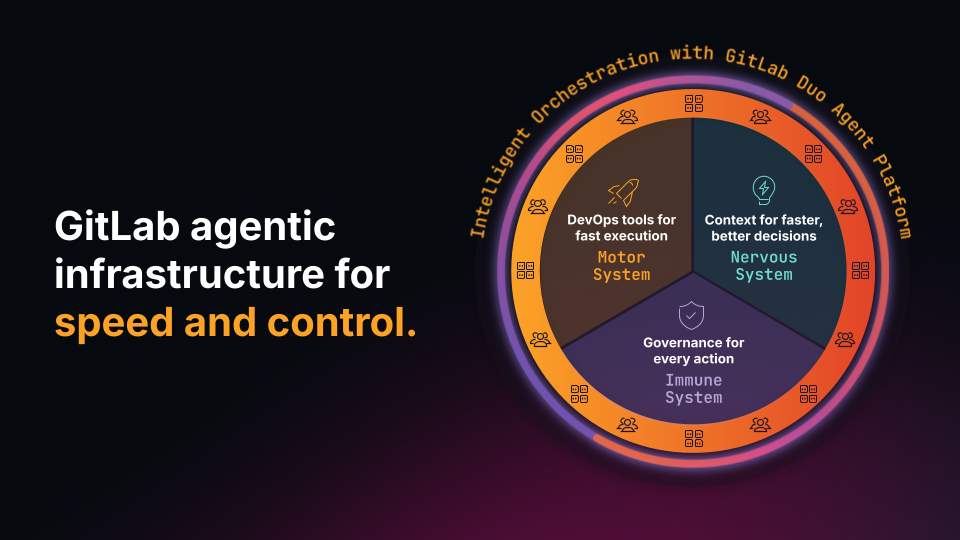
💡Learn how GitLab is building the infrastructure to manage agentic coding at scale without the typical chaos.
⚡ 30-Second TL;DR
What Changed
Introduced a next-gen Git engine designed for agent-scale concurrency (private beta).
Why It Matters
These tools address the 'chaos' of unmanaged AI coding by providing the necessary guardrails and infrastructure. It allows enterprises to scale agentic workflows without sacrificing security or visibility.
What To Do Next
Sign up for the private beta of the new Git engine to test how your CI/CD pipelines handle high-concurrency agentic workloads.
Key Points
- •Introduced a next-gen Git engine designed for agent-scale concurrency (private beta).
- •Launched GitLab Orbit, a context graph for the full software lifecycle (public beta).
- •Added security and governance agents to manage identity, policy, and audit for agent actions.
- •Introduced GitLab Flex, a flexible buying model tailored for AI adoption patterns.
🧠 Deep Insight
Background and context from public sources — not the original article. 18 sources cited.
🔑 Enhanced Key Takeaways
- •The newly introduced Next Generation Source Code Management, currently in private beta, significantly enhances agent performance by replacing traditional repository clones with structured API access to project intelligence, resulting in up to 50 times faster task execution per agent, up to two times fewer token consumption, and up to 1000 times less network traffic.
- •GitLab Orbit, now in public beta, functions as a unified context graph for the entire software lifecycle, mapping code, work items, pipelines, deployments, and production signals. This enables agents to achieve up to 11 times faster responses, utilize up to 4.5 times fewer tokens, and reduce hallucinations by up to 45 times.
- •The 'Governance for Agents' feature, in private beta, expands existing security capabilities by integrating new AI auditing and control mechanisms. These include identity, policy, audit, and approval processes for every agent action, offering real-time visibility into agent inputs, reasoning, tool calls, and high-risk or anomalous activities across the organization.
- •GitLab Flex introduces a flexible buying model that consolidates platform seats and GitLab Credits into a single annual commitment, allowing organizations to dynamically adjust monthly reservations without requiring contract amendments. This model shifts towards a usage-based pricing for AI tools, providing greater predictability and control over AI adoption costs.
📊 Competitor Analysis▸ Show
| Feature/Pricing/Benchmarks | GitLab Agentic Infrastructure | GitHub Copilot / Cursor / V0 by Vercel / Devin AI |
|---|---|---|
| Primary Function | End-to-end DevSecOps platform with AI orchestration, governance, and lifecycle context. | AI coding assistants (Copilot, Cursor), AI-native IDEs (Cursor), full-stack app builders with agentic capabilities (V0), autonomous software engineers (Devin AI). |
| Code Generation/Assistance | AI agents generate code, tests, and automate workflows across the SDLC, leveraging deep context. | Provides inline code suggestions, boilerplate generation (Copilot), AI-native code editing, and multi-step autonomous workflows (Cursor). |
| Context & Governance | GitLab Orbit provides a unified context graph for the entire SDLC. Governance for Agents offers identity, policy, and audit for agent actions. | Cursor uses a proprietary codebase embedding model for deep repository awareness. Other tools focus more on code-level context rather than full SDLC governance. |
| Performance (Agent Tasks) | Next-gen Git engine delivers up to 50x faster task execution per agent. GitLab Orbit enables 11x faster responses and 4.5x fewer tokens. | Specific comparative benchmarks for agent task execution speed across the full SDLC are not readily available for direct comparison. |
| Pricing Model | GitLab Flex offers a unified annual commitment for seats and credits, with a usage-based model for AI tools. Automated code reviews are priced at a flat $0.25 per review. | Often token-based or per-user subscriptions. Competing tools for automated code reviews may charge $15-$25 per review using token-based models. |
🛠️ Technical Deep Dive
- Next Generation Source Code Management (Git engine): Replaces traditional repository clones with structured API access to project intelligence. This allows agents to query the repository server-side for precisely what each task requires, limiting visibility to the minimum necessary.
- GitLab Orbit (Context Graph):
- Functions as a queryable knowledge graph for the entire software development lifecycle (SDLC).
- Indexes data from two primary sources: SDLC data (streamed via Change Data Capture (CDC) to the GitLab Data Insights Platform and then to ClickHouse tables) and source code (fetched via the GitLab Rails internal API, parsed with language-specific parsers to extract definitions and references).
- Constructs a unified property graph in ClickHouse, where entities (projects, users, functions) become nodes and relationships (user authored merge request, file imports module) become directed edges.
- Features two interconnected layers: an SDLC layer for GitLab objects and their relationships, and a Code layer for source code structure and cross-file references.
- Queries are submitted as a JSON query DSL, which is then compiled into ClickHouse SQL for execution, with authorization filtering applied to results.
- Can operate as a standalone data product with open APIs, making its context layer accessible to third-party agents and external tools.
- Runs in a separate Kubernetes cluster for performance on GitLab.com, or locally using a CLI with a DuckDB file for code-only indexing.
- Governance for Agents: Extends security with AI auditing and control capabilities, providing real-time visibility into agent inputs, reasoning, tool calls, and high-risk activities. It assigns identity, policy paths, and audit records to every agent action.
🔮 Future ImplicationsAI analysis grounded in cited sources
⏳ Timeline
📎 Sources (18)
Factual claims are grounded in the sources below. Forward-looking analysis is AI-generated interpretation.
Weekly AI Recap
Read this week's curated digest of top AI events →
👉Related Updates
AI-curated news aggregator. All content rights belong to original publishers.
Original source: GitLab Blog ↗
This is a summary, not the original. Read the source, or get the weekly briefing.
The weekly digest
One email a week. Unsubscribe anytime.