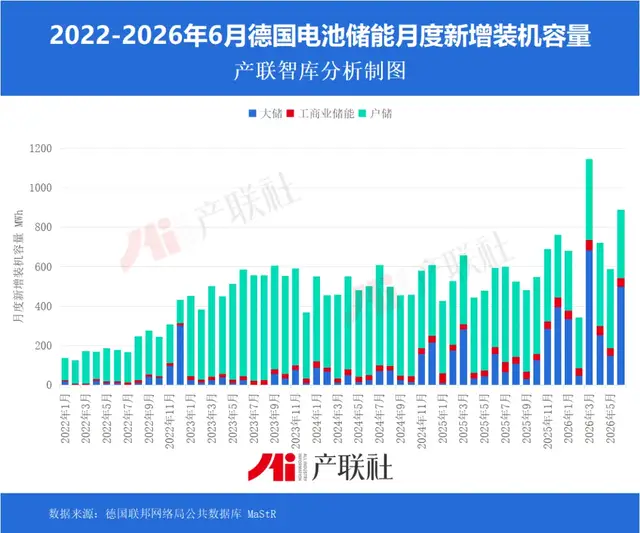
German large-scale energy storage grows 179% in 2026H1
💡Energy storage scaling is the backbone of sustainable AI data center operations.
⚡ 30-Second TL;DR
What Changed
179% year-over-year growth in large-scale energy storage capacity.
Why It Matters
Rapid expansion of energy storage infrastructure is critical for AI data centers to manage power grid stability and renewable energy integration.
What To Do Next
Analyze energy management software requirements if you are working on data center infrastructure or green AI initiatives.
Key Points
- •179% year-over-year growth in large-scale energy storage capacity.
- •Market share for major players has risen to 45%.
- •The operator landscape remains diverse despite consolidation.
🧠 Deep Insight
AI-generated analysis for this event — not the original article.
🔑 Enhanced Key Takeaways
- •The surge in large-scale energy storage is primarily driven by Germany's 'Netzstabilitätsanlagen' (grid stability facilities) initiative, which incentivizes battery deployment to mitigate curtailment of renewable energy.
- •Lithium Iron Phosphate (LFP) battery chemistry has become the dominant technology for these large-scale installations, accounting for over 90% of new capacity due to cost-efficiency and safety profiles.
- •Regulatory changes in the German Capacity Market, specifically the introduction of shorter-duration bidding windows, have significantly improved the internal rate of return (IRR) for storage operators.
- •The increased market concentration is largely attributed to the entry of major European utilities and oil majors acquiring smaller project developers to secure grid-scale assets.
- •Grid-scale storage projects are increasingly being co-located with existing wind and solar farms to utilize existing grid connection points, reducing overall capital expenditure (CAPEX) by an estimated 15-20%.
📊 Competitor Analysis▸ Show
| Feature | German Large-Scale Storage | UK Battery Storage Market | US Utility-Scale Storage |
|---|---|---|---|
| Primary Driver | Grid Stability/Curtailment | Frequency Response/Arbitrage | Capacity Markets/Arbitrage |
| Dominant Tech | LFP | LFP/NMC | LFP |
| Market Maturity | Rapid Growth | Mature | Mature |
🛠️ Technical Deep Dive
- System Architecture: Most new installations utilize modular containerized BESS (Battery Energy Storage System) units with integrated liquid cooling systems to maintain optimal thermal performance.
- Power Conversion: Adoption of high-voltage (1500V) DC architectures is now standard, reducing cabling losses and improving overall round-trip efficiency (RTE) to approximately 88-90%.
- Control Systems: Implementation of advanced AI-driven Energy Management Systems (EMS) that utilize predictive analytics for automated participation in intraday power markets.
- Grid Integration: Projects are increasingly utilizing grid-forming inverters, which provide synthetic inertia to the grid, a critical requirement for maintaining stability as synchronous thermal generation retires.
🔮 Future ImplicationsAI analysis grounded in cited sources
⏳ Timeline
Weekly AI Recap
Read this week's curated digest of top AI events →
👉Related Updates

AI-curated news aggregator. All content rights belong to original publishers.
Original source: 钛媒体 ↗
This is a summary, not the original. Read the source, or get the weekly briefing.
Weekly AI briefing
One email a week. Unsubscribe anytime.