General Intuition aims for robotics' ChatGPT moment

💡Learn how synthetic video game data is being used to solve the robotics data bottleneck and accelerate physical AI.
⚡ 30-Second TL;DR
What Changed
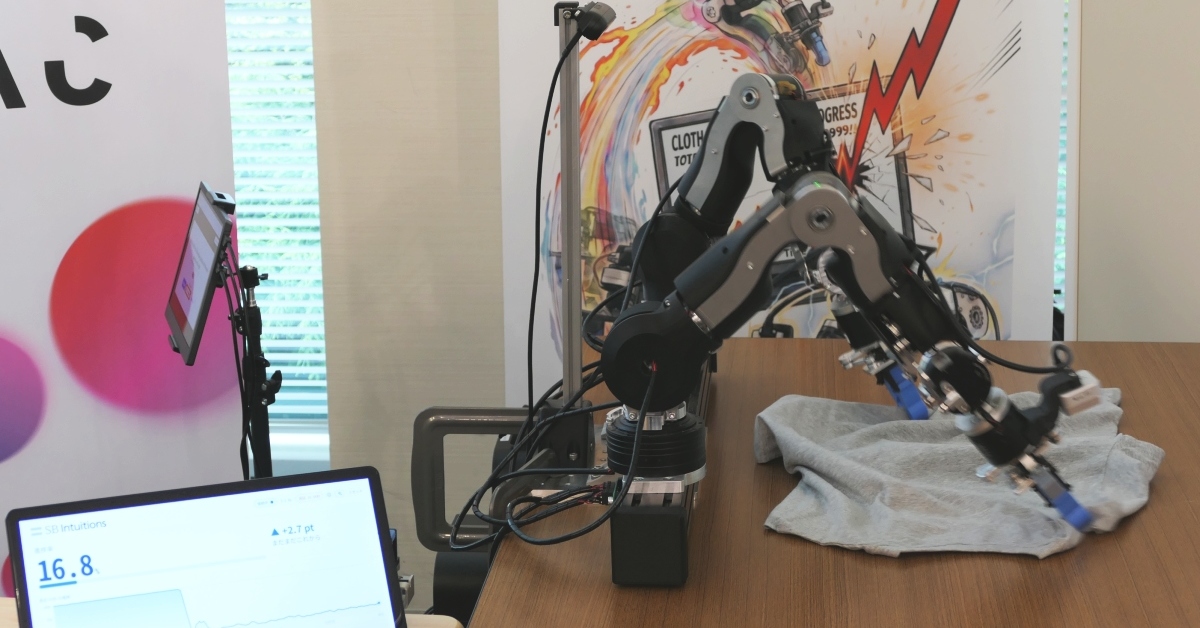
Utilizes video game simulation data to train physical AI foundation models
Why It Matters
If successful, this could drastically lower the barrier to entry for robotics, allowing for faster deployment of autonomous agents in physical environments. It represents a shift toward synthetic data as a primary driver for embodied AI progress.
What To Do Next
Explore synthetic data generation pipelines using game engines like Unreal Engine or Unity to train your own embodied AI agents.
Key Points
- •Utilizes video game simulation data to train physical AI foundation models
- •Focuses on reducing the dependency on expensive and limited real-world robotics data
- •Aims to achieve a 'ChatGPT moment' for the robotics industry through scalable training
- •Develops smarter control systems for physical robots using synthetic environments
🧠 Deep Insight
AI-generated analysis for this event — not the original article.
🔑 Enhanced Key Takeaways
- •General Intuition was founded by former OpenAI researchers, specifically leveraging their expertise in large-scale generative modeling to bridge the 'sim-to-real' gap.
- •The company's proprietary 'World Model' architecture is designed to predict future physical states from video inputs, allowing robots to anticipate consequences before executing actions.
- •Beyond gaming data, the platform integrates multimodal training sets that include physics-based engine outputs to ensure kinematic constraints are respected in virtual environments.
- •General Intuition has secured strategic partnerships with major hardware manufacturers to deploy their foundation models on edge-computing robotics platforms.
- •The startup's training methodology utilizes a technique called 'Active Simulation Learning,' where the model identifies and generates its own challenging scenarios to improve edge-case handling.
📊 Competitor Analysis▸ Show
| Feature | General Intuition | Figure AI | Covariant | Tesla (Optimus) |
|---|---|---|---|---|
| Primary Approach | Video Game Simulation | Humanoid Hardware/AI | Industrial Foundation Models | End-to-End Neural Nets |
| Data Source | Synthetic/Gaming | Real-world/Teleop | Real-world/Warehouse | Real-world/Fleet Data |
| Focus | General Purpose Control | Humanoid Autonomy | Logistics/Manipulation | Consumer/Industrial |
🛠️ Technical Deep Dive
- Architecture: Utilizes a Transformer-based architecture adapted for spatial-temporal reasoning, often referred to as a 'Physical World Model'.
- Training Pipeline: Employs massive-scale self-supervised learning on synthetic video sequences, treating physical interaction as a next-token prediction task.
- Sim-to-Real Transfer: Uses domain randomization and latent space alignment to ensure that policies learned in game engines (like Unreal Engine 5 or Unity) generalize to physical actuators.
- Latency Optimization: Models are distilled for deployment on edge GPUs (e.g., NVIDIA Jetson Orin) to maintain real-time control loops (typically >50Hz).
🔮 Future ImplicationsAI analysis grounded in cited sources
⏳ Timeline
Weekly AI Recap
Read this week's curated digest of top AI events →
👉Related Updates


AI-curated news aggregator. All content rights belong to original publishers.
Original source: TechCrunch AI ↗
This is a summary, not the original. Read the source, or get the weekly briefing.
The weekly digest
One email a week. Unsubscribe anytime.