Geely Teams Nvidia to Match Tesla FSD by 2026
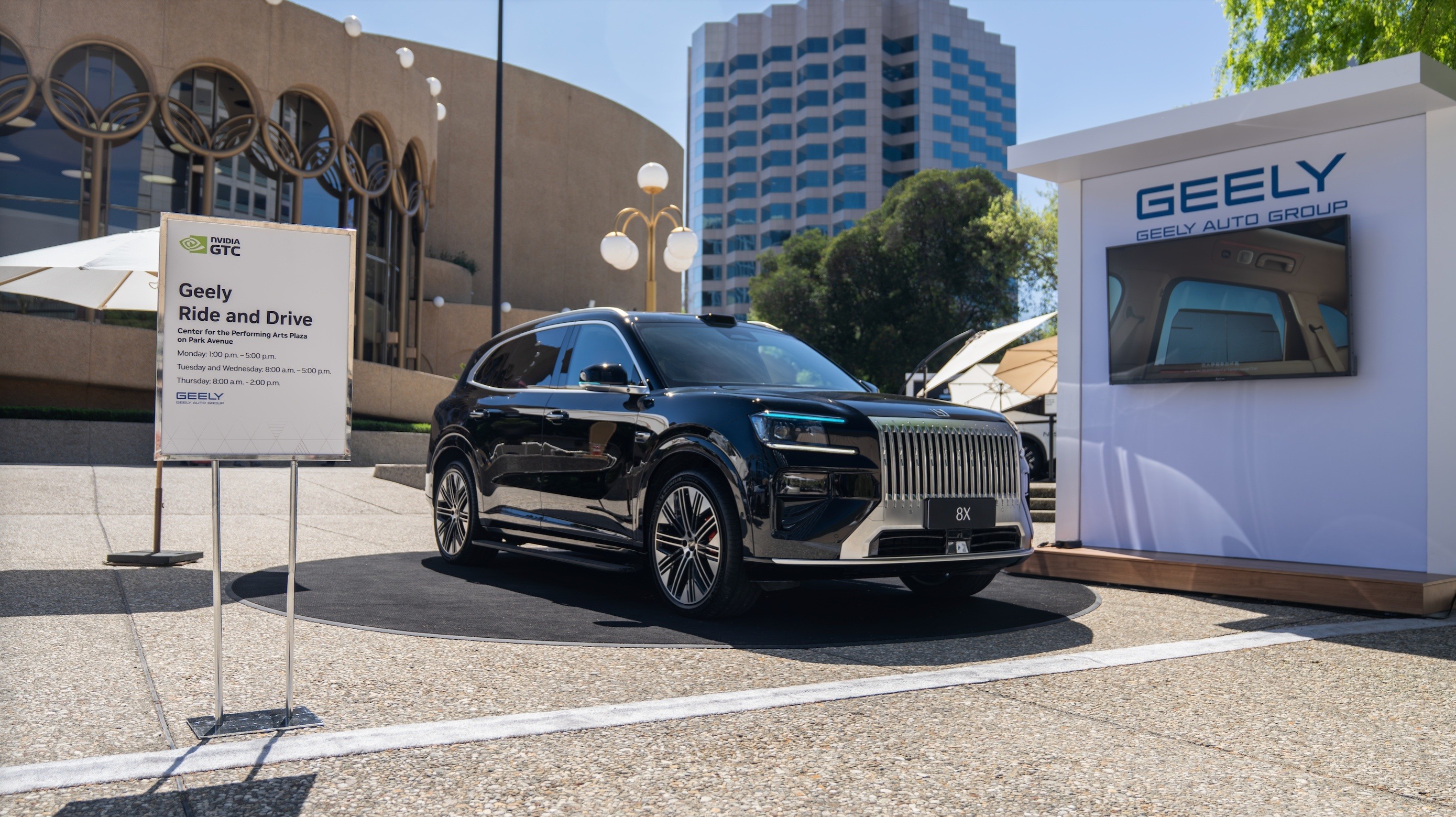
💡Geely's Nvidia collab eyes Tesla FSD parity: watch for L4 breakthroughs
⚡ 30-Second TL;DR
What Changed
2025 sales: 3.02M vehicles (NEVs 1.68M), revenue 3452B RMB
Why It Matters
Geely's Nvidia push could close China-US auto AI gap, boosting L4 adoption if H7 delivers. Risks high if FSD evolves faster, testing R&D ROI.
What To Do Next
Review Nvidia DRIVE Hyperion docs for L4 platform integrations in AV stacks.
Key Points
- •2025 sales: 3.02M vehicles (NEVs 1.68M), revenue 3452B RMB
- •Core net profit: 144.1B RMB (+36%), Zeekr profitable
- •Nvidia DRIVE Hyperion collab for L4 driving, target Tesla FSD parity by 2026
- •R&D expenses: Q4 59B RMB (43% expensed), team of 3000 integrated
🧠 Deep Insight
Background and context from public sources — not the original article. 11 sources cited.
🔑 Enhanced Key Takeaways
- •Geely's autonomous driving push is centered on the new 'G-ASD' (Geely Afari Smart Driving) system, which utilizes visual-language models (VLM) and 'world models' to achieve end-to-end autonomy without high-definition map reliance.
- •The 3,000-person R&D team is being consolidated into a new independent joint venture called 'Chongqing Qianli Intelligent Driving,' merging the previously fragmented AD units of Zeekr, Geely Research Institute, and Megvii's Mach Drive.
- •G-ASD has become the first Chinese-developed intelligent driving system to receive European Union regulatory certification, clearing the path for Geely to export L4-capable vehicles to global markets by late 2026.
- •Geely is aggressively shifting its financial strategy to expense over 40% of R&D costs immediately (up from 31% in 2024) to improve 'profit quality' and ensure long-term sustainability despite the high capital intensity of the Nvidia Thor integration.
📊 Competitor Analysis▸ Show
| Feature | Geely G-ASD (Hyperion 9) | Tesla FSD (v12/HW4) | Huawei ADS 3.0 |
|---|---|---|---|
| Compute Performance | 2,000 TOPS (Dual Nvidia Thor) | ~500 TOPS (AI 4 Hardware) | ~400-540 TOPS (Ascend) |
| Primary Sensor Suite | 14 Cam, 9 Radar, 3 LiDAR | 8-9 Cameras (Vision Only) | 11 Cam, 3 Radar, 1 LiDAR |
| Model Architecture | E2E + World Models (VLM) | E2E Neural Networks | GOD (General Obstacle Detection) |
| Regulatory Status | EU Certified (March 2026) | US/Canada L2+ (Supervised) | China L2+ (Urban NOA) |
| Target Autonomy | Level 4 Ready | Level 2+ (Supervised) | Level 3 Ready |
🛠️ Technical Deep Dive
The partnership leverages the Nvidia DRIVE Hyperion 9 platform, which is architected for software-defined Level 4 autonomy:
- Compute Core: Utilizes dual Nvidia DRIVE Thor SoCs based on the Blackwell architecture, delivering 2,000 TFLOPS of FP8 performance for redundant AI processing.
- Sensor Fusion: The reference architecture integrates 14 high-definition cameras, 9 radars, 3 LiDARs, and 12 ultrasonic sensors, providing 360-degree perception with triple-layer redundancy.
- Reasoning Engine: Employs Nvidia Alpamayo 1.5 open reasoning models, allowing the vehicle to handle 'long-tail' edge cases through human-like judgment rather than rigid rule-based logic.
- Simulation & Validation: Uses Nvidia Omniverse NuRec for high-fidelity digital twin simulation, enabling Geely to validate G-ASD across millions of virtual miles before physical deployment.
🔮 Future ImplicationsAI analysis grounded in cited sources
⏳ Timeline
📎 Sources (11)
Factual claims are grounded in the sources below. Forward-looking analysis is AI-generated interpretation.
Weekly AI Recap
Read this week's curated digest of top AI events →
👉Related Updates
AI-curated news aggregator. All content rights belong to original publishers.
Original source: Huxiu (虎嗅) ↗
This is a summary, not the original. Read the source, or get the weekly briefing.
Weekly AI briefing
One email a week. Unsubscribe anytime.