Fujitsu Takane Automates Dev 100x Faster
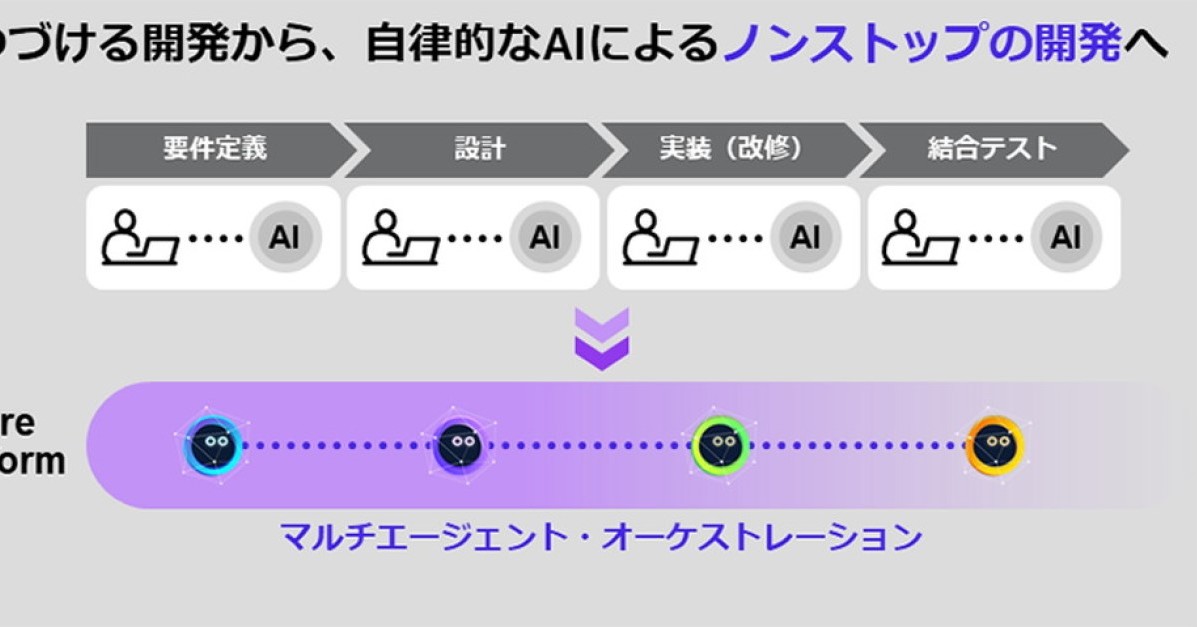
💡Fujitsu's Takane claims 100x dev productivity—game-changer for enterprise coding?
⚡ 30-Second TL;DR
What Changed
Full software dev pipeline automated by AI
Why It Matters
Could transform enterprise software engineering by slashing dev time dramatically. Positions Fujitsu as leader in AI coding tools for Japan Inc.
What To Do Next
Contact Fujitsu for Takane platform demo to automate your dev workflows.
Key Points
- •Full software dev pipeline automated by AI
- •Powered by Fujitsu's proprietary LLM Takane
- •100x productivity in select proof-of-concepts
- •Platform announced for enterprise use
🧠 Deep Insight
Background and context from public sources — not the original article. 6 sources cited.
🔑 Enhanced Key Takeaways
- •Fujitsu's AI-Driven Software Development Platform automates the entire software development lifecycle from requirements definition through integration testing using the Takane LLM and multi-agent AI technology[3][4]
- •The platform will be applied to all 67 medical and government software packages provided by Fujitsu Japan Limited by end of fiscal year 2026, with modifications already underway since January 2026 for medical fee revisions[3]
- •Takane, Fujitsu's proprietary large language model, achieves up to 94% memory reduction through lightweighting and quantization technologies, enabling efficient on-premise deployment[1][2]
- •The broader sovereign AI platform featuring Takane will launch in July 2026 with preliminary trial registration beginning February 2, 2026, supporting deployment across enterprise, edge, and physical AI scales[2]
- •Fujitsu positions AI-Ready Engineering as critical to success, involving preparation of assets and knowledge to ensure AI correctly understands existing systems and achieves reliable automation[3][4]
📊 Competitor Analysis▸ Show
| Aspect | Fujitsu AI-Driven Platform | Key Differentiators |
|---|---|---|
| Scope | Full SDLC automation (requirements to testing) | End-to-end coverage with multi-agent orchestration |
| Core Model | Takane LLM (Japanese-optimized, domain-specific) | High-precision Japanese performance with 94% memory reduction |
| Deployment | On-premise (Private AI Platform on PRIMERGY) + cloud | Sovereign AI focus addressing data security concerns |
| Specialization | Healthcare & government initially, expanding to finance/manufacturing/retail | Domain-specific optimization via AI-Ready Engineering |
| Automation Level | Full automation without human intervention | Multi-AI agents collaboratively execute each development stage |
| Launch Timeline | July 2026 (sovereign platform); already in use since January 2026 (medical revisions) | Early production deployment in regulated industries |
🛠️ Technical Deep Dive
- Takane LLM Architecture: Domain-specific large language model with high-precision Japanese language understanding and image analysis capabilities, announced September 8, 2025
- Memory Optimization: Lightweighting technologies reduce memory consumption by up to 94% through quantization and model compression, enabling resource-efficient on-premise deployment
- Multi-Agent Orchestration: Multiple AI agents collaboratively execute each software development stage, with progressive evaluation of design, coding, and testing results
- AI-Ready Engineering Framework: Transforms judgment domains previously requiring human expertise into AI-processable inputs through formal knowledge enrichment and search index optimization
- Deployment Infrastructure: Private AI Platform on PRIMERGY servers and Private GPT for on-premise sovereign AI deployment; Fujitsu Kozuchi AI platform integration
- Continuous Improvement: In-house fine-tuning features enable business-specific model customization and incremental learning
- Integration Testing Automation: Full automation from requirements definition through integration testing without human intervention
🔮 Future ImplicationsAI analysis grounded in cited sources
Fujitsu's platform signals a fundamental shift in software development economics and workforce dynamics. The automation of the entire SDLC—particularly for regulated industries like healthcare and government—could establish new industry standards for development velocity and cost efficiency. The 94% memory reduction in Takane enables sovereign AI deployment in resource-constrained environments, addressing critical data security concerns for enterprises. Expansion plans to finance, manufacturing, retail, and public services by end of fiscal 2026 suggest rapid market adoption. The shift from person-month-based to customer-value-based development paradigms could reshape engineering roles, with Forward Deployed Engineers focusing on higher-level system understanding rather than code implementation. Success in automating complex legacy system refactoring—currently an unexplored frontier for AI—would unlock significant value in enterprise modernization. However, the platform's reliance on AI-Ready Engineering preparation suggests implementation complexity and the need for organizational change management, potentially limiting rapid adoption despite technical capabilities.
⏳ Timeline
📎 Sources (6)
Factual claims are grounded in the sources below. Forward-looking analysis is AI-generated interpretation.
- nasdaq.com — Fujitsu Launches New Platform Enabling Autonomous Operation Generative AI Optimized
- quantumzeitgeist.com — Fujitsu AI Platform AI Deployment
- newswire.ca — Fujitsu Automates Entire Software Development Lifecycle with New AI Driven Software Development Platform 862248233
- iot-now.com — 155346 Fujitsu Automates Software Development Lifecycle with New AI Driven Software Development Platform
- marketscreener.com — Fujitsu Presentation Material 20260217 01a En Ce7e5dd8dd8bf421
- perplexity.ai — Fujitsu Launches Dedicated AI Dwbntuklqzuwkvpq0uyj3g
Weekly AI Recap
Read this week's curated digest of top AI events →
👉Related Updates


AI-curated news aggregator. All content rights belong to original publishers.
Original source: ITmedia AI+ (日本) ↗
This is a summary, not the original. Read the source, or get the weekly briefing.
Weekly AI briefing
One email a week. Unsubscribe anytime.