Fujitsu Launches Physical AI OS Demos in 2026
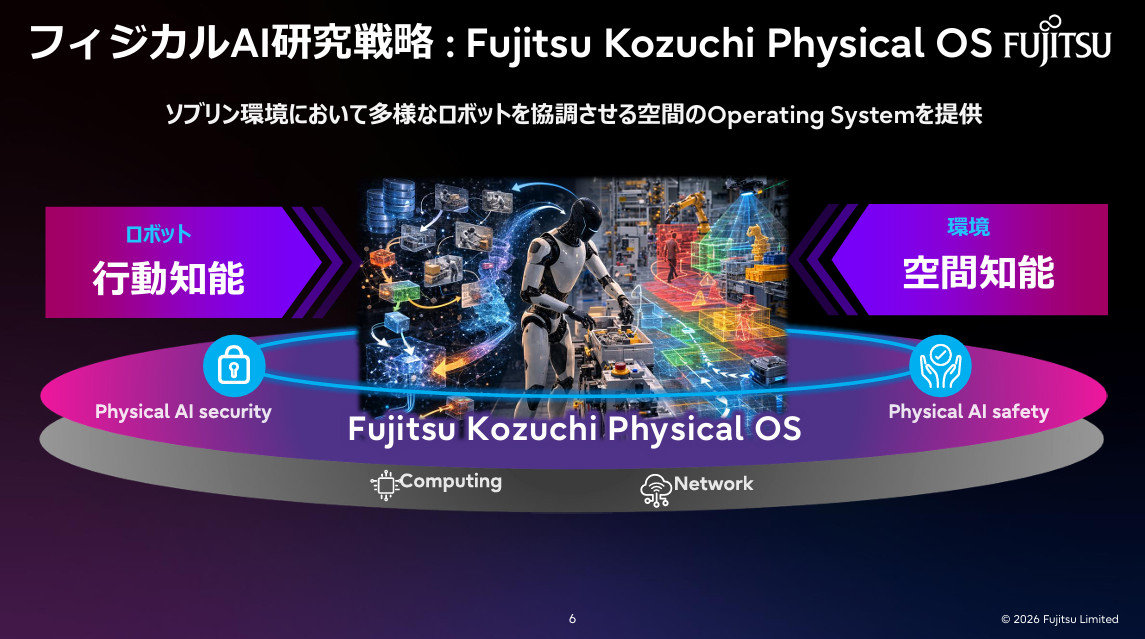
💡Fujitsu's Physical AI OS eyes 2026 demos w/ Carnegie Mellon—key for robotics builders.
⚡ 30-Second TL;DR
What Changed
Physical AI OS real-world demos begin in 2026
Why It Matters
This positions Fujitsu to compete in embodied AI, potentially transforming physical environments like factories and homes. Partnerships with top universities accelerate innovation in robotics OS.
What To Do Next
Explore Fujitsu's Physical AI research papers from the new Carnegie Mellon center for embodied AI insights.
Key Points
- •Physical AI OS real-world demos begin in 2026
- •New research center with Carnegie Mellon University established
- •Focuses on 'smart spaces' via physical AI operating system
🧠 Deep Insight
AI-generated analysis for this event — not the original article.
🔑 Enhanced Key Takeaways
- •The Physical AI OS leverages Fujitsu's 'Digital Annealer' and quantum-inspired computing architectures to optimize real-time decision-making for autonomous systems in complex physical environments.
- •The collaboration with Carnegie Mellon University focuses specifically on 'embodied AI,' aiming to bridge the gap between high-level generative AI models and low-level robotic control systems.
- •Fujitsu is targeting industrial manufacturing and smart logistics as the primary initial use cases, aiming to reduce latency in human-robot collaborative workspaces.
📊 Competitor Analysis▸ Show
| Competitor | Feature Focus | Benchmarks | Pricing |
|---|---|---|---|
| NVIDIA (Isaac/Omniverse) | Simulation & Digital Twins | High-fidelity physics rendering | Enterprise licensing |
| Boston Dynamics (AI Institute) | Embodied AI & Robotics | Real-world mobility performance | N/A (Internal R&D) |
| Siemens (Industrial Operations X) | Industrial Automation | Scalability in factory settings | Subscription-based |
🛠️ Technical Deep Dive
- •Architecture utilizes a distributed edge-computing framework to process sensor data locally, minimizing reliance on centralized cloud infrastructure.
- •Integrates a 'Physical-Digital Synchronization Layer' that maps real-world spatial coordinates to a digital twin in real-time with sub-millisecond latency.
- •Employs a proprietary reinforcement learning framework optimized for non-deterministic physical environments, allowing robots to adapt to dynamic obstacles without retraining.
🔮 Future ImplicationsAI analysis grounded in cited sources
⏳ Timeline
Weekly AI Recap
Read this week's curated digest of top AI events →
👉Related Updates
AI-curated news aggregator. All content rights belong to original publishers.
Original source: ITmedia AI+ (日本) ↗
This is a summary, not the original. Read the source, or get the weekly briefing.
The weekly digest
One email a week. Unsubscribe anytime.