Fujitsu Develops Physical AI Orchestrating OS

💡Fujitsu's OS to orchestrate physical AIs—essential for robotics builders
⚡ 30-Second TL;DR
What Changed
Fujitsu-CMU joint center focuses on physical AI advancements
Why It Matters
Enables scalable coordination of physical AIs, accelerating robotics deployments for enterprises. Positions Fujitsu as leader in embodied AI infrastructure.
What To Do Next
Review Fujitsu Kozuchi docs to prototype physical AI multi-agent systems.
Key Points
- •Fujitsu-CMU joint center focuses on physical AI advancements
- •Kozuchi Physical OS integrates research for AI orchestration
- •Platform bundles and manages multiple physical AI agents
- •Targets robotics and embodied AI applications
🧠 Deep Insight
AI-generated analysis for this event — not the original article.
🔑 Enhanced Key Takeaways
- •The Fujitsu-CMU collaboration leverages 'Digital Annealer' technology and quantum-inspired computing to optimize the real-time coordination of heterogeneous robotic swarms.
- •Kozuchi Physical OS utilizes a decentralized architecture based on a 'Federated Embodied Learning' framework, allowing agents to share behavioral insights without centralizing raw sensor data.
- •The platform incorporates a 'Safety-First' middleware layer designed to enforce formal verification of physical movement constraints, addressing the 'black box' reliability issues common in traditional deep reinforcement learning.
📊 Competitor Analysis▸ Show
| Feature | Fujitsu Kozuchi Physical OS | NVIDIA Isaac Platform | Boston Dynamics AI Institute |
|---|---|---|---|
| Primary Focus | Orchestration of heterogeneous agents | Simulation & synthetic data generation | Hardware-software co-design |
| Architecture | Decentralized/Federated | Centralized/Cloud-to-Edge | Proprietary/Closed-loop |
| Key Strength | Quantum-inspired optimization | Massive-scale simulation (Omniverse) | Advanced mechanical control |
🛠️ Technical Deep Dive
- •Uses a hierarchical control structure: High-level task planning via Large Language Models (LLMs) and low-level motor control via specialized neural controllers.
- •Implements a 'Digital Twin' synchronization engine that maintains a real-time state representation of the physical environment for predictive collision avoidance.
- •Supports cross-platform interoperability via ROS 2 (Robot Operating System) middleware integration, allowing legacy robotic systems to interface with the OS.
- •Employs a proprietary 'Physical-Semantic Mapping' layer that translates unstructured sensor input into actionable spatial-temporal data for multi-agent coordination.
🔮 Future ImplicationsAI analysis grounded in cited sources
⏳ Timeline
Weekly AI Recap
Read this week's curated digest of top AI events →
👉Related Updates
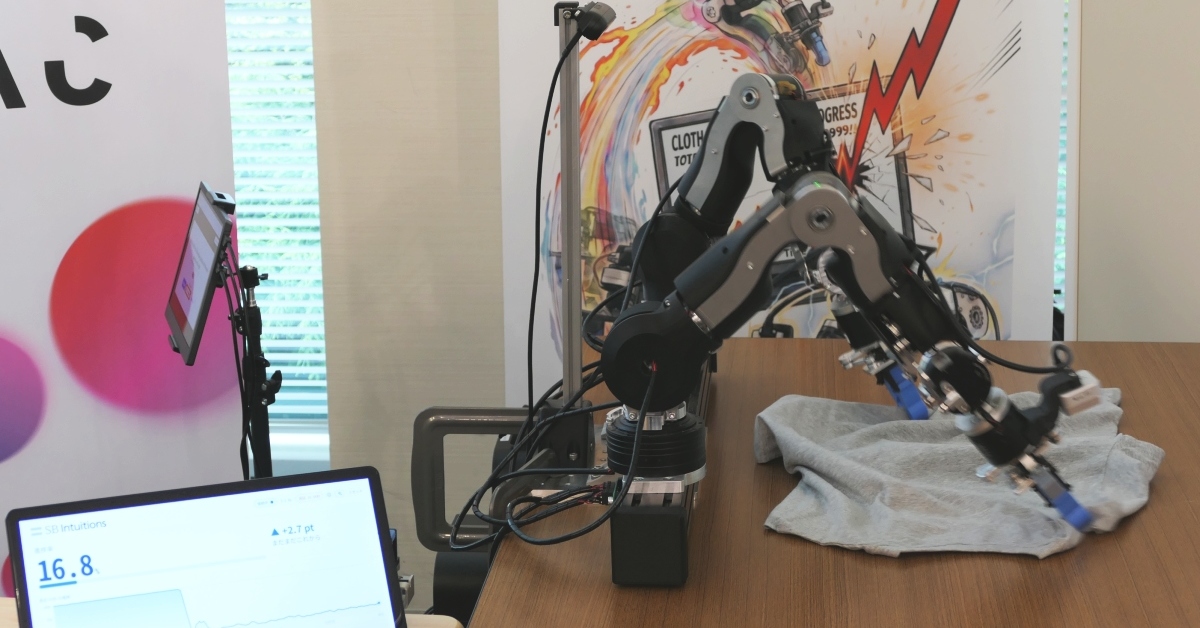
AI-curated news aggregator. All content rights belong to original publishers.
Original source: ITmedia AI+ (日本) ↗
This is a summary, not the original. Read the source, or get the weekly briefing.
The weekly digest
One email a week. Unsubscribe anytime.