FSD V14 Lite Reportedly Overheats HW3 Computers
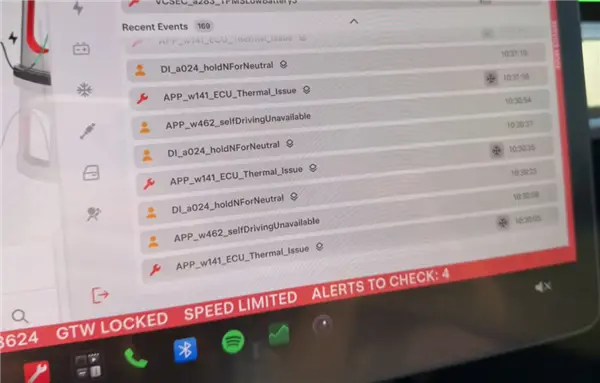
A reported FSD update may expose thermal limits in millions of legacy AI computers.
30-Second TL;DR
What Changed
The reported issue affects older Tesla vehicles equipped with Hardware 3.
Why It Matters
If confirmed, the issue could increase warranty costs, reduce confidence in Tesla’s legacy AI hardware, and complicate FSD support across a large installed base. It also highlights the operational risks of deploying newer autonomy software on constrained edge-compute systems.
What To Do Next
For any edge-AI fleet, reproduce the FSD V14 Lite-style workload in a thermal test and set automatic rollback thresholds for sustained high-temperature alerts.
Key Points
- •The reported issue affects older Tesla vehicles equipped with Hardware 3.
- •FSD V14 Lite allegedly triggers repeated high-temperature warnings in the Autopilot computer.
- •Some owners report complete computer failure and hardware replacement requirements.
Deep Insight
AI-generated analysis for this event — not the original article.
Enhanced Key Takeaways
- •Tesla's HW3 (Hardware 3) utilizes a dual-SoC design with a custom-built FSD chip, which has historically operated with lower thermal overhead compared to the newer HW4 platform.
- •Industry analysts suggest the overheating may stem from increased neural network complexity in V14 Lite, which pushes the older NPU (Neural Processing Unit) architecture closer to its maximum TDP (Thermal Design Power).
- •Tesla has reportedly begun deploying over-the-air (OTA) thermal management patches to throttle FSD compute intensity on HW3 vehicles as a temporary mitigation strategy.
- •Service centers have observed a spike in 'Autopilot Computer' diagnostic codes related to thermal throttling and fan speed anomalies following the V14 Lite rollout.
- •The issue has sparked debate regarding the long-term viability of HW3 for 'Level 4' autonomy, with some experts questioning if the hardware lacks the necessary thermal headroom for future, more compute-intensive FSD iterations.
Competitor Analysis
- Tesla FSD (HW3)
- Integrated SoC (Custom)
- Waymo Driver
- Multi-sensor (LiDAR/Radar/Cam)
- Mobileye SuperVision
- Camera-first (EyeQ6)
- Tesla FSD (HW3)
- High (Passive/Active Hybrid)
- Waymo Driver
- High (Active Cooling)
- Mobileye SuperVision
- Low (Optimized Efficiency)
- Tesla FSD (HW3)
- Centralized
- Waymo Driver
- Centralized
- Mobileye SuperVision
- Distributed/Edge
| Feature | Tesla FSD (HW3) | Waymo Driver | Mobileye SuperVision |
|---|---|---|---|
| Hardware Approach | Integrated SoC (Custom) | Multi-sensor (LiDAR/Radar/Cam) | Camera-first (EyeQ6) |
| Thermal Profile | High (Passive/Active Hybrid) | High (Active Cooling) | Low (Optimized Efficiency) |
| Compute Strategy | Centralized | Centralized | Distributed/Edge |
Technical Deep Dive
- The HW3 computer features two custom Tesla-designed SoCs, each containing an NPU capable of 36 TOPS (Trillions of Operations Per Second).
- Thermal management on HW3 relies on a liquid cooling loop shared with the vehicle's powertrain, which may be insufficient for the sustained high-load inference required by V14 Lite.
- V14 Lite utilizes a new transformer-based architecture that increases memory bandwidth utilization, leading to higher power consumption on the older LPDDR4 memory modules used in HW3.
- The overheating triggers a safety protocol that forces the Autopilot system to disengage or enter a 'degraded mode' to prevent permanent silicon degradation.
Future ImplicationsAI analysis grounded in cited sources
Timeline
- 2019-04Tesla begins mass production and installation of Hardware 3 (HW3) in vehicles.
- 2023-02Tesla introduces Hardware 4 (HW4) with increased compute power and sensor resolution.
- 2026-05Tesla announces FSD V14 Lite, focusing on improved urban navigation and edge-case handling.
- 2026-07Initial user reports of thermal warnings and system shutdowns emerge on Tesla forums following V14 Lite deployment.
Weekly AI Recap
Read this week's curated digest of top AI events →
Related Updates
AI-curated news aggregator. All content rights belong to original publishers.
Original source: cnBeta (Full RSS) ↗
This is a summary, not the original. Read the source, or get the weekly briefing.
The weekly digest
One email a week. Unsubscribe anytime.