Ford Q2 sales drop 10% amid EV and supply issues

💡Understand the supply chain and market hurdles facing legacy auto giants in the EV transition.
⚡ 30-Second TL;DR
What Changed
Total US sales fell 10.3% year-on-year to 549,200 vehicles.
Why It Matters
The decline in EV sales and supply chain fragility highlights the ongoing challenges for legacy automakers transitioning to electric platforms.
What To Do Next
Monitor supply chain resilience metrics if you are building AI-driven logistics or predictive manufacturing tools.
Key Points
- •Total US sales fell 10.3% year-on-year to 549,200 vehicles.
- •Pure EV sales experienced a significant 40.7% decline.
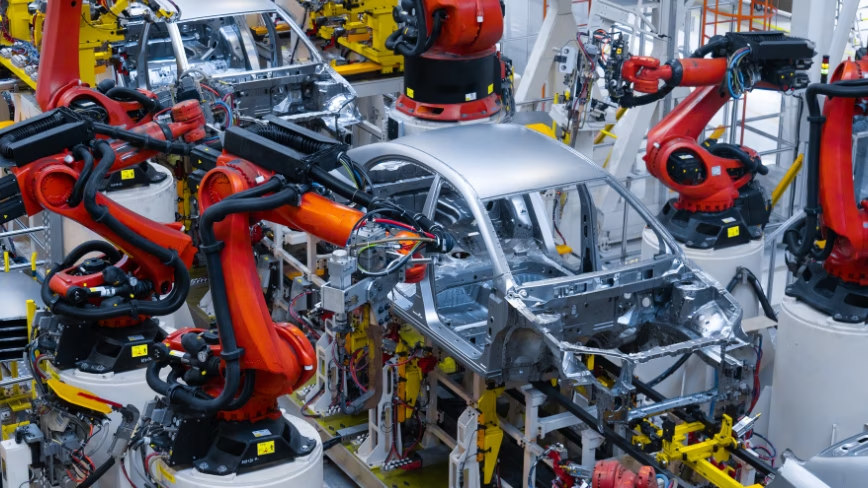
- •F-Series truck production was hampered by an aluminium supply chain disruption.
🧠 Deep Insight
AI-generated analysis for this event — not the original article.
🔑 Enhanced Key Takeaways
- •The aluminum supply chain disruption specifically impacted the production of the F-150 Lightning and Super Duty lines, leading to temporary plant idling.
- •Ford's Model e division, which houses its EV operations, reported widening operating losses as the company recalibrated its electrification strategy to prioritize hybrids.
- •Analysts attribute the 40.7% EV sales decline partly to the sunsetting of older EV models and a strategic pause in production to clear excess dealer inventory.
- •The sales slump occurred despite Ford increasing its marketing spend on commercial fleet services, which typically provide a buffer against retail volatility.
- •Ford's stock price faced downward pressure following the Q2 report, as investors reacted to the combined impact of supply chain fragility and cooling consumer demand for premium-priced EVs.
📊 Competitor Analysis▸ Show
| Feature/Metric | Ford (F-Series/EV) | General Motors (Silverado/EV) | Tesla (Cybertruck/Model Y) |
|---|---|---|---|
| Q2 Sales Trend | -10.3% (Total) | Mixed Performance | Growth in Model Y segment |
| EV Strategy | Hybrid-first pivot | Scaling Ultium platform | Direct-to-consumer/Software focus |
| Supply Chain | Aluminum-dependent | Battery-cell vertical integration | High in-house component control |
🛠️ Technical Deep Dive
- The aluminum supply disruption affected the 6000-series alloy used in the F-Series body-on-frame architecture, which is critical for maintaining the vehicle's payload and towing capacity.
- Ford's EV architecture (GE2 platform) is currently undergoing a transition to incorporate next-generation LFP (Lithium Iron Phosphate) battery chemistry to reduce costs and improve thermal stability.
- The production issues highlighted vulnerabilities in Ford's 'Just-in-Time' manufacturing model, prompting a shift toward 'Just-in-Case' inventory management for critical raw materials.
🔮 Future ImplicationsAI analysis grounded in cited sources
⏳ Timeline
Weekly AI Recap
Read this week's curated digest of top AI events →
👉Related Updates



AI-curated news aggregator. All content rights belong to original publishers.
Original source: The Next Web (TNW) ↗
This is a summary, not the original. Read the source, or get the weekly briefing.
Weekly AI briefing
One email a week. Unsubscribe anytime.