Fine-tune Nova models on Bedrock
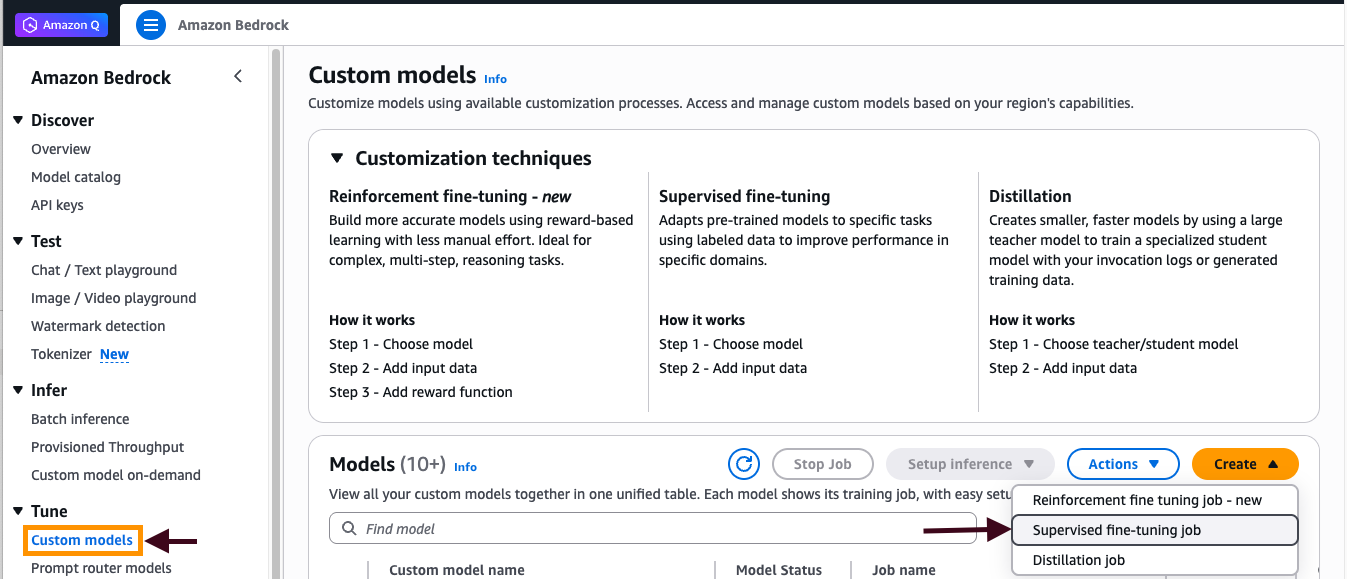
Master fine-tuning Nova on Bedrock for domain tasks with hands-on guide
30-Second TL;DR
What Changed
Prepare high-quality training data for domain-specific improvements
Why It Matters
Enables developers to customize powerful Nova models for specific tasks, improving performance over base models and reducing inference costs in production.
What To Do Next
Prepare your dataset and invoke Bedrock's fine-tuning API for Amazon Nova models.
Key Points
- •Prepare high-quality training data for domain-specific improvements
- •Configure hyperparameters to optimize learning without overfitting
- •Deploy fine-tuned model for superior accuracy and reduced latency
- •Evaluate using training metrics and loss curves
Deep Insight
AI-generated analysis for this event — not the original article.
Enhanced Key Takeaways
- •Amazon Nova models utilize a multimodal architecture designed for high-throughput, low-latency inference, specifically optimized for the Bedrock managed fine-tuning pipeline.
- •The fine-tuning process for Nova models leverages Parameter-Efficient Fine-Tuning (PEFT) techniques, such as LoRA, to minimize compute costs and training time compared to full-parameter fine-tuning.
- •Bedrock provides automated data validation and formatting checks within the console to ensure training datasets meet the specific schema requirements for Nova's instruction-following capabilities.
Competitor Analysis
- Amazon Nova (Bedrock)
- Managed PEFT/LoRA
- Google Vertex AI (Gemini)
- Managed PEFT/LoRA
- Azure OpenAI (GPT-4o)
- Managed Fine-tuning
- Amazon Nova (Bedrock)
- Per-token training + Provisioned Throughput
- Google Vertex AI (Gemini)
- Per-token training + Node-hour usage
- Azure OpenAI (GPT-4o)
- Per-token training + Provisioned Throughput
- Amazon Nova (Bedrock)
- Latency/Cost Efficiency
- Google Vertex AI (Gemini)
- Multimodal Reasoning
- Azure OpenAI (GPT-4o)
- General Purpose Reasoning
| Feature | Amazon Nova (Bedrock) | Google Vertex AI (Gemini) | Azure OpenAI (GPT-4o) |
|---|---|---|---|
| Fine-tuning Method | Managed PEFT/LoRA | Managed PEFT/LoRA | Managed Fine-tuning |
| Pricing Model | Per-token training + Provisioned Throughput | Per-token training + Node-hour usage | Per-token training + Provisioned Throughput |
| Benchmark Focus | Latency/Cost Efficiency | Multimodal Reasoning | General Purpose Reasoning |
Technical Deep Dive
- Architecture: Nova models are built on a transformer-based architecture optimized for multimodal inputs (text, image, video).
- Training Infrastructure: Fine-tuning jobs are executed on isolated, ephemeral compute clusters managed by Bedrock, ensuring data privacy and security.
- Hyperparameter Support: Users can tune learning rate, batch size, and epoch count; Bedrock provides default configurations based on dataset size.
- Evaluation: Integration with Bedrock Model Evaluation allows for side-by-side comparison of base vs. fine-tuned models using automated metrics (e.g., ROUGE, BLEU) and human-in-the-loop workflows.
Future ImplicationsAI analysis grounded in cited sources
Timeline
- 2024-12AWS announces the launch of the Amazon Nova model family.
- 2025-03Amazon Bedrock introduces initial support for fine-tuning select Nova model variants.
- 2026-02AWS expands fine-tuning capabilities for Nova to include broader multimodal support.
Weekly AI Recap
Read this week's curated digest of top AI events →
Related Updates

AI-curated news aggregator. All content rights belong to original publishers.
Original source: AWS Machine Learning Blog ↗
This is a summary, not the original. Read the source, or get the weekly briefing.
The weekly digest
One email a week. Unsubscribe anytime.