Figma struggles as market questions AI growth narrative
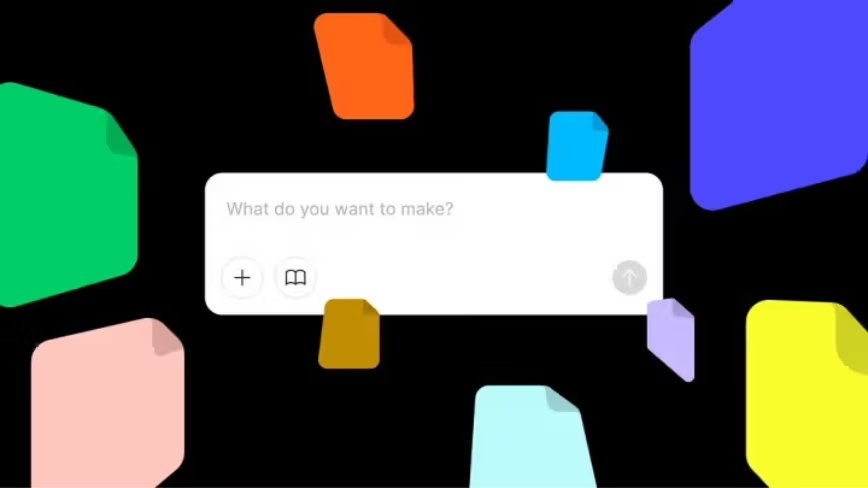
Understand why Wall Street is punishing high-growth AI companies despite strong internal performance metrics.
30-Second TL;DR
What Changed
Figma stock has been in freefall for most of 2026 despite strong internal numbers.
Why It Matters
The market's reaction suggests that even companies with strong AI-driven metrics face valuation risks if competitive moats are perceived to be eroding.
What To Do Next
Analyze your product's competitive moat against low-cost AI-integrated alternatives to ensure long-term defensibility.
Key Points
- •Figma stock has been in freefall for most of 2026 despite strong internal numbers.
- •Competition from Google's free Stitch design tool is pressuring Figma's market share.
- •Anthropic's Claude is cited as a factor impacting Figma's competitive positioning.
- •Investors remain skeptical about the long-term impact of AI on Figma's valuation.
Deep Insight
Background and context from public sources — not the original article. 29 sources cited.
Enhanced Key Takeaways
- •Figma's IPO in July 2025 at $33 per share saw its stock plummet to $21 by May 2026, an 83% drop from its peak of $143, despite reporting strong Q4 2025 revenue of $304 million.
- •Anthropic's Claude Design, launched in April 2026, directly challenges Figma by enabling non-designers to generate interactive prototypes from natural language, contributing significantly to Figma's stock decline.
- •Google Stitch, a free AI-powered UI design tool from Google Labs (acquired Galileo AI in mid-2025), offers multi-screen generation, voice-driven design, and React code export, powered by Gemini models, and can export directly to Figma.
- •Figma has proactively integrated its own AI capabilities, including 'First Draft' for layout generation, text and image generation, smart duplication, and AI prototyping, aiming to act as a 'co-pilot' for designers.
- •The broader AI-powered design tools market is experiencing rapid growth, projected to reach $5.38 billion in 2026, with AI reducing development and prototyping cycles by up to 70% and driving demand for 'AI Design Strategists.'
Competitor Analysis
- Figma (with AI)
- Collaborative UI/UX design, prototyping, and developer handoff with AI assistance.
- Google Stitch
- AI-powered UI design generation from text/images, rapid prototyping, code export.
- Claude Design
- AI-powered creative system for generating visual outputs (mockups, prototypes, presentations) from natural language.
- Figma (with AI)
- Advanced AI models, fine-tuned with public design data from Figma Community files.
- Google Stitch
- Google Gemini models (2.5 Flash, 2.5 Pro, 3.1 Pro/Flash).
- Claude Design
- Anthropic's Claude Opus 4.7.
- Figma (with AI)
- First Draft (text-to-design), text/image generation, smart duplication, visual asset search, auto layer renaming, AI prototyping, Figma Make (design-to-code).
- Google Stitch
- Text-to-UI generation, image-to-UI transformation, multi-screen flow design, voice canvas, instant prototypes, React code export, Figma integration.
- Claude Design
- Natural language to structured visual outputs, conversational interface, instant prototyping with real affordance, customizable properties window, 3D/framework support.
- Figma (with AI)
- Subscription-based (specific tiers not detailed in search, but implied paid).
- Google Stitch
- Free (Google Labs experimental phase) with daily/monthly generation limits; paid plans anticipated Q4 2026, potentially 30-50% below Figma.
- Claude Design
- Available to Claude Pro, Max, Team, and Enterprise subscribers.
- Figma (with AI)
- Figma Make can turn prompts into production-ready code; Dev Mode provides structured data (CSS snippets, design tokens).
- Google Stitch
- Exports clean HTML/CSS or React code.
- Claude Design
- Can generate functional elements with actual coded-out elements; supports third-party frameworks/APIs.
- Figma (with AI)
- Integrates with Dev Mode, Model Code Prototypes (MCP) server.
- Google Stitch
- Figma integration (one-click export with editable layers and auto-layout).
- Claude Design
- Connectors for Adobe, Affinity by Canva, Autodesk Fusion, Blender, SketchUp; can export results to Canva.
| Feature/Category | Figma (with AI) | Google Stitch | Claude Design |
|---|---|---|---|
| Core Function | Collaborative UI/UX design, prototyping, and developer handoff with AI assistance. | AI-powered UI design generation from text/images, rapid prototyping, code export. | AI-powered creative system for generating visual outputs (mockups, prototypes, presentations) from natural language. |
| AI Model | Advanced AI models, fine-tuned with public design data from Figma Community files. | Google Gemini models (2.5 Flash, 2.5 Pro, 3.1 Pro/Flash). | Anthropic's Claude Opus 4.7. |
| Key AI Features | First Draft (text-to-design), text/image generation, smart duplication, visual asset search, auto layer renaming, AI prototyping, Figma Make (design-to-code). | Text-to-UI generation, image-to-UI transformation, multi-screen flow design, voice canvas, instant prototypes, React code export, Figma integration. | Natural language to structured visual outputs, conversational interface, instant prototyping with real affordance, customizable properties window, 3D/framework support. |
| Pricing | Subscription-based (specific tiers not detailed in search, but implied paid). | Free (Google Labs experimental phase) with daily/monthly generation limits; paid plans anticipated Q4 2026, potentially 30-50% below Figma. | Available to Claude Pro, Max, Team, and Enterprise subscribers. |
| Code Export | Figma Make can turn prompts into production-ready code; Dev Mode provides structured data (CSS snippets, design tokens). | Exports clean HTML/CSS or React code. | Can generate functional elements with actual coded-out elements; supports third-party frameworks/APIs. |
| Integration | Integrates with Dev Mode, Model Code Prototypes (MCP) server. | Figma integration (one-click export with editable layers and auto-layout). | Connectors for Adobe, Affinity by Canva, Autodesk Fusion, Blender, SketchUp; can export results to Canva. |
Technical Deep Dive
- Figma AI:
- Leverages advanced AI models, specifically fine-tuned using public design data from Figma's Community files.
- Features like "Figma Make" convert text prompts, images, or design frames into production-ready code, building upon pre-existing infrastructure.
- Key underlying components include "Dev Mode" (providing structured data like CSS snippets and design tokens to developers) and the "Model Code Prototypes (MCP) server" (allowing invocation of a coding agent with full design context).
- The AI is designed as a "co-pilot," ensuring all AI-generated elements (text, image, code) remain fully editable for designer control.
- Google Stitch:
- Powered by Google's Gemini models: Gemini 2.5 Flash (for Standard Mode, optimized for speed) and Gemini 2.5 Pro (for Experimental Mode, higher fidelity, image input). Stitch 2.0 uses Gemini 3.1 Pro and Flash.
- Its architecture includes:
- Natural Language Processing Layer: Processes user prompts, extracts design requirements, color preferences, and functional specifications.
- Computer Vision Module: Analyzes visual inputs (images, sketches, wireframes) and converts them into structured design elements.
- Design Generation Engine: Creates responsive layouts based on modern design principles and generates component hierarchies and visual styling.
- Code Generation System: Produces clean HTML/CSS or React code.
- Utilizes a
DESIGN.mdfile, an open-source standard, to maintain design system consistency across generations by providing context on colors, typography, sizing, and branding guidelines.
- Claude Design:
- Powered by Anthropic's Claude Opus 4.7 model.
- Functions as an AI-powered creative system that translates natural language into structured visual outputs.
- Employs a conversational interface for iterative refinement of designs.
- Offers unique features like a customizable properties window, allowing users to add new properties (e.g., dark mode switch, corner radius toggle) via prompts.
- Supports integration of 3D elements and advanced functionality using third-party frameworks (e.g., WebGL) and JavaScript libraries/APIs.
Future ImplicationsAI analysis grounded in cited sources
Timeline
- 2012Figma founded.
- 2025-05Google acquires Galileo AI, rebranding it as Google Stitch and launching it at Google I/O.
- 2025-07Figma IPOs at $33 per share.
- 2025-08Figma integrates AI across its platform, including Figma Make for production-ready code.
- 2026-03Google ships a significant update to Stitch, including voice canvas and instant prototypes, impacting Figma's stock.
- 2026-04Anthropic launches Claude Design, an AI-powered design tool, directly competing with Figma and further impacting its stock.
Sources (29)
Factual claims are grounded in the sources below. Forward-looking analysis is AI-generated interpretation.
Weekly AI Recap
Read this week's curated digest of top AI events →
Related Updates


AI-curated news aggregator. All content rights belong to original publishers.
Original source: The Next Web (TNW) ↗
This is a summary, not the original. Read the source, or get the weekly briefing.
The weekly digest
One email a week. Unsubscribe anytime.