Figma introduces code layers and custom AI plugins
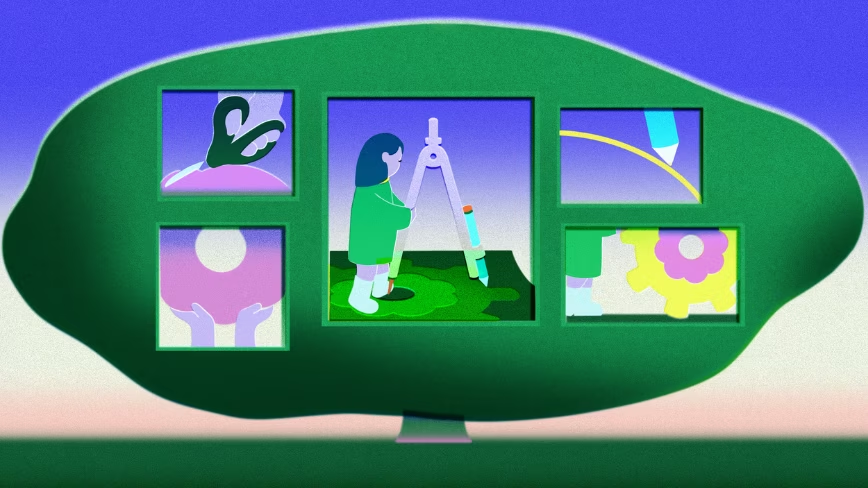
Bridge the gap between design and code with Figma's new executable canvas layers.
30-Second TL;DR
What Changed
Executable code can now be embedded directly into the Figma canvas.
Why It Matters
This significantly reduces the friction between designers and developers by creating a single source of truth. It accelerates the iteration cycle for UI/UX teams working with complex codebases.
What To Do Next
Update your Figma environment to Config 2026 standards and test the code-to-design flow with a small component library.
Key Points
- •Executable code can now be embedded directly into the Figma canvas.
- •Teams can clone repositories and extract flows into design layers.
- •The update aims to collapse the traditional design-to-development handoff step.
Deep Insight
AI-generated analysis for this event — not the original article.
Enhanced Key Takeaways
- •The 'Code Layers' feature utilizes a new proprietary bridge called 'Figma-to-Code Sync' that maintains bi-directional state between the canvas and GitHub/GitLab repositories.
- •Figma introduced a 'Code Sandbox' environment within the canvas, allowing developers to preview component behavior in real-time without leaving the design file.
- •The update includes a new 'AI Plugin SDK' that allows developers to build custom LLM-powered agents capable of generating design tokens directly from existing codebase styles.
- •Figma has partnered with Vercel and Netlify to enable 'One-Click Deployment' directly from the Figma canvas for prototypes that utilize these new code layers.
- •The feature set includes automated 'Drift Detection,' which alerts designers if the code implementation in the repository deviates from the visual design specifications.
Competitor Analysis
- Figma (Code Layers)
- Native Repo Sync
- Penpot (Flex Layout)
- CSS/SVG Export
- Adobe Express (GenAI)
- Limited
- Figma (Code Layers)
- Custom Plugin SDK
- Penpot (Flex Layout)
- Community Plugins
- Adobe Express (GenAI)
- Built-in Firefly
- Figma (Code Layers)
- Enterprise/Org Tier
- Penpot (Flex Layout)
- Open Source/Free
- Adobe Express (GenAI)
- Subscription
- Figma (Code Layers)
- Real-time Sync
- Penpot (Flex Layout)
- Manual Export
- Adobe Express (GenAI)
- Static Assets
| Feature | Figma (Code Layers) | Penpot (Flex Layout) | Adobe Express (GenAI) |
|---|---|---|---|
| Code Integration | Native Repo Sync | CSS/SVG Export | Limited |
| AI Capability | Custom Plugin SDK | Community Plugins | Built-in Firefly |
| Pricing | Enterprise/Org Tier | Open Source/Free | Subscription |
| Handoff Speed | Real-time Sync | Manual Export | Static Assets |
Technical Deep Dive
- Code Layers utilize a virtualized DOM representation that maps Figma nodes to React/Vue components via a JSON-based intermediate representation (IR).
- The AI Plugin SDK leverages a fine-tuned version of Figma's internal 'Design-to-Code' transformer model, which supports multi-modal inputs including design tokens and CSS variables.
- Repository cloning is handled via a secure OAuth-based integration that creates a read-write bridge between the Figma canvas and the user's version control system.
- The system uses a WebSocket connection to ensure that changes made in the code editor are reflected in the Figma canvas within sub-100ms latency.
Future ImplicationsAI analysis grounded in cited sources
Timeline
- 2016-09Figma launches out of beta, introducing browser-based collaborative design.
- 2021-04Figma introduces 'Auto Layout' to better mimic CSS flexbox behavior.
- 2022-06Figma launches 'Dev Mode' at Config 2022 to bridge the gap between design and code.
- 2024-06Figma integrates AI-powered search and asset organization tools.
- 2026-06Figma unveils 'Code Layers' and AI Plugin SDK at Config 2026.
Event Coverage
Weekly AI Recap
Read this week's curated digest of top AI events →
Related Updates

AI-curated news aggregator. All content rights belong to original publishers.
Original source: The Next Web (TNW) ↗
This is a summary, not the original. Read the source, or get the weekly briefing.
The weekly digest
One email a week. Unsubscribe anytime.