Faraday Future pivots to robotics alongside EV production
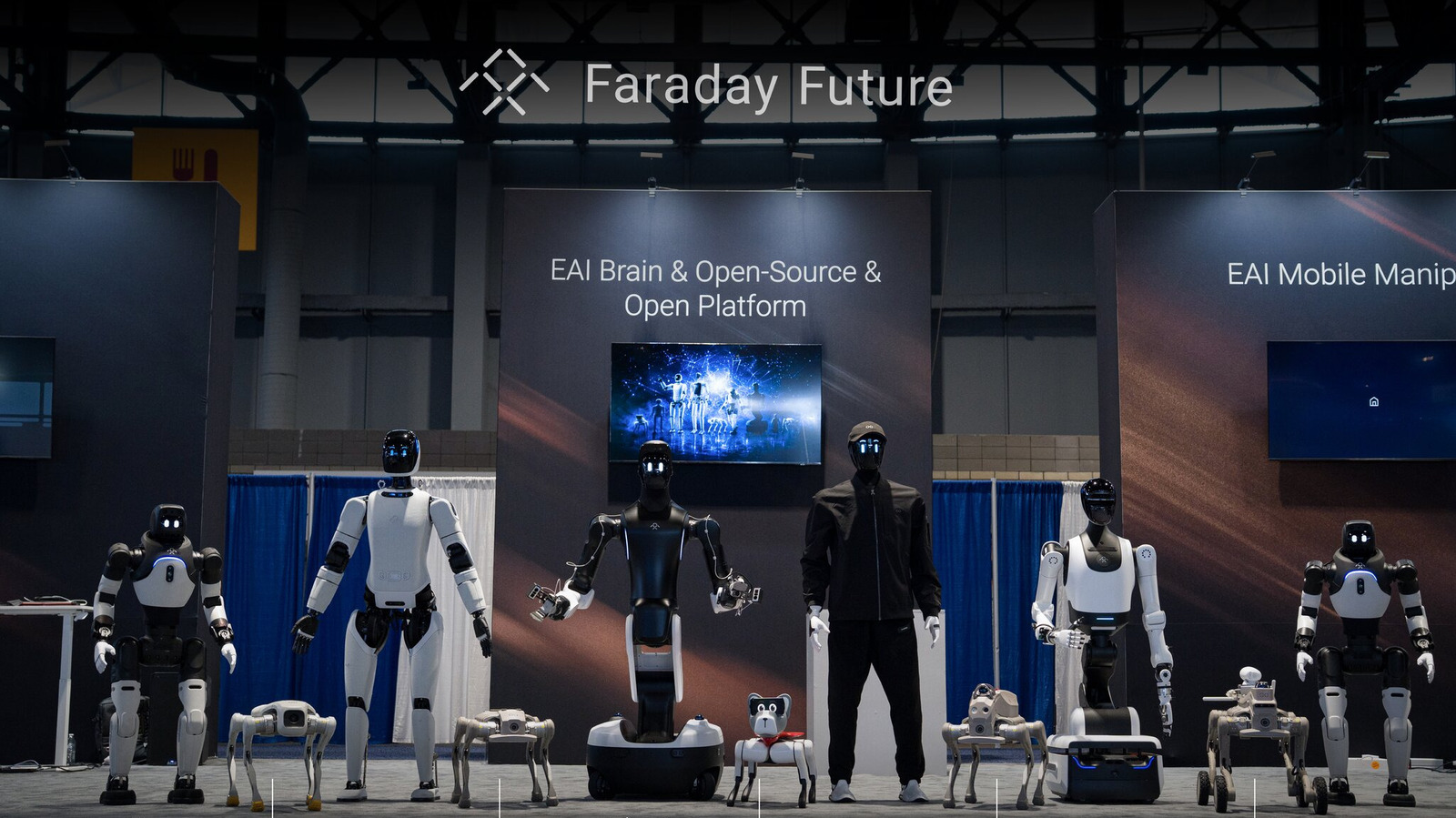
Faraday Future enters the competitive embodied AI market with new humanoid and quadruped robot designs.
30-Second TL;DR
What Changed
Faraday Future is diversifying into the robotics market beyond EVs.
Why It Matters
This move signals a strategic shift for Faraday Future as it attempts to leverage its engineering capabilities in the embodied AI space. It reflects a broader industry trend where EV manufacturers are pivoting toward robotics to diversify revenue streams.
What To Do Next
Monitor Faraday Future's technical whitepapers or patent filings to evaluate the underlying AI stack powering their new robotics platform.
Key Points
- •Faraday Future is diversifying into the robotics market beyond EVs.
- •The new lineup features humanoid robots for various applications.
- •Quadruped robots are being offered with optional canine-style head attachments.
Deep Insight
AI-generated analysis for this event — not the original article.
Enhanced Key Takeaways
- •Faraday Future is leveraging its proprietary 'FF AI' platform, originally developed for autonomous driving, to power the control systems and decision-making algorithms of its new robotics division.
- •The robotics initiative is part of a broader 'Asset-Light' strategy aimed at diversifying revenue streams following prolonged financial instability and production delays with the FF 91.
- •The company has established a dedicated subsidiary, 'FF Robotics,' which is reportedly recruiting talent from former automotive and aerospace automation sectors to accelerate development.
- •Initial prototypes are being manufactured at a pilot facility in California, utilizing modular chassis designs that share components with the company's existing EV platform to reduce overhead.
- •Faraday Future intends to integrate these robots into 'smart factory' environments, marketing them as industrial assistants for logistics and assembly tasks before targeting the consumer market.
Competitor Analysis
- Faraday Future (FF Robotics)
- Industrial/Consumer Hybrid
- Tesla (Optimus)
- Mass-market Humanoid
- Boston Dynamics (Spot/Atlas)
- Specialized/Research
- Faraday Future (FF Robotics)
- FF AI (EV-derived)
- Tesla (Optimus)
- FSD/Dojo
- Boston Dynamics (Spot/Atlas)
- Proprietary Control Systems
- Faraday Future (FF Robotics)
- Pilot/Prototyping
- Tesla (Optimus)
- Production/Testing
- Boston Dynamics (Spot/Atlas)
- Commercial/Deployed
- Faraday Future (FF Robotics)
- TBD
- Tesla (Optimus)
- Projected <$20k
- Boston Dynamics (Spot/Atlas)
- High-end Enterprise
| Feature | Faraday Future (FF Robotics) | Tesla (Optimus) | Boston Dynamics (Spot/Atlas) |
|---|---|---|---|
| Primary Focus | Industrial/Consumer Hybrid | Mass-market Humanoid | Specialized/Research |
| AI Integration | FF AI (EV-derived) | FSD/Dojo | Proprietary Control Systems |
| Market Status | Pilot/Prototyping | Production/Testing | Commercial/Deployed |
| Pricing | TBD | Projected <$20k | High-end Enterprise |
Technical Deep Dive
- Architecture: Utilizes a distributed computing model where the robot's edge processing handles real-time motor control, while complex pathfinding is offloaded to the FF AI cloud infrastructure.
- Actuation: Employs high-torque electric actuators derived from FF 91 powertrain components to ensure parts commonality and supply chain efficiency.
- Sensor Suite: Integrates LiDAR and ultrasonic sensors originally designed for vehicle ADAS (Advanced Driver Assistance Systems) to provide 360-degree spatial awareness.
- Power System: Features a modular battery pack architecture compatible with fast-charging protocols, allowing for rapid swapping in industrial settings.
Future ImplicationsAI analysis grounded in cited sources
Timeline
- 2014-05Faraday Future is founded in California with a focus on premium electric vehicles.
- 2023-08Faraday Future begins initial deliveries of the FF 91 2.0 Futurist Alliance.
- 2025-11Company announces a strategic restructuring to focus on AI-driven automation technologies.
- 2026-06Official unveiling of the FF Robotics division and prototype humanoid/quadruped models.
Weekly AI Recap
Read this week's curated digest of top AI events →
Related Updates

AI-curated news aggregator. All content rights belong to original publishers.
Original source: Engadget ↗
This is a summary, not the original. Read the source, or get the weekly briefing.
The weekly digest
One email a week. Unsubscribe anytime.