Source虎嗅•Stalecollected in 6m
Europe's record-breaking heatwave and climate change
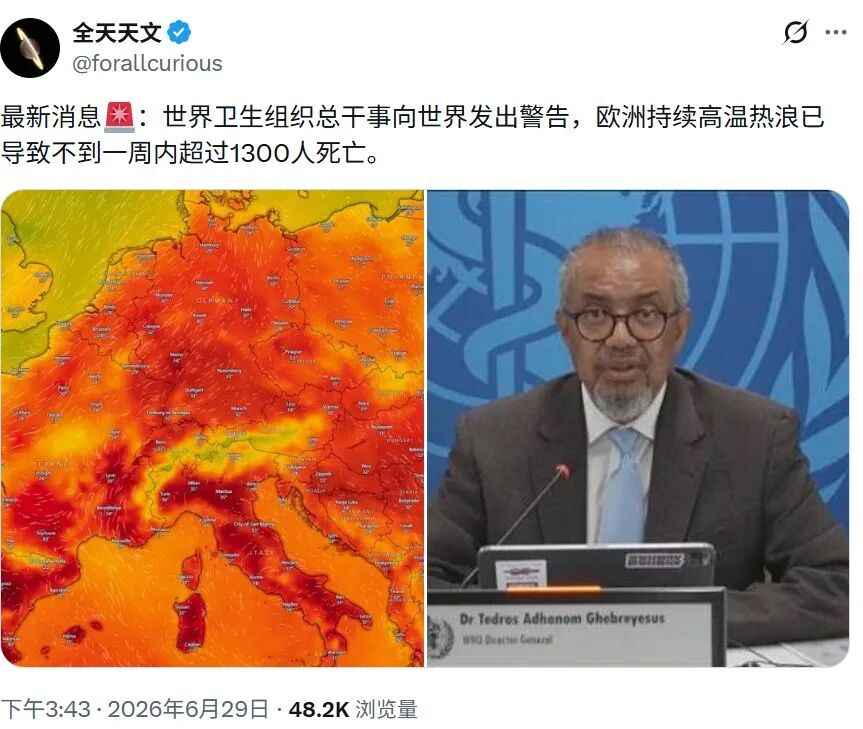
Climate data analysis is a critical application area for predictive AI models.
30-Second TL;DR
What Changed
Omega blocking high-pressure systems as the primary driver
Why It Matters
Extreme weather events are forcing a re-evaluation of infrastructure resilience and energy management strategies.
What To Do Next
N/A
Who should care:Researchers & Academics
Key Points
- •Omega blocking high-pressure systems as the primary driver
- •Significant rise in excess mortality among the elderly
- •Infrastructure failures due to extreme heat
- •Evidence of climate change accelerating in Europe
Deep Insight
AI-generated analysis for this event — not the original article.
Enhanced Key Takeaways
- •The 'Omega' blocking pattern is being exacerbated by a weakening and wavier jet stream, a phenomenon increasingly linked to Arctic amplification.
- •European power grids are facing unprecedented stress as cooling demand surges while thermal power plant efficiency drops due to high ambient temperatures and cooling water restrictions.
- •Urban heat island (UHI) effects are intensifying in European cities, with surface temperatures in dense metropolitan areas measuring up to 10°C higher than surrounding rural regions during these events.
- •Agricultural productivity in Southern Europe is suffering from a 'compounding hazard' effect, where extreme heat coincides with multi-year soil moisture deficits.
- •New EU-wide climate adaptation policies are being fast-tracked to mandate 'cool roof' infrastructure and expanded green space requirements in urban planning by 2028.
Technical Deep Dive
- Omega Blocking Mechanism: A synoptic-scale weather pattern characterized by a high-pressure ridge flanked by two low-pressure troughs, resembling the Greek letter Omega, which stalls weather systems in place.
- Arctic Amplification: The phenomenon where the Arctic warms at a rate significantly faster than the global average, reducing the temperature gradient between the pole and the mid-latitudes, which slows the jet stream.
- Thermal Efficiency Degradation: Power plants experience reduced thermodynamic efficiency (Carnot limit) as the temperature difference between the heat source and the heat sink (ambient air/water) decreases.
- Excess Mortality Modeling: Epidemiological models utilize the 'Heat-Mortality Threshold,' where mortality rates increase non-linearly once temperatures exceed local physiological adaptation limits.
Future ImplicationsAI analysis grounded in cited sources
Mandatory urban cooling infrastructure will become standard in EU building codes by 2027.
The frequency of record-breaking heatwaves is forcing legislative bodies to shift from voluntary guidelines to binding structural requirements for new construction.
Energy grid instability will lead to localized 'rolling brownouts' in major European cities during summer months.
The combination of increased air conditioning load and the reduced operational capacity of thermal and nuclear plants during heatwaves creates a supply-demand mismatch.
Timeline
2003-08
Major European heatwave results in over 70,000 excess deaths, prompting initial climate adaptation discussions.
2019-06
Europe records its hottest June on record at the time, highlighting the increasing frequency of early-summer heat events.
2022-07
Record-breaking temperatures exceed 40°C in the UK for the first time, testing infrastructure resilience.
2023-07
Global mean temperatures reach new highs, with Europe experiencing prolonged heat domes that strain agricultural output.
2026-06
Europe records its hottest June on record, characterized by a persistent Omega blocking high-pressure system.
- 2003-08Major European heatwave results in over 70,000 excess deaths, prompting initial climate adaptation discussions.
- 2019-06Europe records its hottest June on record at the time, highlighting the increasing frequency of early-summer heat events.
- 2022-07Record-breaking temperatures exceed 40°C in the UK for the first time, testing infrastructure resilience.
- 2023-07Global mean temperatures reach new highs, with Europe experiencing prolonged heat domes that strain agricultural output.
- 2026-06Europe records its hottest June on record, characterized by a persistent Omega blocking high-pressure system.
Weekly AI Recap
Read this week's curated digest of top AI events →
AI-curated news aggregator. All content rights belong to original publishers.
Original source: 虎嗅 ↗
This is a summary, not the original. Read the source, or get the weekly briefing.
The weekly digest
One email a week. Unsubscribe anytime.