EU Cyber Resilience Act: Requirements and Timelines
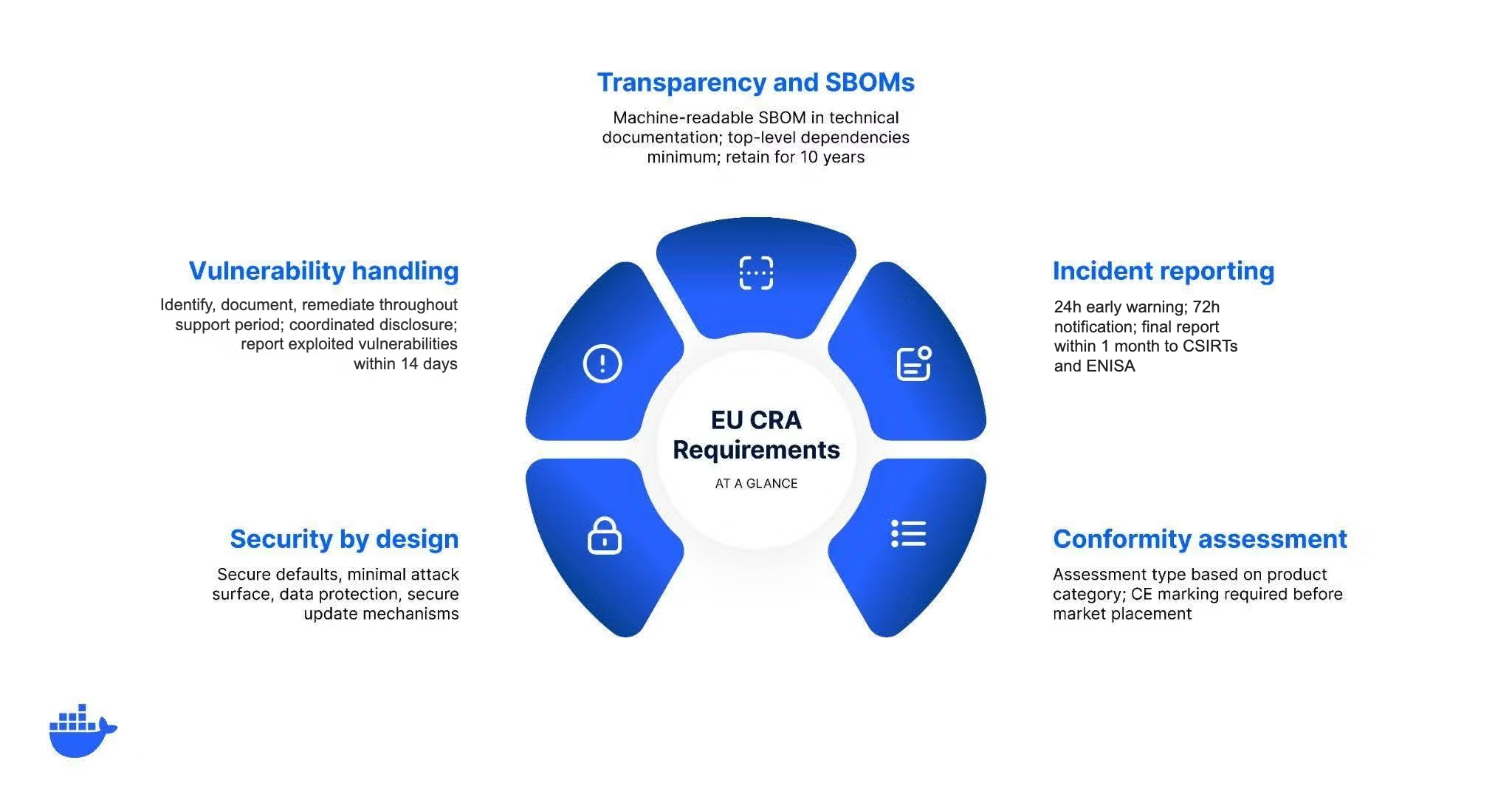
Prepare your containerized products for the EU Cyber Resilience Act to ensure continued market access in Europe.
30-Second TL;DR
What Changed
Mandatory SBOM requirements for software products
Why It Matters
The CRA sets a new baseline for software security in the EU. Teams failing to adapt their release processes will face significant market access barriers.
What To Do Next
Review your current vulnerability disclosure policy to ensure it meets the upcoming CRA reporting standards.
Key Points
- •Mandatory SBOM requirements for software products
- •New vulnerability reporting obligations for developers
- •Compliance timelines for container-based software teams
Deep Insight
AI-generated analysis for this event — not the original article.
Enhanced Key Takeaways
- •The CRA introduces a CE marking requirement for software products, signifying conformity with cybersecurity standards before they can be placed on the EU market.
- •Manufacturers must provide security updates for a period corresponding to the expected product lifetime or a minimum of five years, whichever is shorter.
- •The regulation establishes a tiered risk-based approach, where 'critical' software products face stricter conformity assessment procedures compared to standard products.
- •Non-compliance can result in significant administrative fines, reaching up to €15 million or 2.5% of the total worldwide annual turnover of the preceding financial year.
- •The act mandates that vulnerability handling processes must be documented and include coordinated vulnerability disclosure (CVD) policies to manage security flaws effectively.
Technical Deep Dive
- SBOMs must adhere to standardized formats such as SPDX or CycloneDX to ensure machine-readability and interoperability across the supply chain.
- Vulnerability reporting requires notification to the European Union Agency for Cybersecurity (ENISA) within 24 hours of becoming aware of an actively exploited vulnerability.
- Conformity assessments for critical products often require third-party audits, whereas lower-risk products may utilize self-assessment modules.
- Secure Development Lifecycle (SDL) requirements necessitate the implementation of automated security testing, including static and dynamic analysis, throughout the CI/CD pipeline.
Future ImplicationsAI analysis grounded in cited sources
Timeline
- 2022-09European Commission publishes the initial proposal for the Cyber Resilience Act.
- 2023-11Provisional agreement reached between the European Parliament and the Council on the CRA text.
- 2024-03European Parliament formally adopts the Cyber Resilience Act.
- 2024-10The Cyber Resilience Act is officially published in the Official Journal of the European Union.
Weekly AI Recap
Read this week's curated digest of top AI events →
AI-curated news aggregator. All content rights belong to original publishers.
Original source: Docker Blog ↗
This is a summary, not the original. Read the source, or get the weekly briefing.
The weekly digest
One email a week. Unsubscribe anytime.