EU AI Act Compliance Guide for Engineering Teams
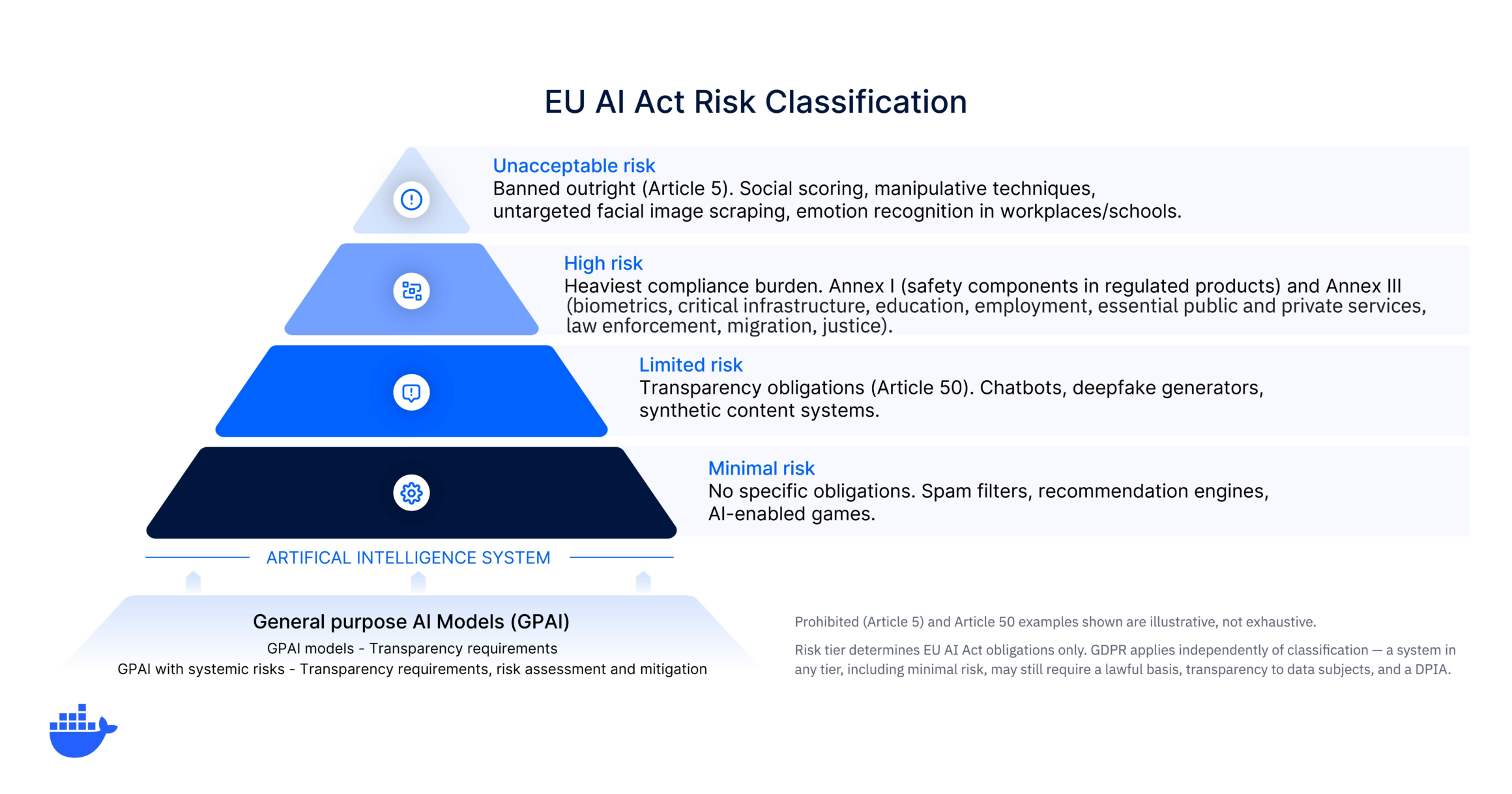
Avoid massive EU fines by aligning your AI development lifecycle with the upcoming EU AI Act mandates.
30-Second TL;DR
What Changed
Breakdown of compliance requirements by AI risk tiers
Why It Matters
Non-compliance could lead to significant fines and operational disruptions for AI-driven products. Teams must integrate governance early to avoid costly retrofitting.
What To Do Next
Audit your current AI model deployment pipeline against the EU AI Act risk classification tiers today.
Key Points
- •Breakdown of compliance requirements by AI risk tiers
- •Key regulatory deadlines extending through 2027
- •Frameworks for operationalizing AI governance in development workflows
Deep Insight
AI-generated analysis for this event — not the original article.
Enhanced Key Takeaways
- •The EU AI Act introduces specific transparency obligations for General Purpose AI (GPAI) models, requiring detailed technical documentation and copyright summaries for training data.
- •Docker's approach emphasizes 'Compliance-as-Code,' integrating automated scanning and policy enforcement directly into CI/CD pipelines to detect non-compliant AI dependencies.
- •High-risk AI systems must implement human-in-the-loop oversight mechanisms and maintain detailed logging of system events to ensure traceability throughout the AI lifecycle.
- •The regulation mandates that providers of AI systems must establish a quality management system (QMS) that covers design, development, and post-market monitoring.
- •Docker's guidance highlights the necessity of managing 'AI Bill of Materials' (AI-BOM) to track provenance and security vulnerabilities in third-party AI components.
Competitor Analysis
- Docker (Compliance-as-Code)
- Container/Workflow Integration
- Snyk (AI Security)
- Vulnerability Scanning
- JFrog (AI Lifecycle)
- Artifact Management
- Docker (Compliance-as-Code)
- Native CI/CD Policy Enforcement
- Snyk (AI Security)
- AI Model Security Scanning
- JFrog (AI Lifecycle)
- Model Provenance/Versioning
- Docker (Compliance-as-Code)
- Tiered (Dev/Team/Business)
- Snyk (AI Security)
- Tiered (Free/Team/Enterprise)
- JFrog (AI Lifecycle)
- Tiered (Subscription)
| Feature | Docker (Compliance-as-Code) | Snyk (AI Security) | JFrog (AI Lifecycle) |
|---|---|---|---|
| Focus | Container/Workflow Integration | Vulnerability Scanning | Artifact Management |
| AI Governance | Native CI/CD Policy Enforcement | AI Model Security Scanning | Model Provenance/Versioning |
| Pricing | Tiered (Dev/Team/Business) | Tiered (Free/Team/Enterprise) | Tiered (Subscription) |
Technical Deep Dive
- Implementation of OCI (Open Container Initiative) artifacts to store and version AI models alongside container images.
- Integration of automated policy engines (e.g., Open Policy Agent) to gate deployments based on AI risk classification metadata.
- Utilization of SBOM (Software Bill of Materials) standards extended to include AI model weights, training datasets, and fine-tuning parameters.
- Automated metadata extraction from container manifests to verify compliance with EU AI Act documentation requirements.
Future ImplicationsAI analysis grounded in cited sources
Timeline
- 2023-12EU AI Act political agreement reached by European Parliament and Council.
- 2024-05EU AI Act formally adopted by the Council of the European Union.
- 2024-08EU AI Act enters into force, triggering initial implementation timelines.
- 2025-02Prohibitions on unacceptable risk AI systems become applicable.
- 2026-06Docker expands AI compliance tooling to support EU AI Act regulatory requirements.
Weekly AI Recap
Read this week's curated digest of top AI events →
Related Updates

AI-curated news aggregator. All content rights belong to original publishers.
Original source: Docker Blog ↗
This is a summary, not the original. Read the source, or get the weekly briefing.
The weekly digest
One email a week. Unsubscribe anytime.