ETH Zurich’s bidirectional pixel turns screens into cameras
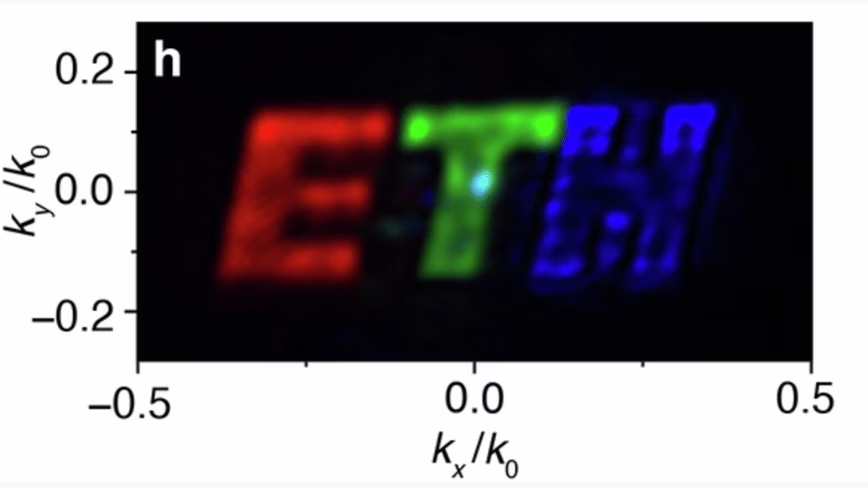
A breakthrough in pixel tech that could make every screen a camera—essential for future vision-based AI hardware.
30-Second TL;DR
What Changed
ETH Zurich researchers created the first bidirectional pixel
Why It Matters
This research could revolutionize hardware design for mobile devices and AR/VR headsets by eliminating the need for front-facing camera cutouts. It opens new possibilities for embedded vision in consumer electronics.
What To Do Next
Follow the Nature publication for updates on sensor integration latency and resolution capabilities for future hardware prototyping.
Key Points
- •ETH Zurich researchers created the first bidirectional pixel
- •Pixels can now emit light and capture images simultaneously
- •Potential for screen-integrated camera technology
Deep Insight
AI-generated analysis for this event — not the original article.
Enhanced Key Takeaways
- •The technology utilizes a modified organic light-emitting diode (OLED) architecture that functions as a photodiode when reverse-biased.
- •Researchers integrated a specialized circuit design that allows the pixel to switch between light emission and light detection modes at high frequencies, effectively creating a 'flicker' imperceptible to the human eye.
- •This approach eliminates the need for traditional camera cutouts or under-display camera (UDC) hardware, potentially increasing the active screen-to-body ratio to 100%.
- •The bidirectional pixel design addresses the 'dead space' issue in current smartphone displays where sensors occupy valuable real estate.
- •Initial prototypes have demonstrated the ability to capture biometric data, such as fingerprints or iris scans, directly through the display surface.
Competitor Analysis
- ETH Zurich Bidirectional Pixel
- Zero (Integrated)
- Traditional Under-Display Camera (UDC)
- Requires physical cutout/transparency
- External Camera Module
- Requires physical space/bezel
- ETH Zurich Bidirectional Pixel
- Limited by pixel density
- Traditional Under-Display Camera (UDC)
- Moderate (diffraction issues)
- External Camera Module
- High (dedicated optics)
- ETH Zurich Bidirectional Pixel
- Potentially lower (fewer parts)
- Traditional Under-Display Camera (UDC)
- High (complex manufacturing)
- External Camera Module
- Moderate
- ETH Zurich Bidirectional Pixel
- Biometrics/Basic Imaging
- Traditional Under-Display Camera (UDC)
- Selfie/Video Conferencing
- External Camera Module
- Professional Photography
| Feature | ETH Zurich Bidirectional Pixel | Traditional Under-Display Camera (UDC) | External Camera Module |
|---|---|---|---|
| Hardware Footprint | Zero (Integrated) | Requires physical cutout/transparency | Requires physical space/bezel |
| Image Quality | Limited by pixel density | Moderate (diffraction issues) | High (dedicated optics) |
| Cost | Potentially lower (fewer parts) | High (complex manufacturing) | Moderate |
| Primary Use Case | Biometrics/Basic Imaging | Selfie/Video Conferencing | Professional Photography |
Technical Deep Dive
- Architecture: Utilizes a dual-mode OLED pixel structure where the organic layers act as a light emitter during forward bias and a light harvester during reverse bias.
- Switching Mechanism: Employs a high-speed time-division multiplexing (TDM) scheme to interleave emission and detection cycles.
- Sensitivity: The photodetector mode leverages the internal photo-effect of the organic semiconductor material to convert incident photons into an electrical current.
- Integration: Requires a custom backplane design (TFT array) capable of handling both high-current driving for display and low-noise sensing for image acquisition.
Future ImplicationsAI analysis grounded in cited sources
Timeline
- 2023-05ETH Zurich research team publishes initial findings on organic photodiode integration in OLEDs.
- 2024-11Successful demonstration of a prototype display panel capable of simultaneous image capture and light emission.
- 2026-03Refinement of the high-speed switching circuit to reduce image artifacts and improve signal-to-noise ratio.
Weekly AI Recap
Read this week's curated digest of top AI events →
Related Updates


AI-curated news aggregator. All content rights belong to original publishers.
Original source: The Next Web (TNW) ↗
This is a summary, not the original. Read the source, or get the weekly briefing.
The weekly digest
One email a week. Unsubscribe anytime.