Edge AI Begins Its Battle for the Next Entry Point
💡The next AI winner may be determined by where users enter, not just which model performs best.
⚡ 30-Second TL;DR
What Changed
Handheld devices, desktops, and vehicles are emerging as competing edge-AI entry points.
Why It Matters
AI builders may need to design experiences that work across multiple endpoint types rather than relying only on cloud interfaces. Startups should consider distribution and hardware partnerships as carefully as model quality.
What To Do Next
Prototype the same AI workflow on a phone, desktop, and in-vehicle interface, then compare latency, context availability, and retention.
Key Points
- •Handheld devices, desktops, and vehicles are emerging as competing edge-AI entry points.
- •The competition is shifting from AI capability alone toward control of user access and distribution.
- •Edge AI could become strategically important for companies that own device ecosystems.
🧠 Deep Insight
AI-generated analysis for this event.
🔑 Enhanced Key Takeaways
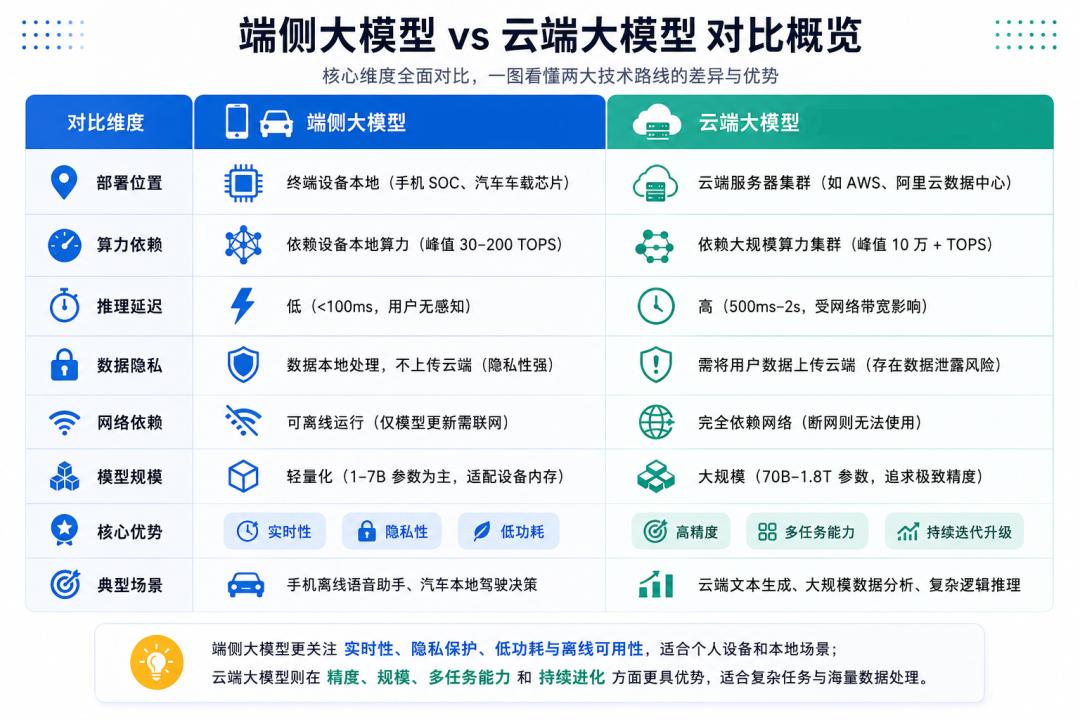
- •The integration of NPU (Neural Processing Unit) hardware into consumer SoCs has reached a critical threshold, with major chipmakers now prioritizing TOPS (Trillions of Operations Per Second) metrics as the primary differentiator for edge AI performance.
- •Privacy-preserving local inference is becoming a key regulatory and consumer demand, driving the adoption of Federated Learning and On-Device Fine-Tuning to keep user data off cloud servers.
- •The 'AI PC' and 'AI Phone' market segments are increasingly defined by the ability to run Small Language Models (SLMs) with parameter counts between 3B and 7B, optimized for low-latency response without network dependency.
- •Energy efficiency (performance-per-watt) has overtaken raw throughput as the most critical technical constraint for edge AI, directly impacting battery life and thermal management in mobile and handheld form factors.
- •Cross-device orchestration, where AI tasks are dynamically offloaded between a vehicle's infotainment system and a user's smartphone, is emerging as the next frontier for seamless AI ecosystem integration.
📊 Competitor Analysis▸ Show
| Feature | AI PC (Desktop/Laptop) | AI Smartphone | AI-Enabled Vehicle |
|---|---|---|---|
| Primary Constraint | Thermal/Power Delivery | Battery/Thermal | Compute/Latency |
| Model Size | 7B - 14B+ Parameters | 1B - 7B Parameters | 7B - 70B+ (Distributed) |
| Latency | Low | Ultra-Low | Ultra-Low (Safety Critical) |
| Ecosystem Lock-in | High (OS Level) | Very High (App/Service) | Medium (Platform/API) |
🛠️ Technical Deep Dive
- Implementation of Quantization-Aware Training (QAT) to compress models from FP16 to INT4/INT8 precision for edge deployment.
- Utilization of heterogeneous computing architectures, distributing AI workloads across CPU, GPU, and dedicated NPU cores to optimize power consumption.
- Adoption of KV Cache compression techniques to reduce memory footprint during long-context inference on resource-constrained devices.
- Integration of hardware-level Trusted Execution Environments (TEEs) to secure local model weights and user-specific fine-tuning data.
🔮 Future ImplicationsAI analysis grounded in cited sources
⏳ Timeline
Weekly AI Recap
Read this week's curated digest of top AI events →
👉Related Updates


AI-curated news aggregator. All content rights belong to original publishers.
Original source: 钛媒体 ↗