Drawing Agent adds 3D modeling and CAE features
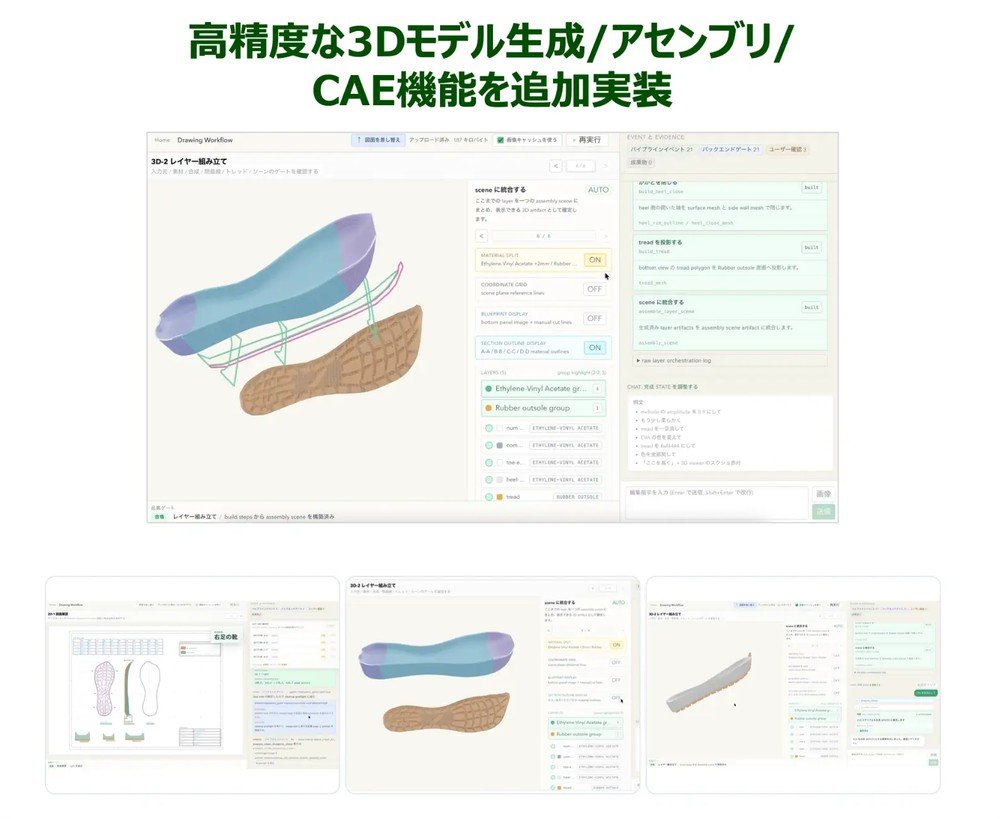
💡See how AI is automating the bridge between 2D technical blueprints and 3D structural engineering analysis.
⚡ 30-Second TL;DR
What Changed
Added high-precision 3D model generation from 2D blueprints
Why It Matters
This update significantly reduces the time required for mechanical engineers to transition from conceptual drawings to structural validation. It demonstrates the growing trend of vertical AI applications in specialized industrial engineering sectors.
What To Do Next
If you are building industrial AI tools, evaluate how to integrate automated mesh generation with your 3D reconstruction pipeline to improve engineering utility.
Key Points
- •Added high-precision 3D model generation from 2D blueprints
- •Introduced assembly functionality for multi-part mechanical designs
- •Launched beta CAE features for automated structural analysis
- •Enables an end-to-end workflow from drawing to engineering validation
🧠 Deep Insight
Background and context from public sources — not the original article. 4 sources cited.
🔑 Enhanced Key Takeaways
- •Drawing Agent achieves high precision through a unique self-evaluation loop, where its AI iteratively refines generated CadQuery code by comparing multi-view renders of the 3D model against the original 2D drawing until a quality target is met.
- •The platform supports a wide range of input formats, including PNG, JPG, PDF, DXF, and DWG, and generates industry-standard output files such as STEP, STL, and GLB, ensuring compatibility with existing CAD software like SolidWorks.
- •The system leverages Google's Gemini for its bidirectional review and self-evaluation process, while Claude Opus is utilized for parsing intricate details like dimensions, parts, hollow regions, and mate hints from the input drawings.
- •A newly implemented 'drawing cleanup' feature, powered by OpenAI's GPT-Image-2 model, automatically removes non-essential elements such as auxiliary lines, dimension annotations, hatching, and title blocks from 2D blueprints to extract pure geometric shapes.
- •These new features are projected to significantly enhance efficiency, with an estimated 80% reduction in review man-hours and a 60-70% reduction in pre-processing man-hours for CAE analysis.
🛠️ Technical Deep Dive
- CAD Engines: Utilizes CadQuery and build123d for generating and manipulating 3D models.
- Drawing Interpretation: Employs Claude Opus to parse and understand complex details from 2D drawing images, PDFs, and DXF/DWG files, including dimensions, individual parts, hollow regions, and assembly mate hints.
- Self-Evaluation and Refinement: Integrates Google's Gemini for a bidirectional review process. The AI renders the generated 3D model from eight different angles and cross-sections, compares these renders against the original 2D drawing, and iteratively re-writes the CadQuery code (up to ten iterations) until the quality score converges to the desired target.
- Output Fidelity: Generates B-Rep (Boundary Representation) solids, ensuring millimeter-accurate parameters on every edge, distinguishing it from mesh-based generative models.
- Drawing Cleanup: Incorporates OpenAI's GPT-Image-2 model to automatically remove 'noise' elements from input drawings, such as auxiliary lines, dimension notations, hatching, leader lines, section labels, and title blocks, isolating the pure geometric shape.
🔮 Future ImplicationsAI analysis grounded in cited sources
⏳ Timeline
📎 Sources (4)
Factual claims are grounded in the sources below. Forward-looking analysis is AI-generated interpretation.
Weekly AI Recap
Read this week's curated digest of top AI events →
👉Related Updates
AI-curated news aggregator. All content rights belong to original publishers.
Original source: ITmedia AI+ (日本) ↗
This is a summary, not the original. Read the source, or get the weekly briefing.
The weekly digest
One email a week. Unsubscribe anytime.