Discord implements default end-to-end encryption for all calls

Understand how major platforms are shifting toward zero-knowledge privacy for real-time media.
30-Second TL;DR
What Changed
End-to-end encryption is now active for all voice and video calls.
Why It Matters
This enhances privacy for millions of users and sets a new standard for communication platforms. It may influence how other platforms handle user data privacy in the future.
What To Do Next
Review your application's communication protocols to ensure they meet modern privacy standards like E2EE.
Key Points
- •End-to-end encryption is now active for all voice and video calls.
- •Discord cannot access or listen to private user communications.
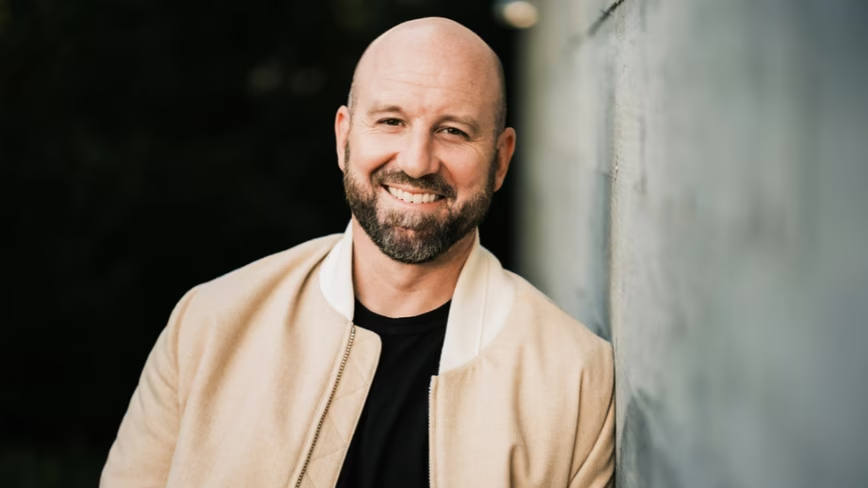
- •The rollout was confirmed by VP of core technology Mark Smith.
Deep Insight
Background and context from public sources — not the original article. 20 sources cited.
Enhanced Key Takeaways
- •Discord developed an open and audited end-to-end encryption (E2EE) protocol named DAVE, in partnership with cybersecurity firm Trail of Bits, which reviewed its design and implementation.
- •The E2EE rollout covers direct messages (DMs), group DMs, voice channels, and Go Live streams across desktop, mobile, web browsers, and gaming consoles, with support for Discord bots/apps and the Social SDK.
- •Discord has no current plans to extend end-to-end encryption to text messages, citing significant engineering challenges due to existing features being built on the assumption of unencrypted text.
- •Stage channels are explicitly excluded from E2EE because they are designed for larger-scale public broadcasts rather than private conversations and rely on a different architecture.
- •Support for the DAVE protocol became a mandatory requirement for Discord calls on March 1, 2026, meaning clients and applications without DAVE support can no longer participate in supported voice and video sessions.
Competitor Analysis
- Discord (Voice/Video)
- Yes (DAVE protocol)
- Discord (Text)
- No
- Zoom (Meetings)
- Yes
- Microsoft Teams (Meetings)
- Yes (on Windows, Mac, mobile)
- Signal (All Communications)
- Yes
- Discord (Voice/Video)
- Community, gaming, casual hangouts
- Discord (Text)
- Community, gaming, casual hangouts
- Zoom (Meetings)
- Professional meetings, webinars, online classes
- Microsoft Teams (Meetings)
- Enterprise unified communications, Microsoft 365 integration
- Signal (All Communications)
- Private, secure messaging and calls
- Discord (Voice/Video)
- Free core features, Nitro subscription for extras
- Discord (Text)
- Free core features, Nitro subscription for extras
- Zoom (Meetings)
- Free (limited), paid plans for more features
- Microsoft Teams (Meetings)
- Paid (often part of Microsoft 365)
- Signal (All Communications)
- Free
| Feature/Platform | Discord (Voice/Video) | Discord (Text) | Zoom (Meetings) | Microsoft Teams (Meetings) | Signal (All Communications) |
|---|---|---|---|---|---|
| End-to-End Encryption | Yes (DAVE protocol) | No | Yes | Yes (on Windows, Mac, mobile) | Yes |
| Primary Use Case | Community, gaming, casual hangouts | Community, gaming, casual hangouts | Professional meetings, webinars, online classes | Enterprise unified communications, Microsoft 365 integration | Private, secure messaging and calls |
| Pricing Model | Free core features, Nitro subscription for extras | Free core features, Nitro subscription for extras | Free (limited), paid plans for more features | Paid (often part of Microsoft 365) | Free |
Technical Deep Dive
- Discord's E2EE for voice and video calls is powered by its custom-developed, open-source DAVE protocol.
- DAVE leverages the WebRTC encoded transform API to encrypt each audio and video frame with a per-sender symmetric key.
- The Messaging Layer Security (MLS) protocol is utilized for scalable group key exchanges, ensuring that media encryption keys are different for each call and change when participants join or leave.
- The protocol uses ephemeral identity keys to enhance privacy and minimize disruptions during call participant changes.
- DAVE's design and implementation were externally audited by the cybersecurity firm Trail of Bits.
- Discord clients use dedicated Web Workers to handle the encryption and decryption of media streams within the WebRTC pipeline, ensuring low-latency performance across diverse platforms.
- The protocol supports out-of-band verification of individual call participants and the overall E2EE call state using Voice Privacy Codes.
Future ImplicationsAI analysis grounded in cited sources
Timeline
- 2023-08Discord began experimenting with end-to-end encryption for voice and video calls.
- 2024-09Discord introduced the DAVE protocol, an open and audited E2EE protocol for audio and video, and began migrating calls on desktop and mobile.
- 2025-09DAVE support was extended to all remaining platforms, including web browsers, gaming consoles, and Discord bots/apps.
- 2026-03Discord completed the migration to DAVE, making E2EE a mandatory requirement for all eligible voice and video calls, and began removing client code that supported unencrypted fallback.
- 2026-05Discord formally announced the default end-to-end encryption for all voice and video calls.
Sources (20)
Factual claims are grounded in the sources below. Forward-looking analysis is AI-generated interpretation.
Weekly AI Recap
Read this week's curated digest of top AI events →
Related Updates


AI-curated news aggregator. All content rights belong to original publishers.
Original source: The Next Web (TNW) ↗
This is a summary, not the original. Read the source, or get the weekly briefing.
The weekly digest
One email a week. Unsubscribe anytime.