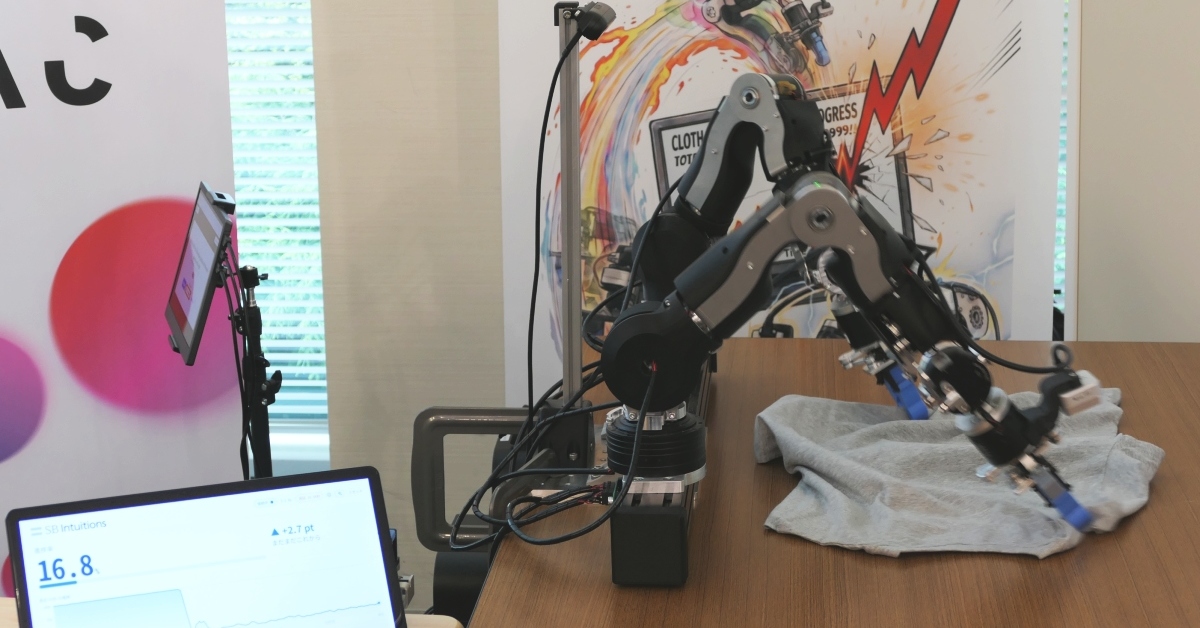
Dexmal Launches Embodied AI Platform and DexOS

💡Dexmal is attempting to build the 'Android of robotics'—a critical move for scaling embodied AI models.
⚡ 30-Second TL;DR
What Changed
Unveiled DM0.5 foundation model for robotics
Why It Matters
This launch signals a shift toward standardized software stacks for embodied AI, potentially lowering the barrier for developers to deploy models on diverse robotic hardware.
What To Do Next
Investigate Dexmal's developer documentation to see if their MaaS platform supports your current robotic simulation stack.
Key Points
- •Unveiled DM0.5 foundation model for robotics
- •Introduced DexOS to standardize robot operating environments
- •Launched embodied MaaS platform to scale real-world model deployment
🧠 Deep Insight
AI-generated analysis for this event — not the original article.
🔑 Enhanced Key Takeaways
- •Dexmal was founded by former senior engineers from leading autonomous driving and robotics firms, focusing on bridging the gap between digital foundation models and physical hardware execution.
- •The DM0.5 model utilizes a proprietary 'Cross-Embodiment Transformer' architecture designed to generalize across different robotic morphologies, including humanoid, quadruped, and robotic arm platforms.
- •DexOS incorporates a real-time kernel optimization layer that reduces latency in sensor-to-actuator feedback loops by a reported 30% compared to standard ROS 2 implementations.
- •The MaaS platform features a 'Digital Twin Simulation Suite' that allows developers to train and validate models in high-fidelity virtual environments before deploying to physical hardware.
- •Dexmal has secured strategic partnerships with three major industrial automation manufacturers to pilot the DexOS ecosystem in warehouse logistics and assembly line environments.
📊 Competitor Analysis▸ Show
| Feature | Dexmal (DexOS) | NVIDIA (Isaac) | Tesla (Optimus/FSD) |
|---|---|---|---|
| Core Focus | Universal Robot OS | Simulation & AI Compute | Vertical Integration |
| Model Architecture | Cross-Embodiment Transformer | Foundation Models (VIMA/GenAI) | End-to-End Neural Nets |
| Deployment | MaaS / Open Ecosystem | Hardware/Software Stack | Proprietary Hardware Only |
| Pricing | Subscription/Usage-based | Licensing/Hardware Sales | N/A (Internal) |
🛠️ Technical Deep Dive
- DM0.5 Architecture: Employs a multi-modal transformer backbone capable of processing visual, tactile, and proprioceptive data streams simultaneously.
- DexOS Kernel: Built on a microkernel architecture that isolates hardware abstraction layers (HAL) to ensure stability during high-frequency control tasks.
- Latency Optimization: Implements a predictive inference engine that pre-computes motion trajectories based on short-term environmental changes.
- Data Pipeline: Supports federated learning protocols, allowing robots to share edge-learned experiences without transmitting raw sensitive visual data to the cloud.
🔮 Future ImplicationsAI analysis grounded in cited sources
⏳ Timeline
Weekly AI Recap
Read this week's curated digest of top AI events →
👉Related Updates

AI-curated news aggregator. All content rights belong to original publishers.
Original source: Pandaily ↗
This is a summary, not the original. Read the source, or get the weekly briefing.
The weekly digest
One email a week. Unsubscribe anytime.