DeepSeek Plans a Gigawatt-Scale Ulanqab Expansion
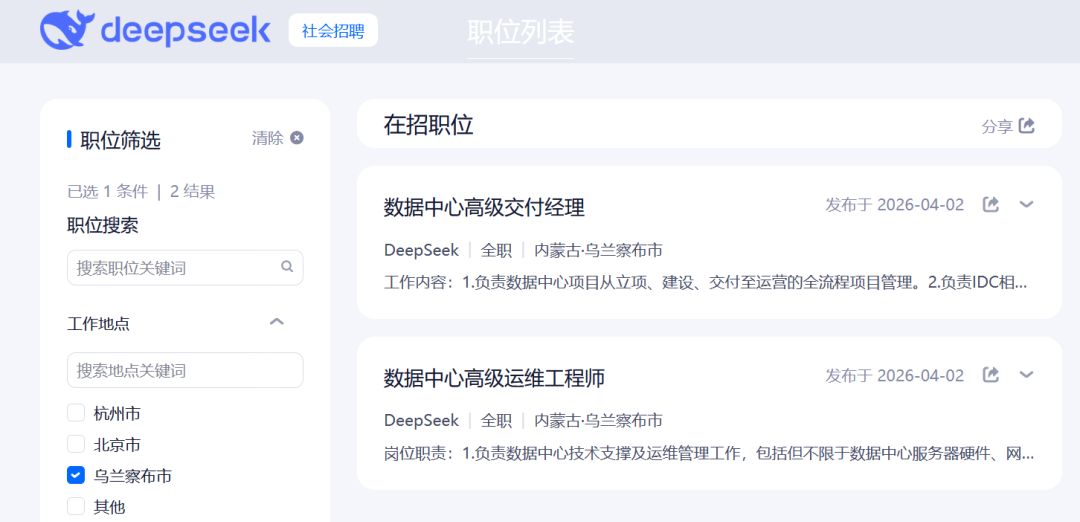
DeepSeek’s next advantage may come from power and land—not just using fewer GPUs.
30-Second TL;DR
What Changed
DeepSeek reportedly targets partial compute availability between late 2027 and early 2028.
Why It Matters
For AI companies, compute competitiveness is increasingly determined by power procurement, land, cooling, network access, and regulatory coordination—not only model efficiency. DeepSeek’s move could intensify the race for low-cost, renewable-powered AI infrastructure across China.
What To Do Next
Add GPU power availability, PUE, renewable-energy access, and regional latency checks to your next AI infrastructure procurement comparison.
Key Points
- •DeepSeek reportedly targets partial compute availability between late 2027 and early 2028.
- •The company began recruiting data-center delivery and operations roles in Ulanqab as early as April.
- •Ulanqab offers cold weather, low electricity costs, Beijing proximity, and approximately 4.2 ms fiber latency.
- •The region’s independent Inner Mongolia electric-grid structure may simplify green-power direct-connect arrangements.
- •A 1 GW facility at an estimated 0.07 yuan per kWh power difference could save nearly 500 million yuan annually.
Deep Insight
AI-generated analysis for this event — not the original article.
Enhanced Key Takeaways
- •DeepSeek's Ulanqab expansion is part of a broader 'National Hub' strategy, leveraging the Inner Mongolia node of China's 'East Data, West Computing' (Dongshu Xisuan) initiative to receive government-backed infrastructure subsidies.
- •The project utilizes liquid cooling technology specifically designed for high-density AI clusters, aiming for a Power Usage Effectiveness (PUE) rating below 1.15 to meet stringent regional energy efficiency mandates.
- •DeepSeek has reportedly secured partnerships with local renewable energy providers to ensure that over 60% of the 1 GW facility's power consumption is sourced from wind and solar farms in the Ulanqab region.
- •The expansion includes the deployment of custom-designed, high-bandwidth interconnect switches to mitigate the latency challenges inherent in remote data center operations compared to urban-core facilities.
- •Regulatory filings indicate that the land acquisition for the Ulanqab site was finalized in Q1 2026, marking the company's transition from a pure-play software model to a capital-intensive infrastructure owner.
Competitor Analysis
- DeepSeek (Ulanqab)
- AI Model Training
- ByteDance (Inner Mongolia)
- Content Delivery/AI
- Alibaba Cloud (Ulanqab)
- Cloud Services/AI
- DeepSeek (Ulanqab)
- Direct Green Power
- ByteDance (Inner Mongolia)
- Grid-Scale Purchase
- Alibaba Cloud (Ulanqab)
- Mixed/Grid-Scale
- DeepSeek (Ulanqab)
- ~4.2 ms
- ByteDance (Inner Mongolia)
- ~5-8 ms
- Alibaba Cloud (Ulanqab)
- ~5-10 ms
- DeepSeek (Ulanqab)
- Self-Built/Leased
- ByteDance (Inner Mongolia)
- Leased/Self-Built
- Alibaba Cloud (Ulanqab)
- Self-Built
| Feature | DeepSeek (Ulanqab) | ByteDance (Inner Mongolia) | Alibaba Cloud (Ulanqab) |
|---|---|---|---|
| Primary Focus | AI Model Training | Content Delivery/AI | Cloud Services/AI |
| Energy Strategy | Direct Green Power | Grid-Scale Purchase | Mixed/Grid-Scale |
| Latency Target | ~4.2 ms | ~5-8 ms | ~5-10 ms |
| Infrastructure | Self-Built/Leased | Leased/Self-Built | Self-Built |
Technical Deep Dive
- Implementation of high-density rack configurations supporting up to 80kW per rack to accommodate next-generation GPU clusters.
- Utilization of advanced liquid-to-chip cooling systems to manage thermal loads for high-TDP (Thermal Design Power) AI accelerators.
- Integration of a proprietary software-defined networking (SDN) layer to optimize traffic routing between the Ulanqab cluster and Beijing-based R&D centers.
- Deployment of modular data center architecture to allow for rapid scaling of compute capacity in 100MW increments.
Future ImplicationsAI analysis grounded in cited sources
Timeline
- 2025-06DeepSeek initiates feasibility studies for large-scale infrastructure deployment in Inner Mongolia.
- 2026-01DeepSeek finalizes land acquisition and site selection in the Ulanqab data center cluster.
- 2026-04DeepSeek launches large-scale recruitment drive for data center operations and delivery personnel in Ulanqab.
Weekly AI Recap
Read this week's curated digest of top AI events →
AI-curated news aggregator. All content rights belong to original publishers.
Original source: 虎嗅 ↗
This is a summary, not the original. Read the source, or get the weekly briefing.
The weekly digest
One email a week. Unsubscribe anytime.