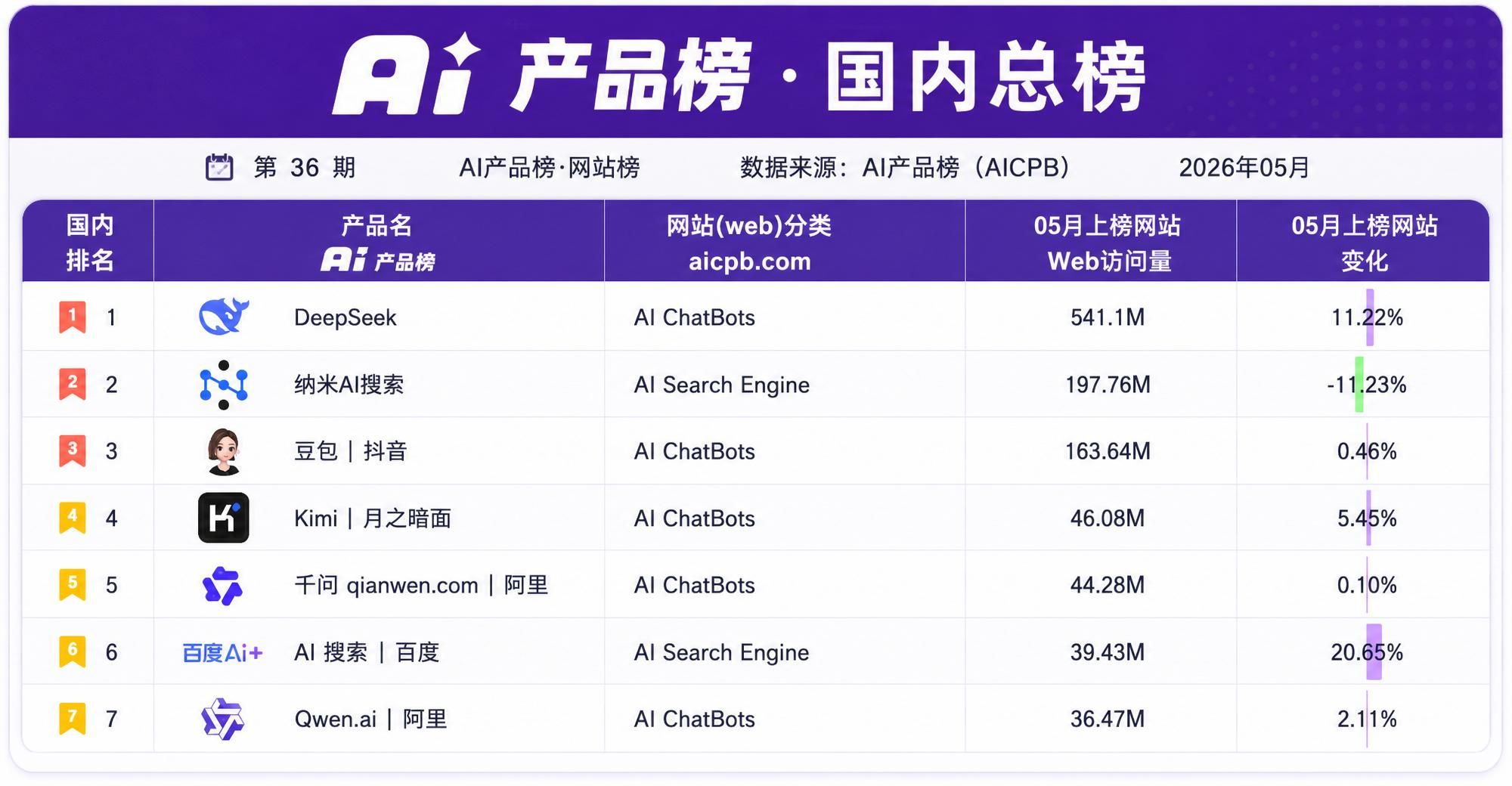
DeepSeek Leads China AI Traffic With 541M Monthly Visits
💡DeepSeek dominates Chinese AI traffic; see how Baidu is fighting back for market share.
⚡ 30-Second TL;DR
What Changed
DeepSeek recorded 541 million monthly visits in May.
Why It Matters
The data highlights a shift in user preference toward specialized AI models like DeepSeek in the Chinese market. It also signals that incumbent tech giants like Baidu are successfully pivoting their legacy search traffic to AI-native interfaces.
What To Do Next
Analyze DeepSeek's UI/UX patterns to understand why it is capturing high user retention compared to traditional search engines.
Key Points
- •DeepSeek recorded 541 million monthly visits in May.
- •DeepSeek remains the #1 ranked AI website in China.
- •Baidu's AI products, including search and long-form content, show strong recovery.
🧠 Deep Insight
Background and context from public sources — not the original article. 31 sources cited.
🔑 Enhanced Key Takeaways
- •DeepSeek, founded in July 2023 by Liang Wenfeng and backed by the Chinese hedge fund High-Flyer, has adopted an 'open-weight' model strategy, releasing its models under free and open-source licenses, which has significantly disrupted the AI industry by offering high performance at a fraction of the cost of proprietary alternatives.
- •The company is reportedly nearing a substantial $7.4 billion funding round, with major investors including Tencent and CATL, which could value DeepSeek at up to $59 billion and marks one of China's largest startup financings.
- •DeepSeek's DeepSeek-V2 model, released in May 2024, gained immense popularity in China for its cost-efficiency and subsequently triggered a price war among domestic AI companies, compelling competitors like ByteDance, Tencent, Baidu, and Alibaba to significantly cut their AI model prices.
- •Baidu's AI business demonstrated strong commercialization in Q1 2026, with AI business revenue accounting for 52% of its total revenue, driven by its AI Cloud and Apollo autonomous driving divisions.
- •DeepSeek's latest V4 models, launched in April 2026, offer a 1 million token context length and are priced significantly lower than Western frontier models, with V4 Flash costing $0.14 per million input tokens and $0.28 per million output tokens.
📊 Competitor Analysis▸ Show
Competitor Analysis: DeepSeek vs. Key AI Players
| Feature / Model | DeepSeek (V4 Flash/Pro) | DeepSeek V4 Flash: $0.14 input / $0.28 output per million tokens. DeepSeek V4 Pro: $1.74 input / $3.48 output per million tokens (regular), $0.435/$0.87 (promo). Context: 1M tokens (V4). Open-weight models. Strong in coding and reasoning.
| Qwen (Alibaba Cloud) | Qwen3-Max: Leads Arena-Hard at 90.5, 262K context (1M extended), trained on 36T tokens. Outperformed DeepSeek V3 and Llama 3.1 in some benchmarks. Uses MoE design.
| Doubao (ByteDance) | Doubao-1.5-pro: Claimed to outperform OpenAI's o1 in tests. Priced at 9 yuan per million tokens (nearly half of DeepSeek-R1).
| Kimi (Moonshot AI) | Kimi K2.6: Tied for highest score among Chinese open-weight models on Artificial Analysis Intelligence Index (54/60). Context: 262,000 tokens. Processed up to 2 million Chinese characters.
| GLM (Zhipu AI) | GLM-5: Ranked among top three in global usage leaderboard.
| WuDao (Zhiyuan Research Institute) | WuDao 3.0: Over 1.75 trillion parameters, includes AquilaChat, AquilaCode, multimodal systems.
| MiniMax | MiniMax M2.5: Ranked among top three in global usage leaderboard. Inspo: Dialogue assistant.
| OpenAI (e.g., GPT-5.4/o1) | GPT-5.4 is 18x more expensive than DeepSeek V4 Flash. ChatGPT-o1 was estimated to be 95% more expensive than DeepSeek-R1. Proprietary models.
🛠️ Technical Deep Dive
- Mixture-of-Experts (MoE) Architecture: DeepSeek models (V2, V3, R1) extensively utilize an MoE design, where only a subset of the total parameters is activated for each token during inference. For instance, DeepSeek-V2 has 236 billion total parameters but activates only 21 billion per token, while DeepSeek-V3/R1 has 671 billion total parameters with 37 billion activated per token, significantly enhancing efficiency and reducing computational costs.
- Multi-head Latent Attention (MLA): An innovative attention mechanism integrated into DeepSeek-V2, V3, and R1, designed to optimize inference efficiency by substantially compressing the Key-Value (KV) cache into a latent vector, thereby reducing memory overhead.
- DeepSeekMoE: This specific MoE architecture is employed for economical training and efficient inference, contributing to the models' cost-effectiveness.
- Extended Context Length: DeepSeek-V2 and V3/R1 models support a context length of 128,000 tokens. The newer DeepSeek V4 models further extend this to 1 million tokens.
- Multi-Token Prediction (MTP): DeepSeek-V3 incorporates an MTP training objective, allowing the model to predict multiple tokens concurrently (specifically, the next two tokens), which improves sample efficiency and accelerates inference.
- Domain-Optimized Training Data: DeepSeek emphasizes curating domain-specific training data, particularly for coding and Chinese-language tasks. For example, DeepSeek-Coder-V2 was trained on 10.2 trillion tokens, with 60% being source code.
- Advanced Optimization Strategies: The architecture includes features like dynamic sparse activation, grouped query attention (GQA) for reduced memory, blockwise quantization, asynchronous pipeline parallelism for larger batch sizes, and built-in support for low-rank adaptation (LoRA) during fine-tuning. DeepSeek V3 also utilizes FP8 precision for training.
🔮 Future ImplicationsAI analysis grounded in cited sources
⏳ Timeline
📎 Sources (31)
Factual claims are grounded in the sources below. Forward-looking analysis is AI-generated interpretation.
- wikipedia.org
- britannica.com
- economictimes.com
- investing.com
- mexicobusiness.news
- techtimes.com
- phemex.com
- binance.com
- digitimes.com
- cloudzero.com
- daily.dev
- benchlm.ai
- index.dev
- theguardian.com
- secondtalent.com
- techtimes.com
- economictimes.com
- bardeen.ai
- nvidia.com
- milvus.io
- geeksforgeeks.org
- arxiv.org
- arxiv.org
- turingpost.com
- nxcode.io
- towardsai.net
- chat-deep.ai
- milvus.io
- fireworks.ai
- deepseek.ai
- aiweekly.co
Weekly AI Recap
Read this week's curated digest of top AI events →
👉Related Updates



AI-curated news aggregator. All content rights belong to original publishers.
Original source: Pandaily ↗
This is a summary, not the original. Read the source, or get the weekly briefing.
The weekly digest
One email a week. Unsubscribe anytime.