DeepSeek Finally Gets Vision—But Still Sees Limits
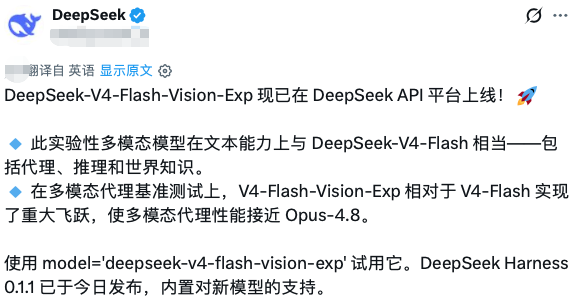
💡DeepSeek adds vision at ultra-low cost, but real-world tests expose accuracy, latency, and reliability trade-offs.
⚡ 30-Second TL;DR
What Changed
Vision-Exp is DeepSeek's first reported V4 Flash variant with native image input.
Why It Matters
The release closes an important capability gap for DeepSeek and makes low-cost visual prototyping more accessible. However, developers should not assume benchmark performance translates directly into production reliability, especially for identity-sensitive or complex coding workflows.
What To Do Next
Use DeepSeek Harness's native image requests to benchmark Vision-Exp on your own screenshots, OCR cases, and coding tasks before switching production traffic.
Key Points
- •Vision-Exp is DeepSeek's first reported V4 Flash variant with native image input.
- •The model can identify locations and describe lighting, spatial relationships, and visual details in ordinary photographs.
- •Screenshot-to-webpage reconstruction captures the overall layout but simplifies icons, color edges, and small text.
- •Independent tests found repeated self-correction, disconnections, roughly 15 times higher token consumption, and 3.5 times longer execution for a Three.js task.
- •Image pricing is capped at 384 input tokens per image, enabling up to eight images for about one cent at peak pricing.
🧠 Deep Insight
Background and context from public sources — not the original article. 14 sources cited.
🔑 Enhanced Key Takeaways
- •DeepSeek released the 'DeepSeek Harness' (dsh) on August 13, 2026, a modular agent framework built on the Cordis kernel that treats vision and tool use as swappable plugins.
- •The Vision-Exp model enforces a hard ceiling of 384 tokens per image, with all inputs automatically resized to approximately 800x800 pixels to maintain cost-efficiency.
- •DeepSeek claims the Vision-Exp model achieves performance parity with Anthropic’s Opus-4.8, specifically outperforming it on 3 out of 11 internal multimodal benchmarks.
- •The vision capability is billed at the same per-token rate as the text-only DeepSeek-V4-Flash, facilitating high-volume agentic workflows at a lower price point than competitors.
- •The model supports multiple input methods including base64 encoding, external image URLs, and the DeepSeek Files API to ensure compatibility with existing developer workflows.
📊 Competitor Analysis▸ Show
| Feature | DeepSeek-V4-Flash-Vision-Exp | Anthropic Opus-4.8 | OpenAI GPT-4o |
|---|---|---|---|
| Pricing Strategy | Fixed 384-token cap per image | Variable based on resolution | Variable based on resolution |
| Architecture | Modular (Cordis/dsh) | Monolithic | Monolithic |
| Benchmark Claim | Claims parity on 3/11 metrics | Baseline for comparison | Industry standard |
| Primary Focus | Cost-efficient agentic workflows | High-reasoning multimodal | General purpose multimodal |
🛠️ Technical Deep Dive
- The model utilizes the Cordis kernel, a meta-framework that enables a plugin-based architecture for agent capabilities.
- Image processing involves a fixed-resolution downsampling to 800x800 pixels prior to inference.
- The system architecture is designed for 'unbundled' AI, allowing developers to swap vision and tool-use modules independently within the DeepSeek Harness (dsh).
- Integration is facilitated through the Responses API and Codex-compatible endpoints to minimize developer friction.
🔮 Future ImplicationsAI analysis grounded in cited sources
⏳ Timeline
📎 Sources (14)
Factual claims are grounded in the sources below. Forward-looking analysis is AI-generated interpretation.
Weekly AI Recap
Read this week's curated digest of top AI events →
👉Related Updates
AI-curated news aggregator. All content rights belong to original publishers.
Original source: 虎嗅 ↗
This is a summary, not the original. Read the source, or get the weekly briefing.
Weekly AI briefing
One email a week. Unsubscribe anytime.