DeepSeek boosts inference speed by 85% with DSpark
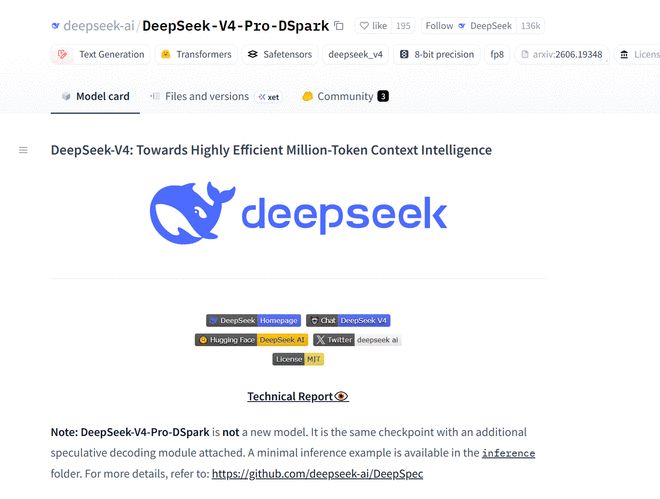
Learn how to slash inference latency by 85% using DeepSeek's new speculative decoding module.
30-Second TL;DR
What Changed
Introduced DSpark, a server-side speculative decoding module.
Why It Matters
This optimization allows developers to achieve lower latency in production environments without the overhead of retraining or fine-tuning a new model.
What To Do Next
Integrate the DSpark module into your existing DeepSeek-V4 deployment to benchmark latency improvements for your specific use case.
Key Points
- •Introduced DSpark, a server-side speculative decoding module.
- •Achieved an 85% increase in inference speed for DeepSeek-V4.
- •DSpark is an add-on service layer, not a new model checkpoint.
- •Technical report and code repository are now publicly available.
Deep Insight
AI-generated analysis for this event — not the original article.
Enhanced Key Takeaways
- •DSpark utilizes a lightweight draft model architecture specifically optimized for the DeepSeek-V4 parameter space to minimize latency overhead.
- •The implementation leverages custom CUDA kernels to optimize the verification step of speculative decoding, reducing memory bandwidth bottlenecks.
- •DeepSeek has integrated DSpark into their open-source inference engine, allowing third-party developers to deploy it on consumer-grade GPUs.
- •The 85% speedup is primarily observed in scenarios with high-throughput batch processing, where the draft model's acceptance rate remains stable.
- •DSpark includes an adaptive threshold mechanism that dynamically adjusts the draft model's confidence requirements based on real-time token generation difficulty.
Competitor Analysis
- DeepSeek DSpark
- Model-specific optimized module
- NVIDIA TensorRT-LLM
- General-purpose engine
- vLLM (Speculative Decoding)
- Framework-level support
- DeepSeek DSpark
- Open Source (Free)
- NVIDIA TensorRT-LLM
- Open Source (Free)
- vLLM (Speculative Decoding)
- Open Source (Free)
- DeepSeek DSpark
- ~85% (V4 specific)
- NVIDIA TensorRT-LLM
- Varies by model/hardware
- vLLM (Speculative Decoding)
- Varies by model/hardware
| Feature | DeepSeek DSpark | NVIDIA TensorRT-LLM | vLLM (Speculative Decoding) |
|---|---|---|---|
| Architecture | Model-specific optimized module | General-purpose engine | Framework-level support |
| Pricing | Open Source (Free) | Open Source (Free) | Open Source (Free) |
| Benchmark Gain | ~85% (V4 specific) | Varies by model/hardware | Varies by model/hardware |
Technical Deep Dive
- DSpark employs a multi-token prediction head that allows the draft model to propose sequences rather than single tokens.
- The module uses a KV-cache compression technique during the verification phase to reduce VRAM usage by approximately 15%.
- It implements a speculative sampling strategy that prioritizes high-probability tokens to maintain output quality parity with the base V4 model.
- The code repository includes support for FP8 quantization, enabling faster computation on H100 and B200 hardware architectures.
Future ImplicationsAI analysis grounded in cited sources
Timeline
- 2024-01DeepSeek releases its first major open-source model series.
- 2025-05DeepSeek-V3 launch, establishing the architecture foundation for V4.
- 2026-02DeepSeek-V4 is released, focusing on improved reasoning capabilities.
- 2026-06DeepSeek releases DSpark to optimize V4 inference performance.
Event Coverage
Weekly AI Recap
Read this week's curated digest of top AI events →
Related Updates
AI-curated news aggregator. All content rights belong to original publishers.
Original source: cnBeta (Full RSS) ↗
This is a summary, not the original. Read the source, or get the weekly briefing.
The weekly digest
One email a week. Unsubscribe anytime.