CXMT Challenges U.S. Military Listing
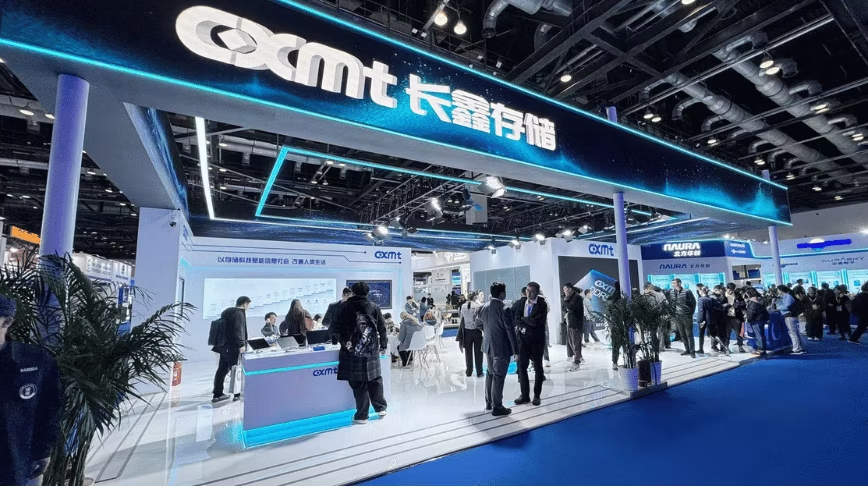
💡CXMT’s case could reshape memory-supply risk assessments for AI servers and data centers.
⚡ 30-Second TL;DR
What Changed
CXMT filed a lawsuit in Washington against the U.S. Department of Defense.
Why It Matters
The lawsuit highlights geopolitical and regulatory risks affecting memory suppliers used in AI servers and data centers. A change in CXMT's status could influence procurement decisions, supply-chain diversification, and access to U.S. defense-related business.
What To Do Next
Review your AI infrastructure bill of materials and identify DRAM dependencies that may require geopolitical-risk or supplier-diversification plans.
Key Points
- •CXMT filed a lawsuit in Washington against the U.S. Department of Defense.
- •The military-company designation blocks defense contracts but does not prohibit commercial sales.
- •CXMT is the world's fourth-largest DRAM maker and recently became China's most valuable listed company.
🧠 Deep Insight
Background and context from public sources — not the original article. 14 sources cited.
🔑 Enhanced Key Takeaways
- •CXMT filed its lawsuit in the U.S. District Court for the District of Columbia on August 28, 2026, specifically citing the Pentagon's Section 1260H list.
- •The company experienced a volatile listing history, including a brief removal from the 1260H list in February 2026 that was rescinded by the Pentagon within 24 hours.
- •CXMT completed a massive $9.8 billion IPO on the Shanghai Stock Exchange on July 27, 2026, achieving a market valuation of $85 billion.
- •Apple has reportedly engaged in early-stage discussions with CXMT to explore sourcing memory chips for its China-market products, prompting the tech giant to lobby U.S. officials regarding the company's status.
- •CXMT reported an 874% revenue increase in the first half of 2026, a growth trajectory largely attributed to the surge in demand for AI-optimized memory components.
📊 Competitor Analysis▸ Show
| Competitor | Primary DRAM Focus | Market Position |
|---|---|---|
| Samsung | HBM3E/LPDDR5X | Global Leader |
| SK Hynix | HBM3E/AI Memory | Global #2 |
| Micron | DDR5/HBM3E | Global #3 |
| CXMT | DDR4/LPDDR4X/DDR5 | Global #4 |
🛠️ Technical Deep Dive
- CXMT utilizes a proprietary 17nm and 19nm process node for its DRAM production.
- The company has focused on scaling production of LPDDR4X and DDR4, with recent efforts shifting toward DDR5 to support AI server architectures.
- Architecture relies on a self-developed design methodology to circumvent reliance on legacy foreign IP, though it faces significant challenges in high-bandwidth memory (HBM) development compared to South Korean peers.
🔮 Future ImplicationsAI analysis grounded in cited sources
⏳ Timeline
📎 Sources (14)
Factual claims are grounded in the sources below. Forward-looking analysis is AI-generated interpretation.
Weekly AI Recap
Read this week's curated digest of top AI events →
👉Related Updates

AI-curated news aggregator. All content rights belong to original publishers.
Original source: The Next Web (TNW) ↗
This is a summary, not the original. Read the source, or get the weekly briefing.
Weekly AI briefing
One email a week. Unsubscribe anytime.