Crazy Philanthropy: Funding Non-Mainstream Science
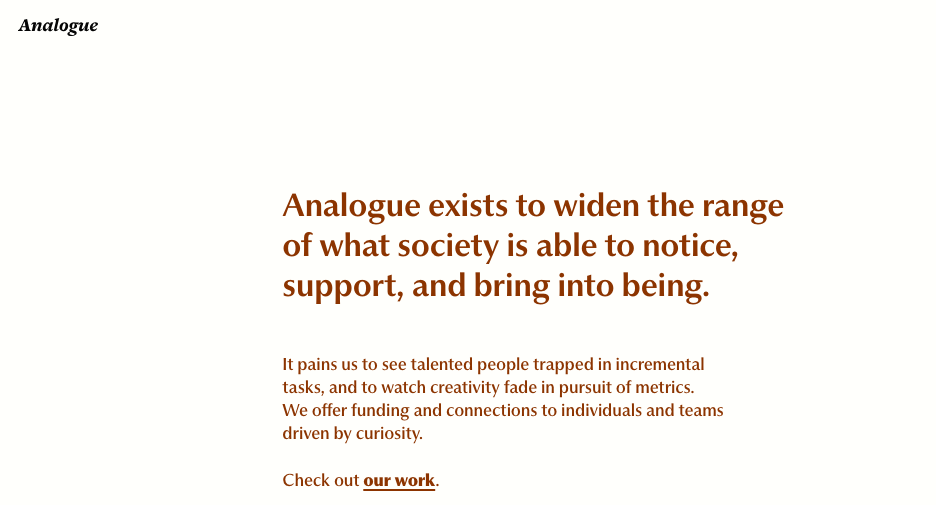
Discover new funding models for high-risk AI and scientific research outside traditional academic grants.
30-Second TL;DR
What Changed
Traditional scientific funding has become overly bureaucratic and risk-averse.
Why It Matters
This shift in funding models could accelerate breakthroughs in AI-driven life sciences and hardware, providing alternative pathways for researchers who don't fit the traditional grant-seeking mold.
What To Do Next
If you are a researcher in AI-bio, look into non-traditional funding sources like Convergent Research or scientific venture funds instead of standard government grants.
Key Points
- •Traditional scientific funding has become overly bureaucratic and risk-averse.
- •Private philanthropy should adopt venture capital models to support 'crazy' or non-mainstream ideas.
- •New organizations like Convergent Research are emerging to fill the gap between academia and market.
- •Focus on funding individuals and unconventional projects rather than established institutions.
Deep Insight
Background and context from public sources — not the original article. 17 sources cited.
Enhanced Key Takeaways
- •The application of AI and machine learning is emerging as a critical tool in scientific funding, with potential to identify high-risk, high-reward proposals, reduce systemic bias, and enhance transparency by flagging unconventional ideas often overlooked by traditional peer review processes.
- •Focused Research Organizations (FROs), exemplified by Convergent Research's model, are non-profit entities structured like startups, employing medium-to-large, tightly coordinated teams (10-30+ individuals) to tackle specific technical bottlenecks and produce public goods like tools, datasets, and infrastructure, rather than focusing on immediate publishable results or commercial profitability.
- •Venture philanthropy, which originated on Wall Street in the late 1980s, applies venture capital principles to philanthropic efforts, often involving equity stakes in companies or the creation of spin-off biotechs, and has shown particular success in accelerating drug development for rare diseases, such as the Cystic Fibrosis Foundation's efforts.
- •Historically, private philanthropy played a foundational role in scientific advancement, predating the widespread government funding that became prominent after World War II. Major foundations like Rockefeller and Carnegie were instrumental in supporting health research and even funded the initial conceptualization of 'artificial intelligence'.
- •Government agencies are beginning to adopt similar innovative funding models; for instance, the U.S. National Science Foundation (NSF) launched the $1.5 billion NSF X-Labs initiative to fund independent, milestone-based research teams focused on specific scientific challenges, reflecting a shift towards more agile and interdisciplinary approaches outside traditional academic grants.
Technical Deep Dive
- Focused Research Organizations (FROs) Model: FROs are non-profit organizations designed to address specific, complex technical problems or perform scientific research that falls outside the typical incentives of academic labs or commercial startups.
- Structure and Team: They operate with corporate-like structures and employ medium-to-large, full-time teams (typically 10-30+ engineers, scientists, and operators) from diverse backgrounds (academia, industry, government).
- Project Focus: FROs concentrate on well-defined, time-bound technical goals (3-7 years) with clear, quantifiable milestones. Their primary output is the creation of public goods, such as tools, datasets, and scientific infrastructure, rather than immediate publishable papers or profitable products.
- Funding and Incubation: Initial grants for FROs typically range from $20-50 million. Organizations like Convergent Research provide programmatic incubation, including scoping, technical roadmapping, operational planning, budgeting, and fundraising support.
- Post-Goal Evolution: Upon achieving their technical goals, FROs have several potential outcomes: they can evolve into more traditional non-profits, become perpetually endowed foundations, or transition into commercial entities through venture capital backing or licensing to for-profit companies.
- Addressing Bottlenecks: The model is specifically designed to overcome scientific bottlenecks that are too complex, cross-cutting, or infrastructure-heavy for traditional university labs or early-stage startups to tackle effectively.
Future ImplicationsAI analysis grounded in cited sources
Timeline
- 1980sConcept of venture philanthropy originates on Wall Street, applying venture capital principles to social problems.
- 1998Multiple Myeloma Research Foundation (MMRF) founded, becoming an early adopter of the venture philanthropy model in medical research.
- 2000Institute for Systems Biology established as a non-profit research organization, incubated with philanthropic funds, later spinning off 19 for-profit companies.
- 2008Workshop on 'Venture Philanthropy Strategies Used by Patient Organizations to Support Translational Research' held, highlighting growing interest in the model.
- 2017Foundation for Angelman Syndrome Therapeutics (FAST) launches GeneTx Biotherapeutics LLC, demonstrating a non-profit spinning out its own biotech.
- 2021Convergent Research founded by Eric Schmidt, Wendy Schmidt, and Ken Griffin, dedicated to incubating and funding Focused Research Organizations (FROs).
Sources (17)
Factual claims are grounded in the sources below. Forward-looking analysis is AI-generated interpretation.
Weekly AI Recap
Read this week's curated digest of top AI events →
AI-curated news aggregator. All content rights belong to original publishers.
Original source: 虎嗅 ↗
This is a summary, not the original. Read the source, or get the weekly briefing.
The weekly digest
One email a week. Unsubscribe anytime.