來源虎嗅•較早收集於 26m
瘋狂慈善:資助非主流科學
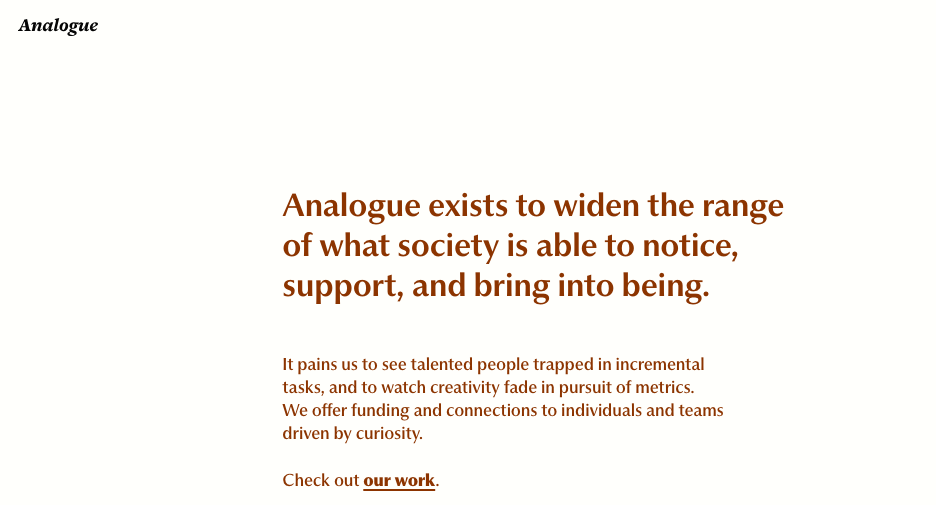
探索傳統學術撥款之外,針對高風險AI與科學研究的新型資助模式。
30 秒速覽
有什麼變化
傳統科學資助體系已變得過於官僚且規避風險。
為什麼重要
這種資助模式的轉變可能會加速AI驅動的生命科學與硬體領域的突破,為不符合傳統撥款模式的研究人員提供替代途徑。
下一步行動
如果您是AI-bio領域的研究人員,請考慮尋求Convergent Research或科學風險基金等非傳統資助來源,而非僅依賴標準政府撥款。
誰應關注:Researchers & Academics
關鍵要點
- •傳統科學資助體系已變得過於官僚且規避風險。
- •私人慈善應採用風險投資模式,以支持「瘋狂」或非主流的創意。
- •像Convergent Research這類新組織正在興起,以填補學術界與市場之間的空白。
- •重點應放在資助個人與非常規項目,而非既有機構。
深度解析
背景與延伸:來自公開資料,非原文內容。引用 17 個來源。
增強重點摘要
- •The application of AI and machine learning is emerging as a critical tool in scientific funding, with potential to identify high-risk, high-reward proposals, reduce systemic bias, and enhance transparency by flagging unconventional ideas often overlooked by traditional peer review processes.
- •Focused Research Organizations (FROs), exemplified by Convergent Research's model, are non-profit entities structured like startups, employing medium-to-large, tightly coordinated teams (10-30+ individuals) to tackle specific technical bottlenecks and produce public goods like tools, datasets, and infrastructure, rather than focusing on immediate publishable results or commercial profitability.
- •Venture philanthropy, which originated on Wall Street in the late 1980s, applies venture capital principles to philanthropic efforts, often involving equity stakes in companies or the creation of spin-off biotechs, and has shown particular success in accelerating drug development for rare diseases, such as the Cystic Fibrosis Foundation's efforts.
- •Historically, private philanthropy played a foundational role in scientific advancement, predating the widespread government funding that became prominent after World War II. Major foundations like Rockefeller and Carnegie were instrumental in supporting health research and even funded the initial conceptualization of 'artificial intelligence'.
- •Government agencies are beginning to adopt similar innovative funding models; for instance, the U.S. National Science Foundation (NSF) launched the $1.5 billion NSF X-Labs initiative to fund independent, milestone-based research teams focused on specific scientific challenges, reflecting a shift towards more agile and interdisciplinary approaches outside traditional academic grants.
技術深入
- Focused Research Organizations (FROs) Model: FROs are non-profit organizations designed to address specific, complex technical problems or perform scientific research that falls outside the typical incentives of academic labs or commercial startups.
- Structure and Team: They operate with corporate-like structures and employ medium-to-large, full-time teams (typically 10-30+ engineers, scientists, and operators) from diverse backgrounds (academia, industry, government).
- Project Focus: FROs concentrate on well-defined, time-bound technical goals (3-7 years) with clear, quantifiable milestones. Their primary output is the creation of public goods, such as tools, datasets, and scientific infrastructure, rather than immediate publishable papers or profitable products.
- Funding and Incubation: Initial grants for FROs typically range from $20-50 million. Organizations like Convergent Research provide programmatic incubation, including scoping, technical roadmapping, operational planning, budgeting, and fundraising support.
- Post-Goal Evolution: Upon achieving their technical goals, FROs have several potential outcomes: they can evolve into more traditional non-profits, become perpetually endowed foundations, or transition into commercial entities through venture capital backing or licensing to for-profit companies.
- Addressing Bottlenecks: The model is specifically designed to overcome scientific bottlenecks that are too complex, cross-cutting, or infrastructure-heavy for traditional university labs or early-stage startups to tackle effectively.
前景展望基於引用來源的 AI 分析
The venture philanthropy model will significantly accelerate the translation of basic scientific discoveries into practical applications and therapies.
By adopting venture capital principles, these philanthropic efforts can provide the agile, risk-tolerant, and milestone-driven funding necessary to bridge the 'Valley of Death' between academic research and commercial development, particularly for high-risk areas like rare diseases.
Artificial intelligence will become an indispensable tool for identifying and prioritizing unconventional, high-potential scientific research proposals.
AI's capacity to analyze vast scientific literature, detect subtle patterns, and mitigate human biases in peer review will enable funding bodies to more effectively discover and support groundbreaking ideas that might otherwise be overlooked by traditional evaluation methods.
Government funding agencies will increasingly integrate operational models inspired by venture philanthropy and Focused Research Organizations (FROs) into their own programs.
Recent initiatives like the NSF X-Labs demonstrate a growing recognition within public funding bodies of the need for more flexible, mission-oriented, and outcome-driven approaches to address complex scientific challenges, moving beyond traditional grant structures.
時間線
1980s
Concept of venture philanthropy originates on Wall Street, applying venture capital principles to social problems.
1998
Multiple Myeloma Research Foundation (MMRF) founded, becoming an early adopter of the venture philanthropy model in medical research.
2000
Institute for Systems Biology established as a non-profit research organization, incubated with philanthropic funds, later spinning off 19 for-profit companies.
2008
Workshop on 'Venture Philanthropy Strategies Used by Patient Organizations to Support Translational Research' held, highlighting growing interest in the model.
2017
Foundation for Angelman Syndrome Therapeutics (FAST) launches GeneTx Biotherapeutics LLC, demonstrating a non-profit spinning out its own biotech.
2021
Convergent Research founded by Eric Schmidt, Wendy Schmidt, and Ken Griffin, dedicated to incubating and funding Focused Research Organizations (FROs).
- 1980sConcept of venture philanthropy originates on Wall Street, applying venture capital principles to social problems.
- 1998Multiple Myeloma Research Foundation (MMRF) founded, becoming an early adopter of the venture philanthropy model in medical research.
- 2000Institute for Systems Biology established as a non-profit research organization, incubated with philanthropic funds, later spinning off 19 for-profit companies.
- 2008Workshop on 'Venture Philanthropy Strategies Used by Patient Organizations to Support Translational Research' held, highlighting growing interest in the model.
- 2017Foundation for Angelman Syndrome Therapeutics (FAST) launches GeneTx Biotherapeutics LLC, demonstrating a non-profit spinning out its own biotech.
- 2021Convergent Research founded by Eric Schmidt, Wendy Schmidt, and Ken Griffin, dedicated to incubating and funding Focused Research Organizations (FROs).
來源 (17)
Factual claims are grounded in the sources below. Forward-looking analysis is AI-generated interpretation.
1nih.govvertexaisearch.cloud.google.com2altum.comvertexaisearch.cloud.google.com3fas.orgvertexaisearch.cloud.google.com4wikipedia.orgvertexaisearch.cloud.google.com5vercel.appvertexaisearch.cloud.google.com6harvard.eduvertexaisearch.cloud.google.com7rarerevolutionmagazine.comvertexaisearch.cloud.google.com8nih.govvertexaisearch.cloud.google.com9issues.orgvertexaisearch.cloud.google.com10youtube.comvertexaisearch.cloud.google.com11fieldofscience.comvertexaisearch.cloud.google.com12cspo.orgvertexaisearch.cloud.google.com13lucas-harrington.comvertexaisearch.cloud.google.com14nsf.govvertexaisearch.cloud.google.com15nsf.govvertexaisearch.cloud.google.com16exponentphilanthropy.orgvertexaisearch.cloud.google.com17philanthropyroundtable.orgvertexaisearch.cloud.google.com
AI 週報
閱讀本週精選 AI 大事摘要 →
AI 策展新聞聚合。所有內容版權歸原始發布者所有。
原始來源: 虎嗅 ↗
每週電子報
每週一封,可隨時退訂。