Coval raises $28M to stress-test AI voice agents
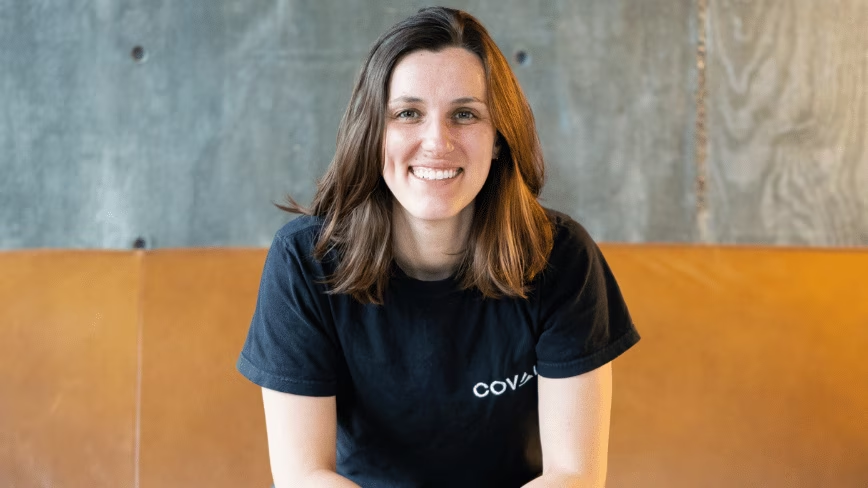
Learn how to prevent your AI voice agent from failing in production with new stress-testing methodologies.
30-Second TL;DR
What Changed
Raised $28M in funding for AI voice safety
Why It Matters
As voice agents move into production, reliability becomes the primary barrier to adoption. Coval's tools could become an industry standard for enterprise-grade voice AI deployment.
What To Do Next
If building voice agents, implement a rigorous 'red-teaming' phase for your conversational logic before going live.
Key Points
- •Raised $28M in funding for AI voice safety
- •Focuses on stress-testing agents before deployment
- •Founder brings experience from Waymo's self-driving safety systems
Deep Insight
AI-generated analysis for this event — not the original article.
Enhanced Key Takeaways
- •The $28 million Series A funding round was led by Insight Partners, with participation from existing investors including Amplify Partners.
- •Coval's platform utilizes a proprietary 'digital twin' simulation environment that mimics complex, high-latency, and noisy real-world telephony conditions.
- •The startup is specifically targeting the enterprise customer service sector, where AI voice agents often fail due to 'hallucination drift' during long-form conversations.
- •Coval's testing framework integrates directly into CI/CD pipelines, allowing developers to automatically trigger stress tests whenever a new voice model version is pushed.
- •The company's methodology draws heavily from 'adversarial testing' techniques used in autonomous vehicle validation to identify edge cases that standard unit tests miss.
Competitor Analysis
- Coval
- Voice Agent Stress Testing
- Cybench
- LLM Benchmarking
- Giskard
- AI Quality/Guardrails
- Coval
- CI/CD Integration
- Cybench
- API-based
- Giskard
- SDK/Platform
- Coval
- Enterprise Custom
- Cybench
- Tiered/Usage
- Giskard
- Open Source/Enterprise
| Feature | Coval | Cybench | Giskard |
|---|---|---|---|
| Primary Focus | Voice Agent Stress Testing | LLM Benchmarking | AI Quality/Guardrails |
| Deployment | CI/CD Integration | API-based | SDK/Platform |
| Pricing | Enterprise Custom | Tiered/Usage | Open Source/Enterprise |
Technical Deep Dive
- Employs a multi-modal evaluation engine that analyzes both audio signal quality (jitter, latency, packet loss) and semantic coherence.
- Uses adversarial prompt injection techniques to test the robustness of voice agents against jailbreaking and prompt injection attacks.
- Implements a feedback loop that converts failed voice interactions into synthetic training data to fine-tune the client's underlying LLM.
- Supports integration with major voice frameworks including Twilio, Vapi, and Retell AI.
Future ImplicationsAI analysis grounded in cited sources
Timeline
- 2024-03Coval founded by former Waymo engineers focusing on AI safety.
- 2024-09Company completes seed funding round to build initial simulation engine.
- 2025-05Coval launches beta platform for enterprise voice AI developers.
- 2026-06Coval secures $28 million Series A funding to scale operations.
Weekly AI Recap
Read this week's curated digest of top AI events →
Related Updates

AI-curated news aggregator. All content rights belong to original publishers.
Original source: The Next Web (TNW) ↗
This is a summary, not the original. Read the source, or get the weekly briefing.
The weekly digest
One email a week. Unsubscribe anytime.