Copilot Evolves into Autonomous Office Agent
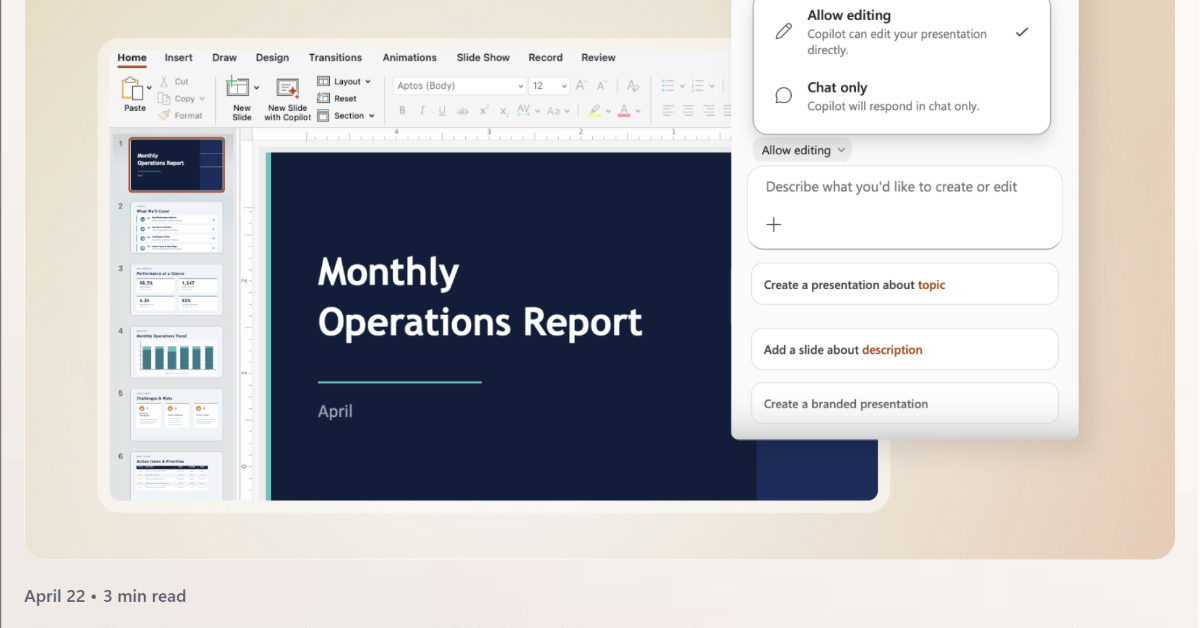
💡Copilot now autonomously edits Office files—unlock 10x productivity gains for devs in teams.
⚡ 30-Second TL;DR
What Changed
Copilot now directly operates within files for autonomous task execution
Why It Matters
This upgrade could significantly boost productivity for enterprise users by automating routine Office tasks, reducing manual effort. It positions Microsoft as a leader in agentic AI for productivity suites, potentially influencing competitors.
What To Do Next
Enable the new Copilot agent in Microsoft 365 Word and test autonomous drafting on a sample document.
Key Points
- •Copilot now directly operates within files for autonomous task execution
- •Handles drafting documents, data analysis, and slide updates automatically
- •Evolves from passive responder to managed 'practical collaborator'
🧠 Deep Insight
AI-generated analysis for this event — not the original article.
🔑 Enhanced Key Takeaways
- •The transition utilizes a new 'Agentic Orchestrator' framework that allows Copilot to maintain state across multi-step workflows, moving beyond the stateless request-response paradigm of previous LLM integrations.
- •Microsoft has introduced 'Agent Governance' controls, enabling IT administrators to set specific guardrails and data access permissions for autonomous agents, addressing enterprise concerns regarding shadow AI and data leakage.
- •The autonomous capabilities are powered by a hybrid model architecture that combines GPT-4o with specialized, smaller 'Action Models' optimized for low-latency execution of UI-based tasks within the Microsoft 365 ecosystem.
📊 Competitor Analysis▸ Show
| Feature | Microsoft Copilot Agents | Google Gemini for Workspace | Anthropic Claude (Projects) |
|---|---|---|---|
| Primary Focus | Deep M365 integration & automation | Real-time collaboration & data synthesis | Complex reasoning & long-context analysis |
| Agentic Capability | High (In-app task execution) | Moderate (Workflow automation) | Low (Primarily chat-based) |
| Pricing | Per-user/month (M365 add-on) | Per-user/month (Google Workspace add-on) | Usage-based (API/Pro) |
| Benchmarks | High enterprise task completion | High search/synthesis accuracy | High reasoning/coding accuracy |
🛠️ Technical Deep Dive
- Agentic Orchestrator: A middleware layer that decomposes complex user prompts into a directed acyclic graph (DAG) of sub-tasks.
- Action Models: Lightweight, fine-tuned models trained specifically on M365 UI interaction patterns to minimize hallucination during file manipulation.
- State Management: Persistent session memory that allows agents to track document versions and user feedback loops across multiple editing sessions.
- Security Layer: Integration with Microsoft Purview to ensure that autonomous actions respect existing sensitivity labels and data loss prevention (DLP) policies.
🔮 Future ImplicationsAI analysis grounded in cited sources
⏳ Timeline
Weekly AI Recap
Read this week's curated digest of top AI events →
👉Related Updates

AI-curated news aggregator. All content rights belong to original publishers.
Original source: ITmedia AI+ (日本) ↗
This is a summary, not the original. Read the source, or get the weekly briefing.
The weekly digest
One email a week. Unsubscribe anytime.