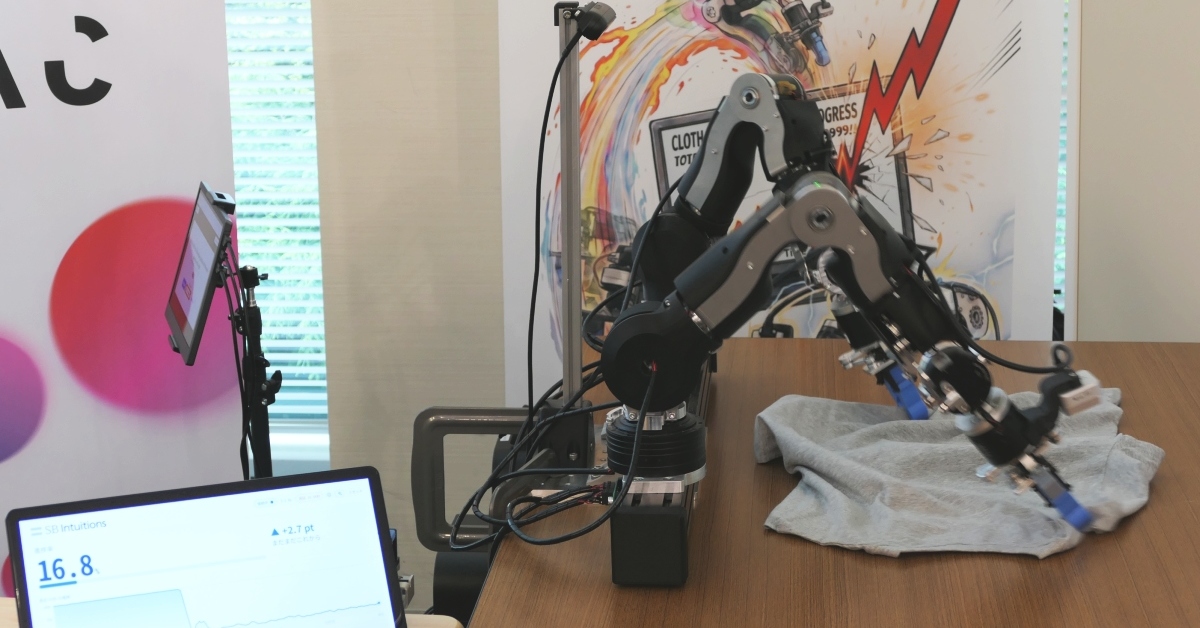
COBALT platform enables remote robot control via smartphone

💡A major step in embodied AI, making complex robot control as simple as using a smartphone app.
⚡ 30-Second TL;DR
What Changed
Developed by Georgia Tech researchers.
Why It Matters
This lowers the barrier to entry for teleoperation, potentially accelerating the deployment of robots in non-industrial settings. It bridges the gap between consumer mobile devices and physical robotics.
What To Do Next
If you are building robotics software, investigate how to integrate mobile sensor APIs to create intuitive, no-code control interfaces.
Key Points
- •Developed by Georgia Tech researchers.
- •Uses smartphone motion controls for real-time robot manipulation.
- •Removes coding barriers for remote robotics operation.
🧠 Deep Insight
AI-generated analysis for this event — not the original article.
🔑 Enhanced Key Takeaways
- •COBALT is a cloud-based teleoperation framework designed to make robot learning accessible and scalable, supporting concurrent operation by multiple users on a single GPU, significantly reducing data collection costs. [4, 6, 9]
- •The platform leverages vectorized environments and a load-balanced, GPU-accelerated infrastructure, enabling dozens of simultaneous users at 20 Hz with sub-100 ms end-to-end latency for up to 8 concurrent users per GPU. [4, 6, 9]
- •Beyond smartphones, COBALT supports various input devices, including dual smartphones for bimanual control, VR headsets, 3D mice, and standard keyboards, and has been used to crowdsource over 50 hours of high-quality robot demonstration data from nine countries in five days. [4, 7, 9]
- •The system aims to revolutionize policy training data collection, which is crucial for advancing robotic capabilities, by enabling a 'gig economy' where people could remotely operate assistive robots for household chores, akin to 'Uber for robots'. [3, 5]
- •COBALT builds upon earlier work by Assistant Professor Animesh Garg, who, ten years prior, developed RoboTurk at Stanford University, an initial version focused on large-scale data collection for robot production. [3, 5]
🛠️ Technical Deep Dive
- Architecture: Cloud-based, scalable, and modular platform. [6, 7]
- Input Devices: Supports single or dual smartphones (Android/iOS), VR headsets, 3D mice, and keyboards. [4, 7, 9]
- Connectivity: Utilizes a secure Wi-Fi connection to a server, with data carried over Web Real-Time Communication (WebRTC) for low-latency video streaming and control. [3, 5, 6]
- Scalability: Leverages vectorized environments and a load-balanced, GPU-accelerated infrastructure. [4, 6, 9]
- Performance: Achieves dozens of concurrent users at 20 Hz with sub-100 ms end-to-end latency for up to 8 concurrent users per GPU. Demonstrated stable operation supporting 256 simulated clients across 8 GPUs. [4, 6, 9]
- Data Handling: Employs an in-memory data cache and efficient video streaming to maintain synchronous control and rendering. [4, 6, 9]
- Simulation Frameworks: Supports Isaac Lab, robosuite, and LIBERO. [7]
- Data Quality: Incorporates a structured training curriculum for novice operators and a suite of real-time performance metrics to automatically filter low-quality demonstrations. [4, 7, 9]
🔮 Future ImplicationsAI analysis grounded in cited sources
⏳ Timeline
Weekly AI Recap
Read this week's curated digest of top AI events →
👉Related Updates
AI-curated news aggregator. All content rights belong to original publishers.
Original source: Digital Trends ↗
This is a summary, not the original. Read the source, or get the weekly briefing.
The weekly digest
One email a week. Unsubscribe anytime.