Claude Memory Now Spans Chats and Cowork
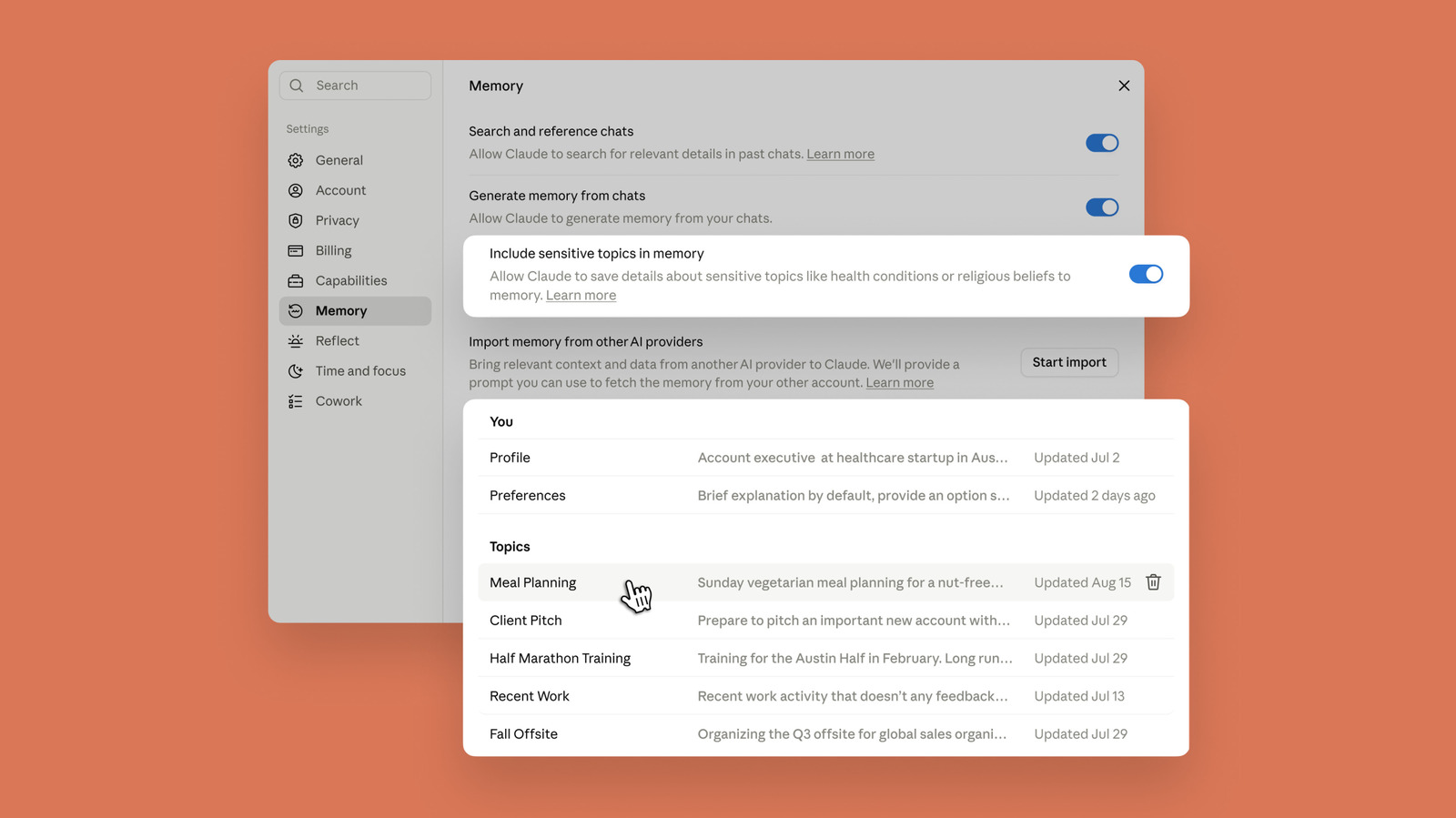
💡Claude can now carry context between chats and Cowork, with more control over saved memory.
⚡ 30-Second TL;DR
What Changed
Claude memory now works across chats and Cowork sessions.
Why It Matters
Cross-session memory can reduce repetitive context-setting for developers and teams using Claude over extended workflows. User controls are also important for privacy, data governance, and preventing unwanted personalization.
What To Do Next
Test Claude memory across a chat-to-Cowork workflow and review which saved memories your team permits before enabling it broadly.
Key Points
- •Claude memory now works across chats and Cowork sessions.
- •Anthropic is adding user controls for saved memories.
- •The update aims to make context more consistent across different Claude workflows.
🧠 Deep Insight
Background and context from public sources — not the original article. 11 sources cited.
🔑 Enhanced Key Takeaways
- •The unified memory system operates in real-time, updating Claude's knowledge base dynamically during interactions rather than relying on post-session summarization.
- •Anthropic has implemented a 'sensitive topics' toggle that allows users to opt-in to storing personal data like religious or political beliefs, which are excluded by default.
- •The system enforces hard-coded privacy guardrails that prevent the storage of high-risk data such as government IDs, financial account numbers, and immigration status, regardless of user settings.
- •The feature is deployed across the entire Claude ecosystem, including web, desktop, and mobile platforms, for all account tiers including Free, Pro, and Max.
- •The memory integration is not retroactive; it only begins capturing and unifying context from the moment the update was deployed, leaving previous chat history isolated.
📊 Competitor Analysis▸ Show
| Feature | Claude (Unified Memory) | ChatGPT (Memory) | Gemini (Gems/Memory) |
|---|---|---|---|
| Cross-Agent Persistence | Yes (Chat + Cowork) | Limited (Chat-focused) | Limited (Gems-focused) |
| Sensitive Data Guardrails | Hard-coded exclusions | Policy-based | Policy-based |
| Real-time Updates | Yes | Yes | Yes |
| Pricing | Free/Pro/Max | Free/Plus/Team | Free/Advanced |
🛠️ Technical Deep Dive
- The architecture utilizes a persistent state layer that bridges the conversational interface and the agentic execution environment of Claude Cowork.
- Memory entries are indexed as discrete, editable objects accessible via a centralized settings management interface.
- The system employs a dual-gate privacy filter: a default exclusion list for sensitive categories and a secondary hard-coded blocklist for high-risk PII (Personally Identifiable Information).
- The implementation relies on a state-synchronization protocol that ensures context parity across disparate client platforms (web, desktop, mobile).
🔮 Future ImplicationsAI analysis grounded in cited sources
⏳ Timeline
📎 Sources (11)
Factual claims are grounded in the sources below. Forward-looking analysis is AI-generated interpretation.
Weekly AI Recap
Read this week's curated digest of top AI events →
👉Related Updates

AI-curated news aggregator. All content rights belong to original publishers.
Original source: Engadget ↗
This is a summary, not the original. Read the source, or get the weekly briefing.
Weekly AI briefing
One email a week. Unsubscribe anytime.