Chinese Startup Spirit AI Outperforms Nvidia in Global Ranking
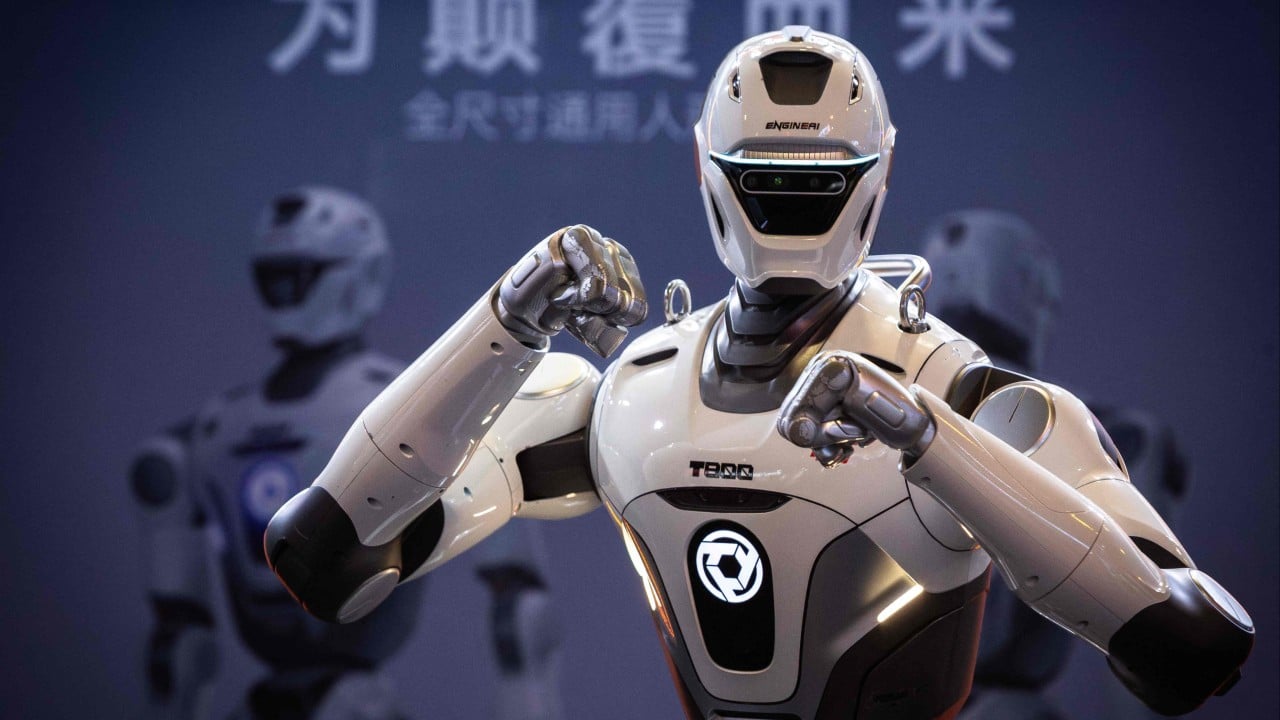
💡A Chinese startup is challenging Nvidia in the critical race for embodied AI brains. See how they compare.
⚡ 30-Second TL;DR
What Changed
Spirit AI launched a new foundation model designed for physical robotics.
Why It Matters
This breakthrough suggests that Chinese firms are rapidly closing the gap in embodied AI, potentially challenging U.S. dominance in robotics hardware and software integration.
What To Do Next
Monitor Spirit AI's technical whitepapers to compare their architectural approach to Nvidia's Cosmos 3 for your own robotics projects.
Key Points
- •Spirit AI launched a new foundation model designed for physical robotics.
- •The startup outperformed Nvidia's Cosmos 3 model in specific global AI rankings.
- •The competition marks a shift toward 'embodied AI' as the next major tech battleground.
🧠 Deep Insight
Background and context from public sources — not the original article. 14 sources cited.
🔑 Enhanced Key Takeaways
- •Hangzhou-based Spirit AI, founded in February 2024, rapidly secured nearly 200 million yuan in angel round financing within four months, underscoring significant investor confidence in its specialized team and its objective to develop a 'universal brain' for robotics.
- •Spirit AI's 'Spirit v1.6' model achieved its superior ranking by specifically outperforming Nvidia's Cosmos 3 on the RoboArena leaderboard, a critical benchmark designed to evaluate robot strategies and task completion in real-world physical environments, rather than solely in simulations.
- •Nvidia's competing Cosmos 3, launched on June 1, 2026, is an open world foundation model built on a Mixture-of-Transformers (MoT) architecture, and is offered in two main variants: Cosmos 3 Nano (16 billion parameters) for efficient inference and Cosmos 3 Super (64 billion parameters) for maximum capability.
- •The global embodied AI market is projected for substantial growth, with its size estimated at $3.22 billion in 2025 and expected to reach $7.24 billion by 2030, while China's domestic embodied AI market alone is anticipated to exceed US$146 billion by 2035.
- •The intensifying competition in embodied AI is partly fueled by global labor shortages and demographic trends, with China strategically focusing on rapid deployment and efficiency improvements in AI applications, even as it navigates U.S. export controls on advanced AI chips.
📊 Competitor Analysis▸ Show
| Feature/Metric | Spirit AI (Spirit v1.6) | Nvidia (Cosmos 3) |
|---|---|---|
| Model Type | Foundation model for robotics | Open world foundation model for physical AI |
| Architecture | (Not explicitly detailed in search, but demonstrated real-world performance) | Mixture-of-Transformers (MoT) architecture, combining autoregressive and diffusion transformers |
| Key Capabilities | Real-world task completion, including 'seeing, judging, grabbing, and placing' | Vision reasoning, world generation, action prediction, multimodal generation (text, image, video, audio, actions), synthetic data generation |
| Parameters | (Not specified in search results) | Cosmos 3 Nano: 16B parameters; Cosmos 3 Super: 64B parameters |
| Deployment | (Not specified, but demonstrated real-world performance) | Cosmos 3 Nano: workstation-grade compute (NVIDIA RTX PRO 6000 GPU); Cosmos 3 Super: datacenter deployment (NVIDIA Hopper and Blackwell GPUs); Cosmos 3 Edge (forthcoming) for real-time inference |
| RoboArena Ranking | Global top spot (outperformed Cosmos 3) | Ranked first among open models on major global rankings before Spirit v1.6 update, then overtaken on RoboArena |
| Other Benchmarks | Spirit v1.5 won RoboChallenge real-machine evaluation | Leads on Artificial Analysis, Physics-IQ, PAI-Bench, R-Bench, RoboLab, VANTAGE-Bench, TAR (among open models) |
| Open Source | (Not explicitly stated for Spirit v1.6) | Fully open omnimodel, open-sourcing models, training scripts, deployment tools, and datasets |
🛠️ Technical Deep Dive
- Nvidia Cosmos 3 Architecture: Built on a Mixture-of-Transformers (MoT) architecture, comprising two complementary transformer towers: an autoregressive transformer for discrete token generation (e.g., text) and a diffusion transformer for continuous multimodal generation (e.g., images, video, audio, actions).
- Nvidia Cosmos 3 Modalities: Capable of native vision reasoning and multimodal generation across text, image, video, ambient sound, and physical actions.
- Nvidia Cosmos 3 Output: Can generate physically plausible video sequences, support synthetic data workflows, and produce numerical action data such as joint angles, gripper positions, and trajectory points for robot control.
- Nvidia Cosmos 3 Variants:
- Cosmos 3 Nano: Features 16 billion parameters, optimized for efficient inference, and designed for workstation-grade compute (e.g., NVIDIA RTX PRO 6000 GPU) for real-time robotics applications.
- Cosmos 3 Super: Contains 64 billion parameters, engineered for maximum quality and capability, targeting datacenter deployment on NVIDIA Hopper and Blackwell GPUs for large-scale synthetic data generation and advanced physical reasoning.
- Cosmos 3 Edge: A forthcoming variant specifically designed for real-time inference at the edge.
- RoboArena Evaluation Mechanism: Employs distributed collaboration to expand task and environment coverage, uses double-blind duels to minimize subjective biases, features an Elo-style dynamic ranking system for continuous leaderboard updates, and provides an open evaluation network for testing models in real-world scenarios.
🔮 Future ImplicationsAI analysis grounded in cited sources
⏳ Timeline
📎 Sources (14)
Factual claims are grounded in the sources below. Forward-looking analysis is AI-generated interpretation.
Weekly AI Recap
Read this week's curated digest of top AI events →
👉Related Updates

AI-curated news aggregator. All content rights belong to original publishers.
Original source: SCMP Technology ↗
This is a summary, not the original. Read the source, or get the weekly briefing.
The weekly digest
One email a week. Unsubscribe anytime.