Chinese EVs enter Canadian market via dealer networks
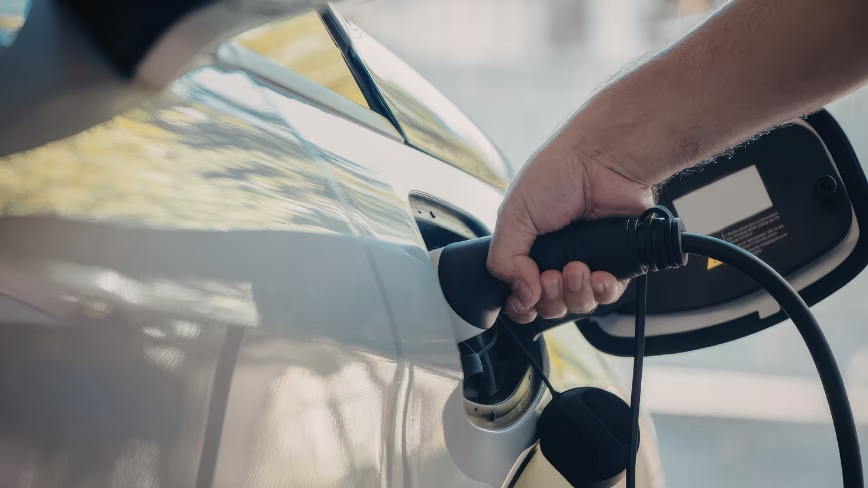
Global EV market expansion impacting smart cabin and autonomous driving software adoption.
30-Second TL;DR
What Changed
Chinese EVs are officially entering the Canadian automotive market.
Why It Matters
The entry of Chinese EVs into North America signals a shift in the global competitive landscape for autonomous driving and smart cabin technologies.
What To Do Next
Research the software stacks (e.g., smart cockpit OS) used by Chinese EV manufacturers for potential integration opportunities.
Key Points
- •Chinese EVs are officially entering the Canadian automotive market.
- •Nearly 400 dealerships are vying for distribution rights.
- •Early feedback highlights superior material quality compared to expectations.
Deep Insight
Background and context from public sources — not the original article. 24 sources cited.
Enhanced Key Takeaways
- •The market entry is a direct result of a new Canada-China trade agreement finalized in January 2026, which significantly reduced tariffs on Chinese-built EVs from 100% to 6.1% for an annual quota of 49,000 vehicles, set to rise to 70,000 by 2030.
- •Key Chinese automakers like BYD, Chery, and Geely are actively establishing their presence, with BYD planning 20 sales locations in 2026 and Chery aiming for 10 dealerships by late June 2026.
- •The initial wave of imports includes both luxury models, such as Geely's Lotus Eletre SUV, and upcoming mass-market vehicles like BYD's Seagull (estimated around C$25,000) and Atto 3 (around C$42,000).
- •Tesla has already capitalized on the reduced tariffs by introducing its Shanghai-built Model 3 Premium RWD in Canada at a sharply lower price of C$39,490, intensifying market competition.
- •Canada is actively pursuing strategic partnerships for local EV manufacturing with Chinese companies, with BYD reportedly considering building a factory in the country to reduce dependence on the U.S.
Competitor Analysis
- BYD Seagull (Est. Canada)
- City hatchback
- BYD Atto 3 (Est. Canada)
- Compact SUV
- Chery Omoda 5 EV (Est. Canada)
- Sporty Compact Crossover
- Tesla Model 3 Premium RWD (Shanghai-built, Canada)
- Midsize Sedan
- Lotus Eletre (Canada)
- Luxury SUV
- BYD Seagull (Est. Canada)
- ~C$25,000
- BYD Atto 3 (Est. Canada)
- ~C$42,000
- Chery Omoda 5 EV (Est. Canada)
- ~C$37,000
- Tesla Model 3 Premium RWD (Shanghai-built, Canada)
- C$39,490
- Lotus Eletre (Canada)
- C$119,900
- BYD Seagull (Est. Canada)
- N/A
- BYD Atto 3 (Est. Canada)
- 345-420 km
- Chery Omoda 5 EV (Est. Canada)
- N/A
- Tesla Model 3 Premium RWD (Shanghai-built, Canada)
- 463 km
- Lotus Eletre (Canada)
- N/A
- BYD Seagull (Est. Canada)
- N/A
- BYD Atto 3 (Est. Canada)
- N/A
- Chery Omoda 5 EV (Est. Canada)
- N/A
- Tesla Model 3 Premium RWD (Shanghai-built, Canada)
- 5.2 seconds
- Lotus Eletre (Canada)
- N/A
- BYD Seagull (Est. Canada)
- N/A
- BYD Atto 3 (Est. Canada)
- 49.9 kWh or 60.48 kWh Blade
- Chery Omoda 5 EV (Est. Canada)
- N/A
- Tesla Model 3 Premium RWD (Shanghai-built, Canada)
- N/A
- Lotus Eletre (Canada)
- N/A
- BYD Seagull (Est. Canada)
- N/A
- BYD Atto 3 (Est. Canada)
- 88 kW (30-80% in 29 min)
- Chery Omoda 5 EV (Est. Canada)
- N/A
- Tesla Model 3 Premium RWD (Shanghai-built, Canada)
- N/A
- Lotus Eletre (Canada)
- N/A
| Feature/Model | BYD Seagull (Est. Canada) | BYD Atto 3 (Est. Canada) | Chery Omoda 5 EV (Est. Canada) | Tesla Model 3 Premium RWD (Shanghai-built, Canada) | Lotus Eletre (Canada) |
|---|---|---|---|---|---|
| Type | City hatchback | Compact SUV | Sporty Compact Crossover | Midsize Sedan | Luxury SUV |
| Est. Price (CAD) | ~C$25,000 | ~C$42,000 | ~C$37,000 | C$39,490 | C$119,900 |
| Range (WLTP/Est.) | N/A | 345-420 km | N/A | 463 km | N/A |
| 0-100 km/h | N/A | N/A | N/A | 5.2 seconds | N/A |
| Battery | N/A | 49.9 kWh or 60.48 kWh Blade | N/A | N/A | N/A |
| Charging (DC) | N/A | 88 kW (30-80% in 29 min) | N/A | N/A | N/A |
Technical Deep Dive
- BYD e-Platform 3.0: A modular platform designed for electric vehicles, utilized by models like the BYD Atto 3.
- BYD Blade Battery: Features lithium-iron-phosphate (LFP) chemistry, known for its enhanced safety, durability, and thermal stability.
- Nio Battery Swap Technology: Offers a unique solution for quick battery exchanges, aiming to alleviate range anxiety and reduce charging times.
- XPeng SEPA 2.0 Platform: A software-centric platform that supports over-the-air (OTA) updates and modular battery management, potentially allowing for software-limited battery capacities to meet specific market price points.
- XPeng Tianji OS: An AI-powered operating system that integrates intelligent cockpit features and advanced smart driving systems.
- Advanced Driver-Assistance Systems (ADAS): Nio's ES8 model incorporates 'Aquila super sensing,' powered by four Nvidia Orin chips, to provide sophisticated environmental perception for enhanced safety features.
- 800V Architecture: Featured in some Geely-owned brands like Polestar 5 and Nio models, enabling ultra-fast charging capabilities.
Future ImplicationsAI analysis grounded in cited sources
Timeline
- 2024-10Canada imposed 100% tariff on Chinese EVs.
- 2026-01Canada-China trade agreement announced, reducing tariffs to 6.1% for a quota of 49,000 EVs.
- 2026-02-05Canada announced new automotive industry strategy, including EV affordability program and strategic partnerships with China.
- 2026-03-01New tariff regime took effect; import permit applications opened.
- 2026-05-06Geely (Lotus) shipped first batch of Eletre SUVs to Canada.
- 2026-05Tesla launched Shanghai-built Model 3 Premium RWD in Canada at C$39,490.
Sources (24)
Factual claims are grounded in the sources below. Forward-looking analysis is AI-generated interpretation.
Weekly AI Recap
Read this week's curated digest of top AI events →
Related Updates


AI-curated news aggregator. All content rights belong to original publishers.
Original source: The Next Web (TNW) ↗
This is a summary, not the original. Read the source, or get the weekly briefing.
The weekly digest
One email a week. Unsubscribe anytime.