China's Tech Giants Deploy AI for 618 Shopping Festival
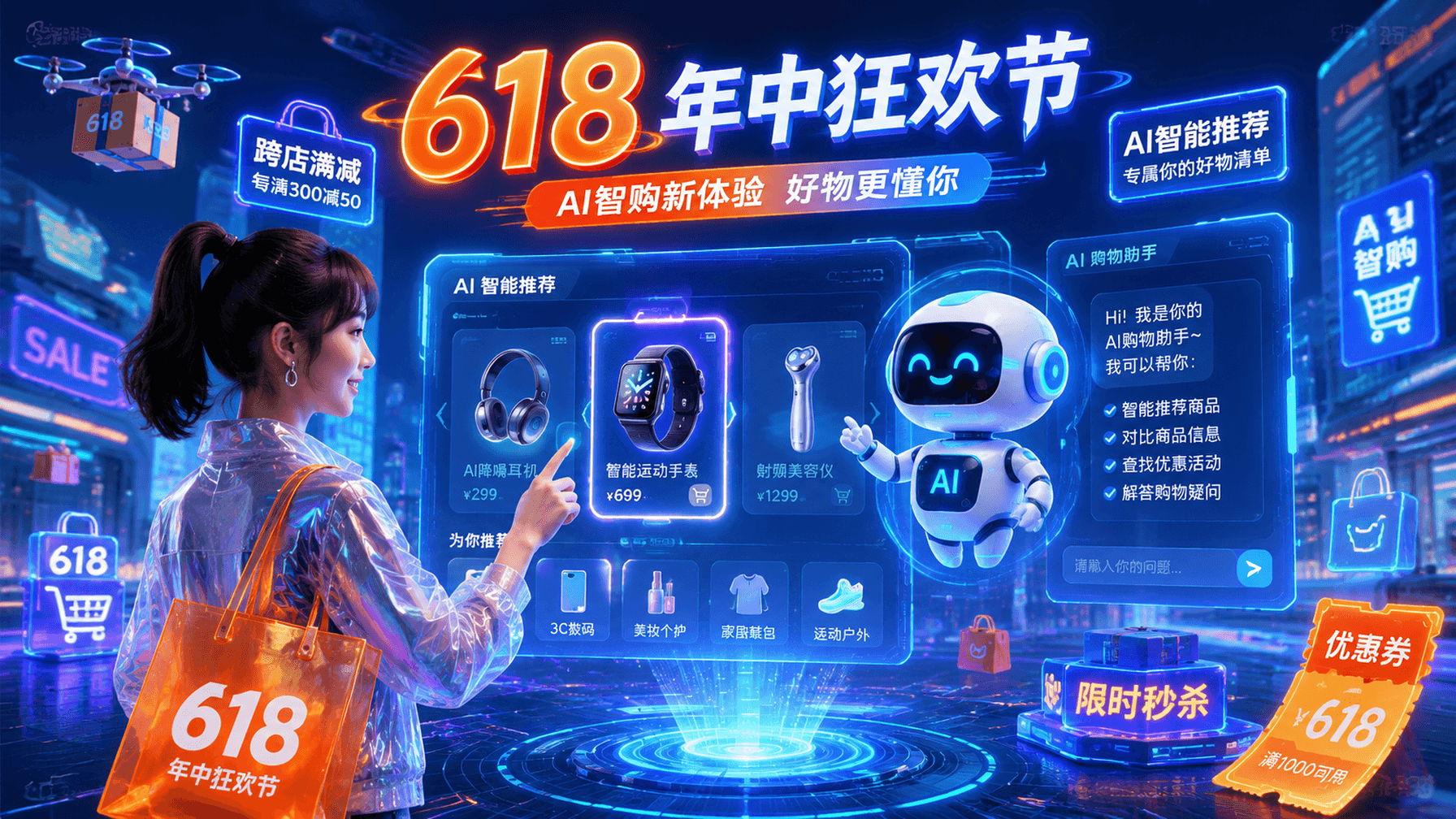
💡Discover how AI is transforming large-scale e-commerce operations during China's biggest shopping event.
⚡ 30-Second TL;DR
What Changed
AI digital hosts are being deployed for 24/7 live-streamed sales.
Why It Matters
The widespread adoption of these tools demonstrates the maturity of AI in high-concurrency e-commerce environments, setting a new standard for retail operations.
What To Do Next
Analyze the performance of AI digital hosts during 618 to evaluate the ROI of generative video in retail.
Key Points
- •AI digital hosts are being deployed for 24/7 live-streamed sales.
- •Smart logistics algorithms are optimizing delivery routes and warehouse management during peak traffic.
- •AI-driven shopping assistants are providing personalized product recommendations to consumers.
🧠 Deep Insight
Background and context from public sources — not the original article. 29 sources cited.
🔑 Enhanced Key Takeaways
- •The 2026 618 festival marks a significant shift from traditional search-based e-commerce to "conversational commerce," where AI assistants like Alibaba's Qwen and ByteDance's Doubao enable users to complete entire shopping processes, from product discovery to payment, within a chat interface.
- •Beyond consumer-facing applications, AI is deeply integrated into merchant operations, with platforms offering tools for AI-generated product content (images, videos, livestreaming scripts), optimized marketing placement, business diagnostics, and customer service, significantly reducing operational costs and enhancing efficiency for over a million merchants.
- •The 618 festival has become a battleground for distinct AI commerce strategies, with Alibaba building a direct bridge between its AI and commerce platforms, ByteDance integrating AI within its retail ecosystem, and Tencent positioning WeChat as an orchestration layer for third-party AI-callable services, including JD.com.
- •Smart logistics AI systems, such as JD.com's "Super Brain Large Model," are now covering over 1,000 core supply chain scenarios, utilizing algorithms like Genetic Algorithms, Ant Colony Optimization, and Neural Networks to optimize warehouse management, routing, and demand forecasting, leading to reported reductions in delivery times and costs.
- •AI-driven personalization extends beyond product recommendations to dynamic pricing, customized app layouts, and real-time offer adjustments based on behavioral loyalty, shopping recency, and device type, aiming to create highly individualized shopping journeys.
📊 Competitor Analysis▸ Show
| Feature/Platform | Alibaba (Qwen/Taobao/Tmall) | ByteDance (Doubao/Douyin) | JD.com (JoyAI/JD AI) | Tencent (WeChat AI Ecosystem) |
|---|---|---|---|---|
| AI Assistant Integration | Fully integrated Qwen with Taobao/Tmall for conversational search, comparison, ordering, and payment. | Doubao chatbot connected to Douyin's e-commerce for in-app payment, product comparison, and "Help Me Choose" feature. | Launched standalone "JD AI" app and integrated AI across consumer experiences and industrial operations. | Opened WeChat's AI ecosystem to outside developers, turning Mini Program services into AI-callable capabilities. |
| Core Strategy | Direct bridge between AI layer and commerce platform, willing to cannibalize existing ad model. | Sealed AI inside its own retail ecosystem, focusing on content engagement and social commerce. | Deeply integrated AI across retail, logistics, healthcare, and merchant operations, with a focus on supply chain and industrial services. | Orchestration layer above partners, not trying to own product catalog or fulfillment stack. |
| Merchant Enablement | AI tools like Quanzhantui for performance optimization, "Image-to-Video" for content generation, and AI shopping assistant for price calculation. | Douyin offers intelligent production tools for short videos and product images, free AI customer service to reduce labor costs (up to 70%). | AI directly participates in business diagnostics, merchandising, marketing, livestreaming conversion, customer service, and after-sales support for over a million merchants. | Provides a framework for third-party services to become callable skills for a future WeChat AI agent. |
| Logistics AI | Leverages machine learning for demand forecasting during peak events. | (Not explicitly detailed in search results for 618 logistics, but generally uses AI for content recommendation and user engagement) | "Super Brain Large Model" covers over 1,000 core supply chain scenarios, optimizing routes, warehousing, and inventory. | (Not directly involved in logistics fulfillment, relies on partners like JD.com) |
| User Base (AI Chatbot) | Qwen had 166 million monthly active users as of Q1 2026. | Doubao had 345 million monthly active users as of March 2026. | JD.com's AI shopping assistant, Jingyan, accumulated over 50 million users by May 2026. | WeChat has 1.3 billion monthly active users, with AI agent capabilities being built in. |
🛠️ Technical Deep Dive
- Alibaba:
- Qwen: Flagship AI assistant, a large language model (LLM) integrated with Taobao and Tmall.
- E-commerce Brain: Processes billions of data points daily for hyper-personalized product feeds.
- Deep-learning models: Developed by Damo Academy for real-time product recommendations, analyzing browsing duration, click-through patterns, historical purchases, and time-of-day activity.
- Image-to-Video tool: Generates promotional videos for merchants.
- JD.com:
- JoyAI (formerly Yanxi): Full-stack AI solution with models ranging from 3B to 750B parameters, covering language, speech, image, video, and digital humans.
- JoyInside: AI agent for smart hardware, expanding into AI-enabled home products.
- JD Cloud's K-PLUG (Knowledge-injected Pre-trained Language Model for Natural Language Understanding and Generation in E-Commerce): Used for generating livestreaming scripts and extracting product details.
- JoyAgent 2.0: Proprietary intelligent agent for commercial queries, with over 14,000 internal instances.
- Logistics "Super Brain Large Model": Covers over 1,000 core supply chain scenarios, including intelligent location, intelligent routing, and commodity layout.
- Logistics Algorithms: Utilizes Genetic Algorithms (GA), Ant Colony Optimization (ACO), and Neural Networks (NN) for route optimization, demand forecasting, and warehouse management.
- ByteDance:
- Doubao: AI chatbot with 345 million monthly active users, integrated with Douyin's e-commerce platform.
- Seedance: Video model, part of ByteDance's AI portfolio.
- Vision-Language-Action (VLA) models: Explored for world models, combining visual perception, language understanding, and action planning.
- General AI in E-commerce:
- AI-enabled search tools for product selection.
- Generative AI for product content generation.
- Machine learning for real-time product recommendations and behavioral clustering.
- Dynamic pricing engines adjusting based on user profiles, demand, and inventory.
- AI-powered chatbots for customer support.
🔮 Future ImplicationsAI analysis grounded in cited sources
⏳ Timeline
📎 Sources (29)
Factual claims are grounded in the sources below. Forward-looking analysis is AI-generated interpretation.
- hellochinatech.com
- biggo.com
- chinadaily.com.cn
- jdcorporateblog.com
- businessinsider.com
- manilatimes.net
- jingdaily.com
- 36kr.com
- cgtn.com
- fieam.org
- ieee.org
- intexsoft.com
- ashleydudarenok.com
- sidecar.ai
- ashleydudarenok.com
- umbrex.com
- dimsumdaily.hk
- johanhanekom.com
- medium.com
- thenextweb.com
- iosrjournals.org
- itiger.com
- jingdaily.com
- jdcorporateblog.com
- kucoin.com
- kr-asia.com
- asianews.network
- futunn.com
- ai.cc
Weekly AI Recap
Read this week's curated digest of top AI events →
👉Related Updates

AI-curated news aggregator. All content rights belong to original publishers.
Original source: Pandaily ↗
This is a summary, not the original. Read the source, or get the weekly briefing.
Weekly AI briefing
One email a week. Unsubscribe anytime.