China’s New $110K Robot Trainer Career
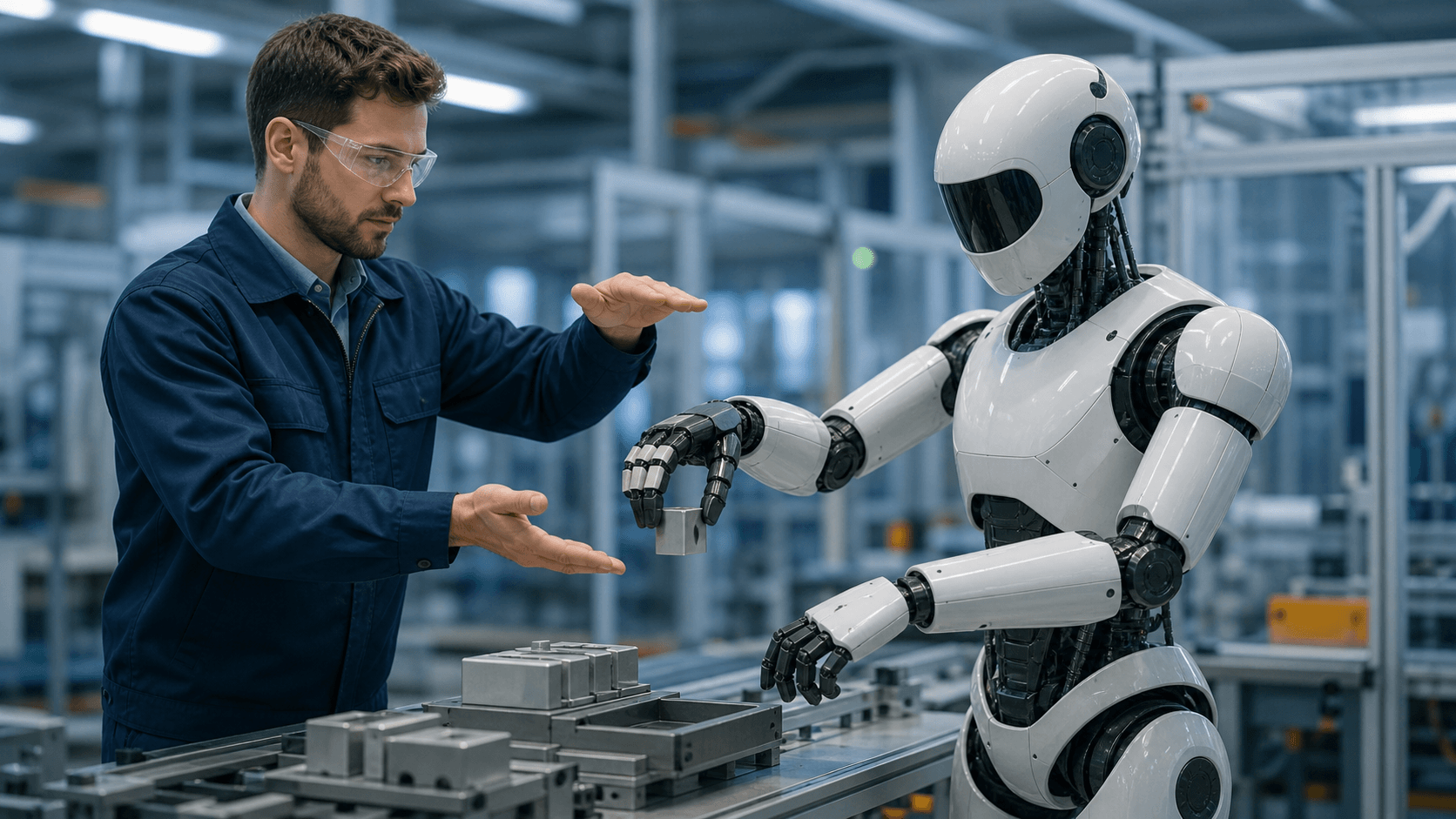
A new six-figure robotics role signals where embodied-AI implementation bottlenecks—and hiring demand—are emerging.
30-Second TL;DR
What Changed
The Chinese Ministry of Human Resources and Social Security plans to formally recognize the occupation.
Why It Matters
The emergence of a formally recognized, highly paid robotics role suggests that embodied-AI adoption is creating specialized implementation jobs beyond traditional software engineering. Robotics startups and enterprise adopters may need to invest earlier in deployment, data-collection, and operator-training teams.
What To Do Next
Create an embodied-AI data-collection and labeling pipeline, then identify which robot deployment tasks require dedicated application technicians.
Key Points
- •The Chinese Ministry of Human Resources and Social Security plans to formally recognize the occupation.
- •Reported annual salaries already range from 500,000 to 800,000 yuan.
- •The role emerged within roughly three years, highlighting the rapid commercialization of embodied AI.
- •Demand is growing for workers who can apply, train, and deploy robots in real-world settings.
Deep Insight
AI-generated analysis for this event — not the original article.
Enhanced Key Takeaways
- •The Ministry of Human Resources and Social Security (MHRSS) identified this role as part of a broader initiative to standardize 19 new professional categories, including intelligent manufacturing and digital technology roles.
- •The 'Robot Trainer' role specifically focuses on data annotation for embodied AI, reinforcement learning from human feedback (RLHF), and fine-tuning motion control models to bridge the gap between simulation and reality (Sim2Real).
- •Industry experts note that the high salary range is driven by a severe talent shortage, as the position requires a hybrid skill set combining mechanical engineering, software development, and behavioral psychology.
- •Major Chinese tech hubs, particularly in Shenzhen and Beijing, are establishing specialized vocational training programs to certify these technicians, moving beyond traditional academic degrees.
- •The role is distinct from traditional industrial robot maintenance, as it involves teaching robots to perform non-repetitive, complex tasks in unstructured environments like households or service sectors.
Technical Deep Dive
- Data Collection and Annotation: Technicians utilize VR/AR interfaces to teleoperate robots, capturing high-fidelity human motion data to train imitation learning models.
- Sim2Real Transfer: Implementation of domain randomization techniques where technicians adjust environmental variables in digital twins to ensure robot policies generalize to physical settings.
- Reward Function Engineering: Technicians define and refine reward signals for reinforcement learning agents to optimize task completion efficiency and safety.
- Model Fine-tuning: Application of transformer-based architectures for embodied AI, where technicians curate datasets to improve the robot's semantic understanding of natural language commands and physical object manipulation.
Future ImplicationsAI analysis grounded in cited sources
Timeline
- 2024-07MHRSS releases the first draft of new digital-era occupations for public comment.
- 2025-03Initial pilot programs for embodied AI technician training emerge in Shenzhen's robotics industrial parks.
- 2026-05MHRSS officially includes 'Embodied AI Robot Application Technician' in the national occupation catalog.
Weekly AI Recap
Read this week's curated digest of top AI events →
Related Updates




AI-curated news aggregator. All content rights belong to original publishers.
Original source: Pandaily ↗
This is a summary, not the original. Read the source, or get the weekly briefing.
The weekly digest
One email a week. Unsubscribe anytime.