China's Net Recovery Path for Reusable Rockets
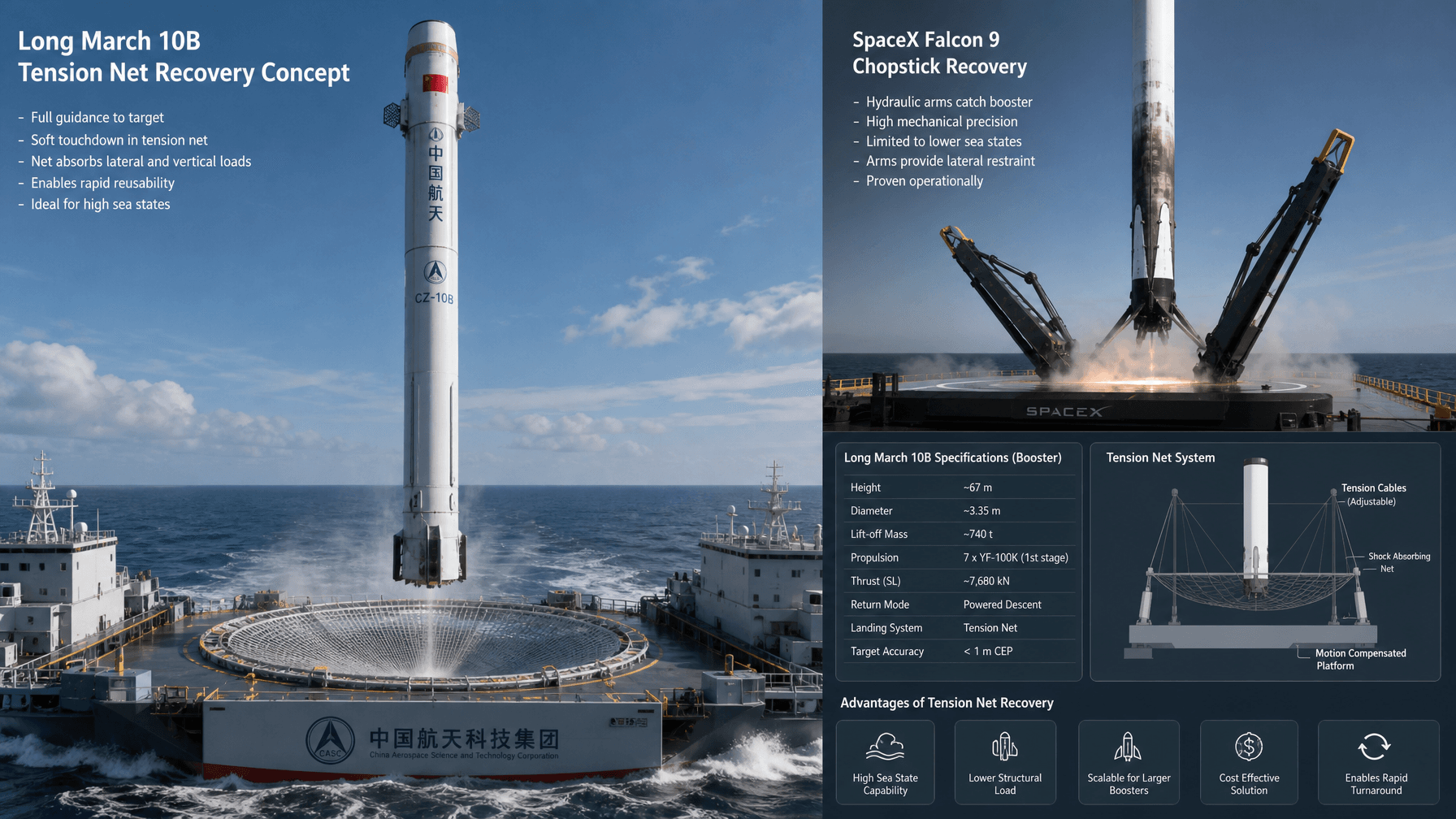
💡A novel approach to rocket recovery that prioritizes flexible, software-driven capture over rigid mechanical hardware.
⚡ 30-Second TL;DR
What Changed
Utilizes a flexible net capture system instead of rigid mechanical arms
Why It Matters
This development signals a diversification in aerospace engineering strategies, potentially lowering the barrier for reusable rocket technology by prioritizing software-defined capture precision over massive mechanical infrastructure.
What To Do Next
Research the control algorithms behind flexible capture systems to understand how sensor fusion and real-time trajectory adjustment are applied in high-stakes robotics.
Key Points
- •Utilizes a flexible net capture system instead of rigid mechanical arms
- •Designed for higher error tolerance during high-speed booster descent
- •Focuses on gentler handling to extend the lifespan of reusable rocket components
🧠 Deep Insight
AI-generated analysis for this event — not the original article.
🔑 Enhanced Key Takeaways
- •The net-based recovery concept is being explored by Chinese aerospace entities as a potential solution for mid-air retrieval of smaller rocket stages or fairings, distinct from the heavy-lift booster recovery methods used by SpaceX.
- •Research into flexible capture systems in China often involves high-strength synthetic fibers and dynamic tension-control mechanisms designed to absorb kinetic energy upon impact.
- •This recovery method is being evaluated as a cost-effective alternative to propulsive landing, which requires significant fuel reserves that reduce payload capacity.
- •Chinese aerospace engineers are investigating the use of autonomous drone-ship or barge-based net systems that utilize real-time trajectory correction to align with the descending booster.
- •The development of net-based recovery is part of a broader Chinese strategy to diversify reusable launch vehicle technologies, including grid-fin control and retro-propulsion landing tests.
📊 Competitor Analysis▸ Show
| Feature | SpaceX (Mechazilla) | China Net Recovery (Proposed) | Rocket Lab (Mid-Air) |
|---|---|---|---|
| Capture Method | Mechanical 'Chopstick' Arms | Flexible Net/Tension System | Helicopter/Parachute Hook |
| Primary Target | Super Heavy Booster | Small/Medium Launchers | Electron Booster |
| Mechanical Stress | High (Rigid Contact) | Low (Energy Absorption) | Moderate (Tension Loads) |
| Operational Status | Active/Proven | Conceptual/Experimental | Retired (Shifted to Splashdown) |
🛠️ Technical Deep Dive
- System utilizes high-tensile, heat-resistant polymer netting designed to distribute impact loads across a wide surface area.
- Employs active tensioning winches that adjust net geometry in milliseconds based on booster descent velocity and wind shear data.
- Integration of computer vision systems on the recovery platform to track the booster's center of gravity during the final seconds of descent.
- Focuses on minimizing the 'hard-dock' shock that typically causes structural fatigue in reusable airframes.
🔮 Future ImplicationsAI analysis grounded in cited sources
⏳ Timeline
Weekly AI Recap
Read this week's curated digest of top AI events →
👉Related Updates


AI-curated news aggregator. All content rights belong to original publishers.
Original source: Pandaily ↗
This is a summary, not the original. Read the source, or get the weekly briefing.
The weekly digest
One email a week. Unsubscribe anytime.