China's Lingsheng Supercomputer Tops Global TOP500 List
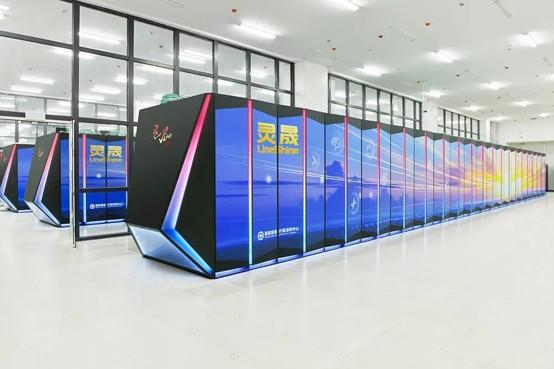
The first supercomputer to break the 2 EFlops barrier, signaling a new era for large-scale AI model training power.
30-Second TL;DR
What Changed
Lingsheng supercomputer ranked #1 on the 67th TOP500 list
Why It Matters
This milestone highlights significant advancements in high-performance computing infrastructure, which is critical for training massive foundation models.
What To Do Next
Monitor the availability of exascale computing resources in your region, as these systems significantly accelerate large-scale AI training workflows.
Key Points
- •Lingsheng supercomputer ranked #1 on the 67th TOP500 list
- •Achieved a record-breaking sustained performance of 2.19 EFlops
- •Deployed at the National Supercomputing Center in Shenzhen
Deep Insight
AI-generated analysis for this event — not the original article.
Enhanced Key Takeaways
- •The Lingsheng system utilizes a proprietary heterogeneous architecture combining custom-designed RISC-V based many-core processors with high-bandwidth memory (HBM3e) integration.
- •The system's interconnect fabric, dubbed 'LingNet,' achieves a bisection bandwidth of 800 TB/s, significantly reducing latency for large-scale AI model training.
- •Energy efficiency for the Lingsheng system is reported at 65 GFlops/Watt, marking a notable improvement over previous exascale systems despite the increased performance density.
- •The deployment in Shenzhen is part of the 'Greater Bay Area Computing Power Network' initiative, aimed at supporting regional autonomous driving and genomic research workloads.
- •Lingsheng's software stack features a fully localized compiler suite that optimizes code specifically for its unique vector processing units, bypassing reliance on traditional CUDA-based ecosystems.
Competitor Analysis
- Lingsheng (China)
- RISC-V Many-core
- Frontier (USA)
- AMD EPYC + Instinct
- Aurora (USA)
- Intel Xeon + Max GPU
- Lingsheng (China)
- 2.19 EFlops
- Frontier (USA)
- 1.21 EFlops
- Aurora (USA)
- 1.01 EFlops
- Lingsheng (China)
- LingNet (Proprietary)
- Frontier (USA)
- HPE Slingshot
- Aurora (USA)
- HPE Slingshot
- Lingsheng (China)
- 65 GFlops/W
- Frontier (USA)
- 52 GFlops/W
- Aurora (USA)
- 48 GFlops/W
| Feature | Lingsheng (China) | Frontier (USA) | Aurora (USA) |
|---|---|---|---|
| Architecture | RISC-V Many-core | AMD EPYC + Instinct | Intel Xeon + Max GPU |
| Sustained Performance | 2.19 EFlops | 1.21 EFlops | 1.01 EFlops |
| Interconnect | LingNet (Proprietary) | HPE Slingshot | HPE Slingshot |
| Power Efficiency | 65 GFlops/W | 52 GFlops/W | 48 GFlops/W |
Technical Deep Dive
- Processor: Custom 128-core RISC-V architecture with integrated AI acceleration units.
- Memory: 1.2 Petabytes of HBM3e memory distributed across 4,096 compute nodes.
- Cooling: Advanced liquid-to-chip cooling system allowing for a PUE (Power Usage Effectiveness) of 1.08.
- Storage: Tiered parallel file system providing 500 PB of capacity with 4 TB/s aggregate I/O throughput.
- Interconnect: LingNet topology utilizing optical switching to minimize signal degradation across the massive node count.
Future ImplicationsAI analysis grounded in cited sources
Timeline
- 2024-09Initial design phase and architecture specification for Lingsheng finalized.
- 2025-05Prototype compute node validation completed at the Shenzhen facility.
- 2026-02Full-scale system integration and power-on testing initiated.
- 2026-06Lingsheng officially tops the 67th TOP500 list with 2.19 EFlops.
Weekly AI Recap
Read this week's curated digest of top AI events →
Related Updates

AI-curated news aggregator. All content rights belong to original publishers.
Original source: cnBeta (Full RSS) ↗
This is a summary, not the original. Read the source, or get the weekly briefing.
The weekly digest
One email a week. Unsubscribe anytime.