China’s Humanoid Robots Face the Scale Test
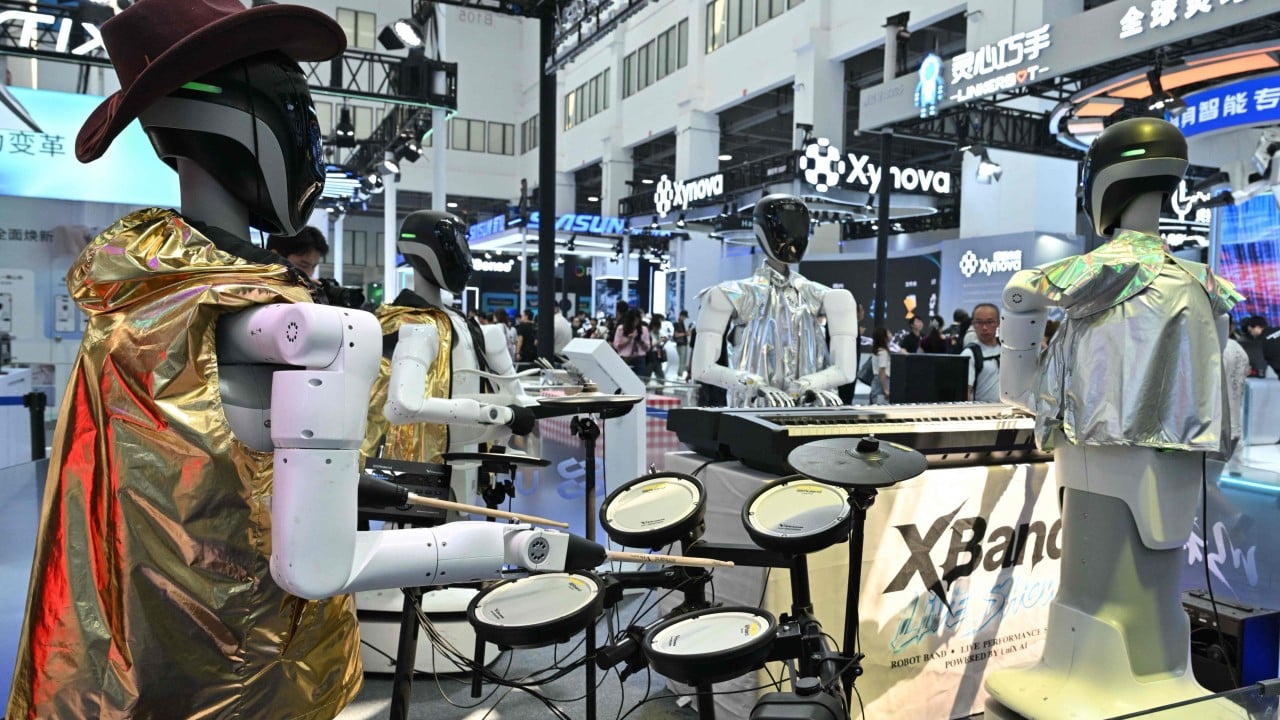
💡China’s humanoid robot boom is moving from viral demos to the harder challenge of reliable commercial scale.
⚡ 30-Second TL;DR
What Changed
Humanoid robots demonstrated dexterity through table tennis and drum performances.
Why It Matters
For AI and robotics founders, the competitive advantage may shift from flashy demos to reliability, unit economics, manufacturing capacity, and deployable software. Teams building embodied AI systems should prepare to prove performance in repeatable real-world workflows rather than one-off conference scenarios.
What To Do Next
Use ROS 2 and a simulator to benchmark one humanoid manipulation workflow across repeatability, latency, safety, and cost before committing to a hardware pilot.
Key Points
- •Humanoid robots demonstrated dexterity through table tennis and drum performances.
- •High-profile demonstrations have helped China’s robotics sector attract global attention and substantial capital.
- •Executives, investors, and policymakers now view the industry as being at a critical juncture focused on scaling beyond spectacle.
- •The key challenge is converting technical demonstrations into commercially viable robotic products.
🧠 Deep Insight
AI-generated analysis for this event.
🔑 Enhanced Key Takeaways
- •The Chinese government has integrated humanoid robotics into its 'New Productive Forces' economic strategy, aiming to establish mass production capabilities by 2027.
- •Supply chain localization is a major hurdle, with manufacturers struggling to source high-torque density actuators and specialized harmonic reducers domestically at scale.
- •Leading Chinese humanoid firms are increasingly adopting end-to-end neural network architectures, moving away from traditional rule-based control systems to improve adaptability in unstructured environments.
- •The Ministry of Industry and Information Technology (MIIT) has launched a national humanoid robot innovation center in Beijing to standardize testing protocols and safety benchmarks.
- •Cost reduction targets for Chinese humanoid units are set at sub-$20,000 price points to compete with industrial automation solutions in automotive assembly lines.
📊 Competitor Analysis▸ Show
| Feature | Chinese Humanoids (e.g., Unitree, Fourier) | Tesla Optimus | Figure AI |
|---|---|---|---|
| Primary Focus | Industrial/Manufacturing | Mass Consumer/Factory | General Purpose/Logistics |
| Architecture | Modular/Open-source focus | Integrated FSD-based | Foundation Model-driven |
| Target Price | $15k - $30k | <$20k (projected) | Premium/Enterprise |
| Key Benchmark | High dexterity (table tennis) | High autonomy (factory tasks) | Human-like reasoning |
🛠️ Technical Deep Dive
- Actuation: Utilization of quasi-direct drive (QDD) actuators to achieve high torque-to-weight ratios and back-drivability for safe human-robot interaction.
- Perception: Integration of multi-modal sensor fusion combining LiDAR, depth cameras, and tactile skin sensors for precise object manipulation.
- Control: Transition to Whole-Body Control (WBC) frameworks combined with Reinforcement Learning (RL) policies trained in high-fidelity physics simulators like Isaac Gym.
- Power: Adoption of high-energy-density lithium-ion battery packs designed for 2-4 hours of continuous operation under heavy load.
🔮 Future ImplicationsAI analysis grounded in cited sources
⏳ Timeline
Weekly AI Recap
Read this week's curated digest of top AI events →
👉Related Updates


AI-curated news aggregator. All content rights belong to original publishers.
Original source: SCMP Technology ↗