China’s Health Plan Bets on AI and Innovation
China’s next five-year health strategy points AI builders toward datasets, clinical pilots, and real reimbursement.
30-Second TL;DR
What Changed
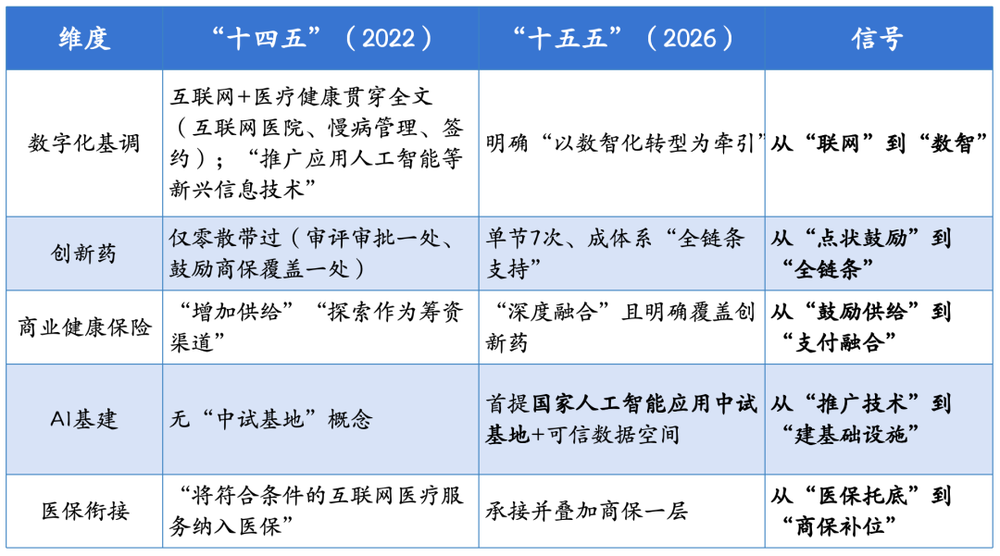
The policy language shifts from building internet healthcare to deploying AI across healthcare systems.
Why It Matters
The plan could shift China’s healthcare AI competition from algorithm development toward data access, clinical validation, workflow integration, and reimbursement. Builders that can prove measurable value in primary care or connect AI products to trusted healthcare data infrastructure may gain an early market advantage.
What To Do Next
Prototype a primary-care AI workflow using de-identified clinical data, and define clinical, operational, and reimbursement metrics before seeking a pilot partnership.
Key Points
- •The policy language shifts from building internet healthcare to deploying AI across healthcare systems.
- •Innovative drugs are mentioned seven times, with support spanning R&D, approvals, clinical evaluation, hospital use, and reimbursement.
- •National healthcare AI pilot bases will support clinical validation, data testing, standards, and commercialization.
- •Primary-care AI applications and commercial insurance coverage for innovative drugs are highlighted as practical adoption channels.
Deep Insight
AI-generated analysis for this event — not the original article.
Enhanced Key Takeaways
- •The 15th Five-Year Plan emphasizes 'Data Sovereignty' by mandating that all healthcare AI training datasets must be processed within state-approved 'Trusted Data Spaces' to ensure compliance with the Data Security Law.
- •The plan introduces a 'Fast-Track Reimbursement' mechanism specifically for AI-driven diagnostic tools, allowing them to be billed under existing medical service codes if they meet specific clinical accuracy thresholds.
- •Government subsidies are shifting away from general hospital IT upgrades toward 'Edge-AI' hardware deployment, specifically targeting rural and primary-care clinics to reduce the digital divide.
- •A new national regulatory framework for 'Algorithmic Accountability' in healthcare is being established, requiring AI models to undergo mandatory bias testing against diverse ethnic and regional demographic datasets.
- •The policy explicitly encourages Public-Private Partnerships (PPPs) to fund the construction of 'Clinical Pilot Bases,' where tech companies provide the infrastructure in exchange for exclusive access to anonymized, high-quality longitudinal patient data.
Technical Deep Dive
- Focus on Federated Learning architectures to enable model training across decentralized hospital nodes without moving raw patient data.
- Implementation of standardized 'Data Desensitization' protocols to ensure HIPAA-equivalent privacy compliance within the Chinese regulatory context.
- Integration of multimodal Large Language Models (LLMs) capable of processing Electronic Health Records (EHR), medical imaging (DICOM), and genomic data simultaneously.
- Deployment of 'Human-in-the-loop' (HITL) verification layers where AI diagnostic suggestions must be validated by a licensed physician before clinical action is taken.
Future ImplicationsAI analysis grounded in cited sources
Timeline
- 2021-0314th Five-Year Plan emphasizes digital transformation and internet-based healthcare services.
- 2023-07National Health Commission releases guidelines on the ethical management of AI in medical settings.
- 2025-12Completion of preliminary pilot programs for AI-assisted diagnostic tools in Tier-1 cities.
- 2026-03Official release of the 15th Five-Year Health Plan outlining the shift toward AI-integrated infrastructure.
Weekly AI Recap
Read this week's curated digest of top AI events →
AI-curated news aggregator. All content rights belong to original publishers.
Original source: 虎嗅 ↗
This is a summary, not the original. Read the source, or get the weekly briefing.
The weekly digest
One email a week. Unsubscribe anytime.