China's Embodied AI Sector Sees 93.5B RMB Investment Surge
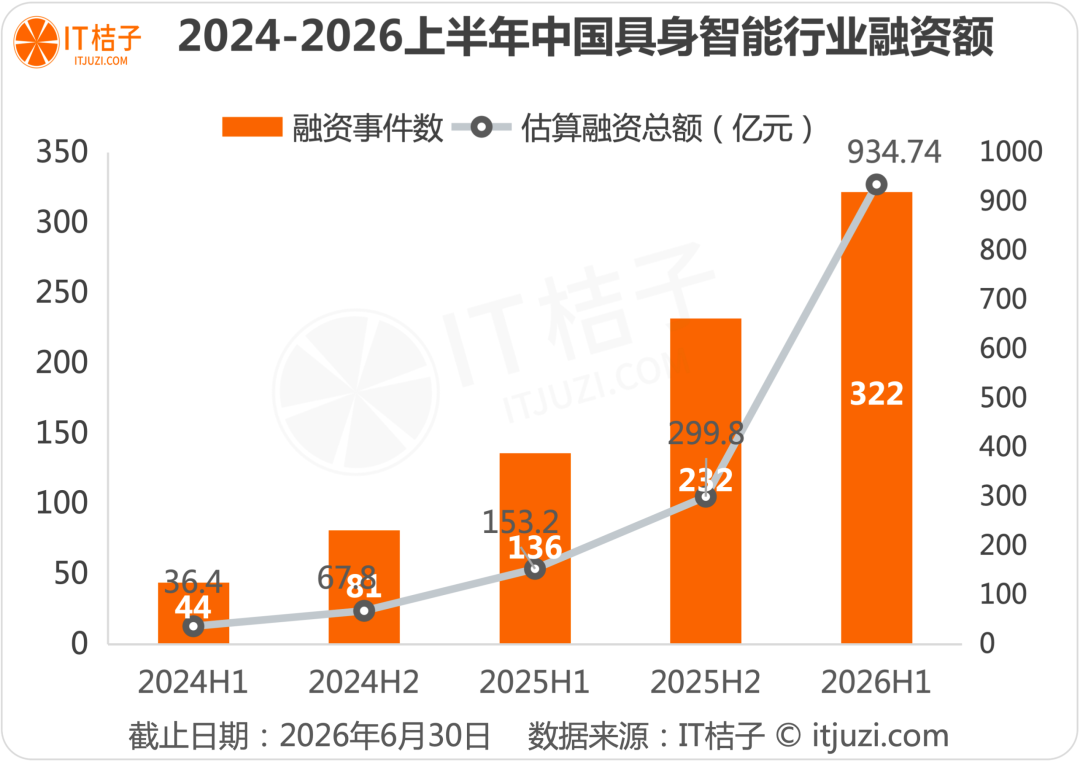
Understand the investment trends and core technology focus driving China's 93.5B RMB embodied AI boom.
30-Second TL;DR
What Changed
H1 2026 funding reached 93.5 billion RMB, a 5x increase year-over-year.
Why It Matters
The massive capital injection signals a rapid transition from technical validation to industrial-scale production for embodied AI in China. This will likely accelerate the commercialization of humanoid robots in manufacturing and service sectors.
What To Do Next
Monitor the technical stack of top-funded startups like Galaxy General or Starbot to identify emerging standards in embodied AI control systems.
Key Points
- •H1 2026 funding reached 93.5 billion RMB, a 5x increase year-over-year.
- •Beijing, Shenzhen, and Shanghai account for over 79% of total funding.
- •Capital is shifting toward humanoid robots, embodied AI brains, and specialized hardware like sensors and actuators.
- •Top-tier VC firms like Sequoia China are leading the investment, with a focus on both early-stage startups and scaling leaders.
Deep Insight
AI-generated analysis for this event — not the original article.
Enhanced Key Takeaways
- •The surge is largely driven by the 'Embodied AI Action Plan' released by the Ministry of Industry and Information Technology (MIIT) in early 2026, which provides tax incentives and R&D subsidies for domestic robot manufacturers.
- •A significant portion of the 93.5 billion RMB is being directed toward the development of 'General Purpose Robot Foundation Models' (GRFM) that aim to unify control across different hardware form factors.
- •State-owned enterprises (SOEs) and local government guidance funds have contributed approximately 40% of the total capital, signaling a shift toward state-led industrial policy in the robotics sector.
- •Supply chain localization efforts have intensified, with a specific focus on reducing reliance on imported harmonic drives and high-torque density motors, which previously accounted for 60% of BOM costs.
- •The investment trend shows a pivot from pure software-based AI startups to 'hardware-software integrated' entities, with investors requiring proof of deployment in industrial manufacturing environments before Series B funding.
Technical Deep Dive
- Development of multi-modal large models that integrate visual-language-action (VLA) architectures to enable zero-shot task generalization in unstructured environments.
- Implementation of sim-to-real transfer learning techniques using high-fidelity physics engines like NVIDIA Isaac Sim and domestic alternatives to accelerate training cycles.
- Integration of tactile sensing arrays using MEMS technology to improve dexterity in fine-motor manipulation tasks.
- Adoption of distributed control architectures where the 'AI brain' handles high-level reasoning while edge-based microcontrollers manage low-latency motor feedback loops.
Future ImplicationsAI analysis grounded in cited sources
Timeline
- 2023-11MIIT releases the 'Guiding Opinions on the Innovation and Development of Humanoid Robots'.
- 2024-05Beijing Humanoid Robot Innovation Center is established as the first provincial-level innovation center for the sector.
- 2025-01First large-scale deployment of domestic humanoid robots in automotive assembly lines in Shanghai.
- 2026-02Government announces the 'Embodied AI Action Plan' to accelerate industrial integration.
Weekly AI Recap
Read this week's curated digest of top AI events →
Related Updates

AI-curated news aggregator. All content rights belong to original publishers.
Original source: 虎嗅 ↗
This is a summary, not the original. Read the source, or get the weekly briefing.
The weekly digest
One email a week. Unsubscribe anytime.