來源虎嗅•較早收集於 6m
中國具身智能產業半年獲935億元資本狂歡
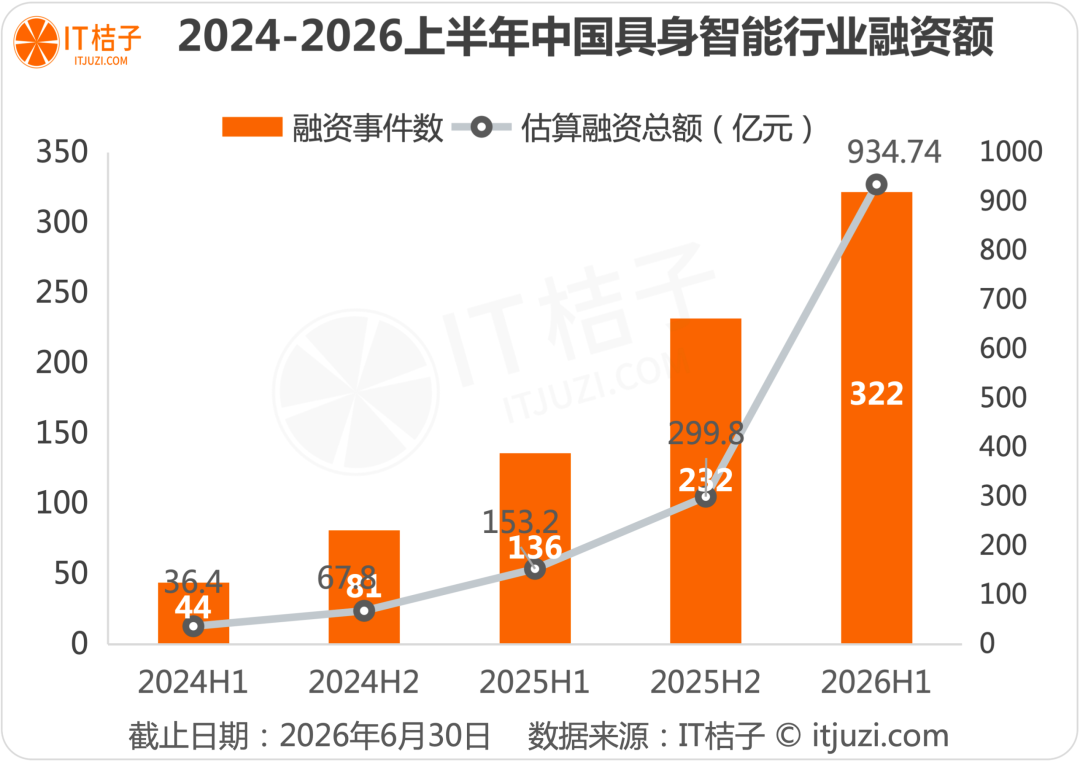
深入了解驅動中國935億元具身智能熱潮的投資趨勢與核心技術布局。
30 秒速覽
有什麼變化
2026年上半年融資額達935億元,同比增長5倍。
為什麼重要
大規模資本注入標誌著中國具身智能產業正從技術驗證加速邁向工業化量產,將顯著推動人形機器人在製造與服務領域的商業化進程。
下一步行動
密切關注如銀河通用或星動紀元等獲投企業的技術棧,以識別具身智能控制系統的行業新標準。
誰應關注:Founders & Product Leaders
關鍵要點
- •2026年上半年融資額達935億元,同比增長5倍。
- •北京、深圳、上海三地融資總額佔全國近80%。
- •資本重倉人形機器人、具身智能大腦及傳感器等核心零部件。
- •紅杉中國等頂級VC領投,覆蓋從早期孵化到規模化擴張的全階段。
關鍵數字40%60%935億
深度解析
本篇為 AI 生成分析,非原文內容。
增強重點摘要
- •The surge is largely driven by the 'Embodied AI Action Plan' released by the Ministry of Industry and Information Technology (MIIT) in early 2026, which provides tax incentives and R&D subsidies for domestic robot manufacturers.
- •A significant portion of the 93.5 billion RMB is being directed toward the development of 'General Purpose Robot Foundation Models' (GRFM) that aim to unify control across different hardware form factors.
- •State-owned enterprises (SOEs) and local government guidance funds have contributed approximately 40% of the total capital, signaling a shift toward state-led industrial policy in the robotics sector.
- •Supply chain localization efforts have intensified, with a specific focus on reducing reliance on imported harmonic drives and high-torque density motors, which previously accounted for 60% of BOM costs.
- •The investment trend shows a pivot from pure software-based AI startups to 'hardware-software integrated' entities, with investors requiring proof of deployment in industrial manufacturing environments before Series B funding.
技術深入
- Development of multi-modal large models that integrate visual-language-action (VLA) architectures to enable zero-shot task generalization in unstructured environments.
- Implementation of sim-to-real transfer learning techniques using high-fidelity physics engines like NVIDIA Isaac Sim and domestic alternatives to accelerate training cycles.
- Integration of tactile sensing arrays using MEMS technology to improve dexterity in fine-motor manipulation tasks.
- Adoption of distributed control architectures where the 'AI brain' handles high-level reasoning while edge-based microcontrollers manage low-latency motor feedback loops.
前景展望基於引用來源的 AI 分析
China will achieve a 30% reduction in humanoid robot production costs by Q4 2026.
Aggressive scaling of domestic supply chains for core components like actuators and sensors is expected to drive economies of scale.
Consolidation of the embodied AI startup landscape will begin by early 2027.
The high burn rate required for hardware development will likely force smaller, undercapitalized startups to merge with larger tech conglomerates.
時間線
2023-11
MIIT releases the 'Guiding Opinions on the Innovation and Development of Humanoid Robots'.
2024-05
Beijing Humanoid Robot Innovation Center is established as the first provincial-level innovation center for the sector.
2025-01
First large-scale deployment of domestic humanoid robots in automotive assembly lines in Shanghai.
2026-02
Government announces the 'Embodied AI Action Plan' to accelerate industrial integration.
- 2023-11MIIT releases the 'Guiding Opinions on the Innovation and Development of Humanoid Robots'.
- 2024-05Beijing Humanoid Robot Innovation Center is established as the first provincial-level innovation center for the sector.
- 2025-01First large-scale deployment of domestic humanoid robots in automotive assembly lines in Shanghai.
- 2026-02Government announces the 'Embodied AI Action Plan' to accelerate industrial integration.
AI 週報
閱讀本週精選 AI 大事摘要 →
相關動態

AI 策展新聞聚合。所有內容版權歸原始發布者所有。
原始來源: 虎嗅 ↗
每週電子報
每週一封,可隨時退訂。