China's Domestic AI Chip Adoption Reaches 41% Market Share
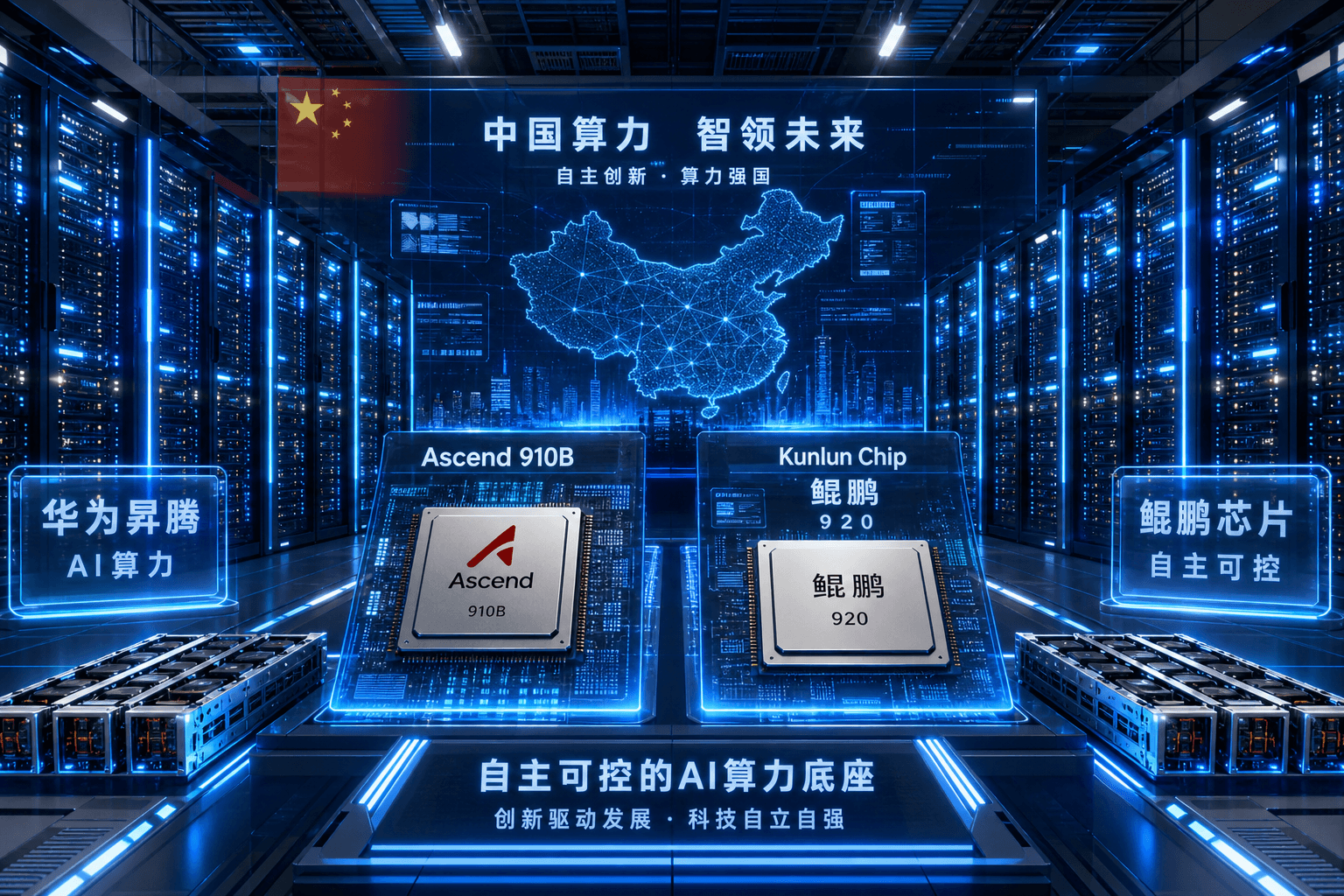
Major Chinese tech giants are pivoting to domestic chips—understand the impact on global AI hardware supply chains.
30-Second TL;DR
What Changed
ByteDance, Alibaba, and Baidu pivoting to domestic hardware
Why It Matters
This shift signals a major change in the AI infrastructure landscape, potentially altering the competitive dynamics of the global GPU market.
What To Do Next
Monitor the performance benchmarks of domestic Chinese GPUs to assess compatibility for your cross-region AI infrastructure deployments.
Key Points
- •ByteDance, Alibaba, and Baidu pivoting to domestic hardware
- •Domestic GPU share hits 41% of new deployments
- •Strategic shift to mitigate reliance on foreign compute
Deep Insight
AI-generated analysis for this event — not the original article.
Enhanced Key Takeaways
- •The surge in domestic adoption is largely driven by U.S. export controls, specifically the tightening of restrictions on high-end AI accelerators like NVIDIA's H20 and A800 series.
- •Major Chinese foundries, particularly SMIC, have improved 7nm and 5nm process yields, enabling domestic chip designers like Huawei (Ascend series) and Cambricon to produce competitive alternatives.
- •The 41% market share figure reflects a strategic 'China-first' procurement policy mandated by state-owned enterprises and large-scale cloud providers to ensure supply chain resilience.
- •Software ecosystem fragmentation remains a primary hurdle, as developers must increasingly support both CUDA and domestic frameworks like Huawei's CANN (Compute Architecture for Neural Networks).
- •Investment in High Bandwidth Memory (HBM) development is accelerating within China, as domestic firms seek to overcome the bottleneck of relying on SK Hynix, Samsung, and Micron for memory components.
Competitor Analysis
- NVIDIA (H20/A800)
- Hopper/Ampere
- Huawei Ascend (910B/C)
- Da Vinci
- Cambricon (MLU Series)
- MLUv03
- NVIDIA (H20/A800)
- CUDA (Industry Standard)
- Huawei Ascend (910B/C)
- CANN (Proprietary)
- Cambricon (MLU Series)
- Bang (Proprietary)
- NVIDIA (H20/A800)
- 4nm/5nm (TSMC)
- Huawei Ascend (910B/C)
- 7nm (SMIC)
- Cambricon (MLU Series)
- 7nm (SMIC)
- NVIDIA (H20/A800)
- Restricted (Export Controls)
- Huawei Ascend (910B/C)
- Unrestricted (Domestic)
- Cambricon (MLU Series)
- Unrestricted (Domestic)
| Feature | NVIDIA (H20/A800) | Huawei Ascend (910B/C) | Cambricon (MLU Series) |
|---|---|---|---|
| Architecture | Hopper/Ampere | Da Vinci | MLUv03 |
| Software Stack | CUDA (Industry Standard) | CANN (Proprietary) | Bang (Proprietary) |
| Process Node | 4nm/5nm (TSMC) | 7nm (SMIC) | 7nm (SMIC) |
| Market Access | Restricted (Export Controls) | Unrestricted (Domestic) | Unrestricted (Domestic) |
Technical Deep Dive
- Huawei Ascend 910B utilizes a multi-die architecture to bypass lithography limitations, focusing on high-density matrix multiplication operations for LLM training.
- Domestic chips are increasingly adopting Chiplet-based designs to improve yield rates on older DUV (Deep Ultraviolet) lithography equipment.
- Integration of proprietary interconnect technologies (similar to NVLink) is being prioritized to allow for large-scale cluster scaling beyond 1,000 GPUs.
- Optimization efforts are heavily focused on FP8 and INT8 precision to compensate for lower raw FP64 performance compared to Western counterparts.
Future ImplicationsAI analysis grounded in cited sources
Timeline
- 2022-10U.S. Department of Commerce implements initial sweeping export controls on advanced AI chips to China.
- 2023-08Huawei releases the Mate 60 Pro, signaling unexpected progress in domestic 7nm chip manufacturing capabilities.
- 2024-01Major Chinese cloud providers begin large-scale pilot programs transitioning from NVIDIA A100s to domestic alternatives.
- 2025-05Domestic AI chip market share crosses the 30% threshold as supply chain localization efforts intensify.
Weekly AI Recap
Read this week's curated digest of top AI events →
Related Updates




AI-curated news aggregator. All content rights belong to original publishers.
Original source: Pandaily ↗
This is a summary, not the original. Read the source, or get the weekly briefing.
The weekly digest
One email a week. Unsubscribe anytime.