China's Commercial Space Race: Compliance and Market Challenges
Understand the regulatory and technical shifts in the $40B satellite communication race between SpaceX and China.
30-Second TL;DR
What Changed
SpaceX secured exclusive D2D spectrum rights, intensifying the global satellite communication race.
Why It Matters
The intensifying competition in satellite communications and the focus on D2D connectivity will drive demand for edge computing and AI-integrated signal processing in orbit. Companies must prioritize international legal compliance to successfully integrate into global infrastructure.
What To Do Next
Evaluate edge AI deployment strategies for satellite-based data processing to optimize bandwidth usage in low-latency communication scenarios.
Key Points
- •SpaceX secured exclusive D2D spectrum rights, intensifying the global satellite communication race.
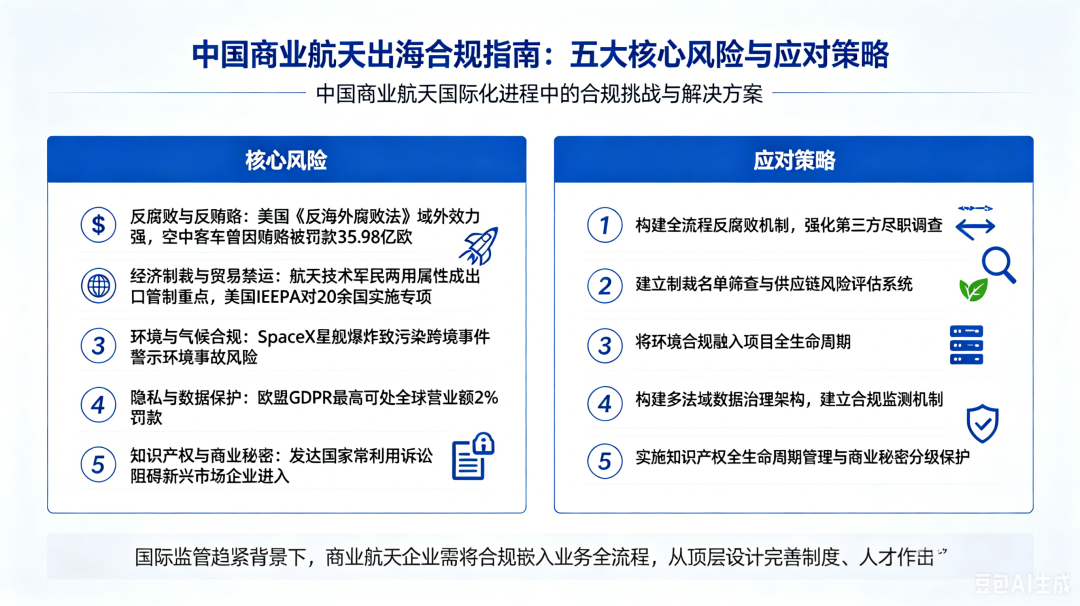
- •Chinese commercial space firms face five major compliance risks, including anti-corruption, trade sanctions, and data privacy.
- •The industry is shifting from technical R&D to capital and supply chain competition, with a focus on rocket reusability.
- •Satellite-to-phone (D2D) technology is becoming a critical battleground for market dominance.
Deep Insight
Background and context from public sources — not the original article. 29 sources cited.
Enhanced Key Takeaways
- •The U.S. Federal Communications Commission (FCC) recently granted SpaceX 65 megahertz of exclusive, contiguous, nationwide spectrum for Starlink Direct-to-Device (D2D) services, transforming SpaceX into a spectrum-holding network operator rather than solely a satellite vendor. This transaction, part of a larger deal exceeding $40 billion, also involved EchoStar selling 50 megahertz to AT&T.
- •China's commercial space industry experienced significant growth in 2025, with revenue surpassing $146.75 billion (1 trillion yuan), marking a 7% year-on-year increase, and the number of operating companies exceeding 600. Total investment in the sector in 2024 increased by almost 40% compared to 2023, reaching over 15 billion yuan, with substantial financial backing from local governments.
- •Chinese commercial space companies are actively pursuing reusable rocket technology, with Landspace's Zhuque-3 rocket making China's first orbital-class first-stage recovery attempt in December 2025, although the landing was unsuccessful. Other private firms like CAS Space and Tianbing Technology are also planning reusable rocket flight experiments in 2026, aiming to bridge the technology gap with leaders like SpaceX.
- •China is strategically developing a multi-orbit Non-Terrestrial Network (NTN) architecture, including large-scale Low-Earth Orbit (LEO) constellations such as Guowang (planning over 13,000 satellites) and Qianfan/G60 Starlink (targeting 15,000 satellites), with a strong focus on direct-to-cellular (D2C) connectivity. China Telecom notably launched the world's first satellite-direct smartphone service in September 2023.
- •Chinese commercial space firms face escalating international compliance risks due to China's Anti-Foreign Sanctions Law (enacted 2021, expanded 2025) and Data Security Law (2021). These regulations empower China to impose countermeasures, including potential intellectual property seizure, export prohibitions, and restrictions on cross-border data transfers, against foreign entities perceived as harming Chinese interests, posing significant challenges for global operations.
Competitor Analysis
- China's Commercial Space Sector (e.g., Landspace, Guowang, G60)
- First orbital-class first-stage recovery attempt (Zhuque-3, Dec 2025) failed. - Lagging SpaceX by over a decade in reusable technology. - Multiple companies (CAS Space, Tianbing Technology) planning reusable rocket tests in 2026.
- SpaceX (Starlink, Falcon 9)
- Falcon 9 successfully verified reusable technology in Dec 2015. - Falcon 9 completed 165 missions in 2025, with boosters reused up to 21 times.
- China's Commercial Space Sector (e.g., Landspace, Guowang, G60)
- Guowang: Plans for over 13,000 satellites. - Qianfan/G60 Starlink: Plans for 15,000 satellites; aims for 648 satellites for APAC coverage by EOY 2025, global by EOY 2027. - Production capacity: G60 factory aims for 300 satellites/year.
- SpaceX (Starlink, Falcon 9)
- Starlink: Over 5,800 operational satellites as of Feb 2024. - Added over 2,300 satellites between mid-2024 and July 2025. - Production rate: Daily production rate of six satellites.
- China's Commercial Space Sector (e.g., Landspace, Guowang, G60)
- Developing direct-to-cell broadband satellite links. - China Telecom launched world's first satellite-direct smartphone service in Sept 2023.
- SpaceX (Starlink, Falcon 9)
- FCC granted 65 MHz of exclusive, contiguous, nationwide spectrum for Starlink D2D in May 2026. - Starlink Mobile (formerly Direct-to-Cell) launched July 2025 (messaging), expanded to broadband Oct 2025.
- China's Commercial Space Sector (e.g., Landspace, Guowang, G60)
- Total investment in 2024 exceeded 15 billion yuan (approx. $2.1 billion), up 40% from 2023. - Annual financing reached 18.6 billion yuan in 2025, up 32% year-on-year. - Shanghai Spacecom Satellite Technology (SSST) raised $933 million in Feb 2024 for G60.
- SpaceX (Starlink, Falcon 9)
- Combined deal value for spectrum acquisition from EchoStar was over $40 billion (SpaceX and AT&T).
| Feature/Metric | China's Commercial Space Sector (e.g., Landspace, Guowang, G60) | SpaceX (Starlink, Falcon 9) |
|---|---|---|
| Rocket Reusability |
|
|
| Satellite Constellations |
|
|
| D2D Spectrum Rights |
|
|
| Investment (2024-2025) |
|
|
Technical Deep Dive
- Rocket Reusability:
- Landspace's Zhuque-3 rocket utilizes a methane and liquid oxygen fuel mixture, drawing inspiration from SpaceX's Starship design principles. Its first-stage recovery attempt in December 2025 failed by approximately 40 meters due to a braking function issue.
- The Lanyan 220-ton liquid oxygen-methane full-flow staged combustion engine has successfully passed long-duration full-system tests, advancing the development of efficient and reusable heavy-lift propulsion systems.
- The Gravity-2 carrier rocket is slated for its maiden flight in the second half of 2026, incorporating critical trials of reusable launch technology.
- Satellite Manufacturing:
- GalaxySpace operates a smart factory designed to reduce satellite development cycles by 80% and achieve an annual production capacity of hundreds of 1,000 kg satellites.
- The G60 Starlink industrial base features a digital-production plant aiming to produce 300 satellites per year, with a goal to shorten the build time for a single satellite from 2-3 months to 1.5 days.
- Direct-to-Device (D2D) Technology:
- China is actively conducting technology tests for direct-to-cell broadband satellite links and comprehensive space-ground network integration.
- The country is developing a multi-orbit Non-Terrestrial Network (NTN) architecture that integrates LEO satellites, high-altitude platforms (HAPs), and unmanned aerial vehicles (UAVs) to complement its terrestrial wireless infrastructure.
- The GEO-based Tiantong-1 system provides stable narrowband services, including voice and messaging, particularly for remote or emergency applications.
Future ImplicationsAI analysis grounded in cited sources
Timeline
- 2014China's State Council published 'Document 60', officially opening its space sector to private investment and fostering commercial space development.
- 2021China enacted the Anti-Foreign Sanctions Law and Data Security Law, introducing a complex compliance landscape for international businesses.
- 2023-09China Telecom launched the world's first satellite-direct smartphone service, demonstrating early direct-to-device (D2D) capabilities.
- 2023-12The G60 Starlink industrial base in Shanghai produced its first commercial satellite, aiming for mass production to support large constellations.
- 2025-12Landspace's Zhuque-3 rocket attempted China's first-stage recovery of an orbital-class launch vehicle, marking a significant step in reusable rocket development.
- 2026-05The FCC granted SpaceX 65 MHz of exclusive, contiguous, nationwide spectrum for Starlink D2D services, intensifying the global spectrum race.
Sources (29)
Factual claims are grounded in the sources below. Forward-looking analysis is AI-generated interpretation.
Weekly AI Recap
Read this week's curated digest of top AI events →
AI-curated news aggregator. All content rights belong to original publishers.
Original source: 虎嗅 ↗
This is a summary, not the original. Read the source, or get the weekly briefing.
The weekly digest
One email a week. Unsubscribe anytime.