China's AI Strategy: International Public Goods Approach
💡Understand the geopolitical shift in AI governance and how China's 'international public good' model impacts global R&D.
⚡ 30-Second TL;DR
What Changed
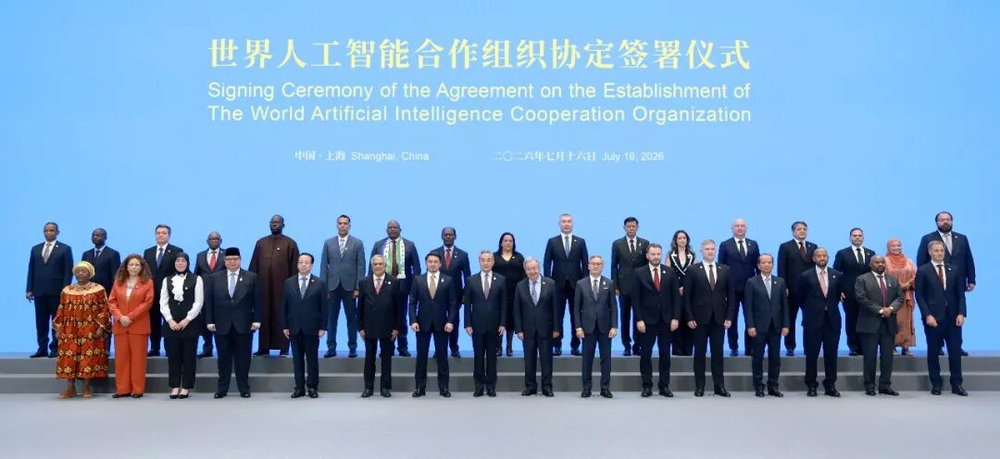
China officially positions AI as an 'international public good' to promote global shared prosperity.
Why It Matters
This strategic shift suggests a move toward more open, collaborative, and state-supported AI ecosystems, potentially influencing global regulatory standards and the availability of AI resources for developing nations.
What To Do Next
Monitor the 'AI+' policy implementation and open-source initiatives from Chinese research institutions for potential cross-border collaboration opportunities.
Key Points
- •China officially positions AI as an 'international public good' to promote global shared prosperity.
- •The 'AI+' initiative aims to integrate AI into economic and social development, diverging from US-centric monopoly models.
- •Establishment of the World AI Cooperation Organization to foster international collaboration.
- •Critique of current AI development trends that prioritize surveillance, automation, and tech-giant consolidation.
🧠 Deep Insight
AI-generated analysis for this event.
🔑 Enhanced Key Takeaways
- •China's 'Global AI Governance Initiative' (GAIGI) explicitly emphasizes the principle of 'mutual respect' and 'equal participation,' aiming to prevent 'technological hegemony' by Western powers.
- •The strategy involves significant investment in 'AI for Science' (AI4S) platforms, which are being positioned as open-access resources for the Global South to accelerate drug discovery and climate modeling.
- •China has actively promoted the 'Beijing Consensus' on AI safety, which advocates for a human-centric approach that prioritizes state-led development over the market-driven, profit-maximizing models prevalent in Silicon Valley.
- •The 'AI+' initiative is structurally linked to the 'Digital Silk Road' (DSR), facilitating the export of Chinese AI infrastructure, smart city technologies, and surveillance standards to developing nations.
- •China's approach includes a dual-track regulatory framework that mandates strict domestic algorithmic transparency and security assessments while simultaneously advocating for international interoperability standards.
🛠️ Technical Deep Dive
- The AI4S infrastructure relies on large-scale heterogeneous computing clusters utilizing domestic NPU (Neural Processing Unit) architectures to bypass export restrictions on high-end GPUs.
- Implementation of 'Federated Learning' frameworks is being prioritized in international collaborations to allow data training across borders without requiring the physical transfer of sensitive datasets.
- Development of 'Model-as-a-Service' (MaaS) platforms that integrate pre-trained foundational models with localized, domain-specific datasets for industrial applications in emerging markets.
🔮 Future ImplicationsAI analysis grounded in cited sources
⏳ Timeline
Weekly AI Recap
Read this week's curated digest of top AI events →
👉Related Updates


AI-curated news aggregator. All content rights belong to original publishers.
Original source: 虎嗅 ↗