China vs US: The Real AI Competition Logic
💡Gain a strategic perspective on the shifting global AI landscape beyond simple talent statistics.
⚡ 30-Second TL;DR
What Changed
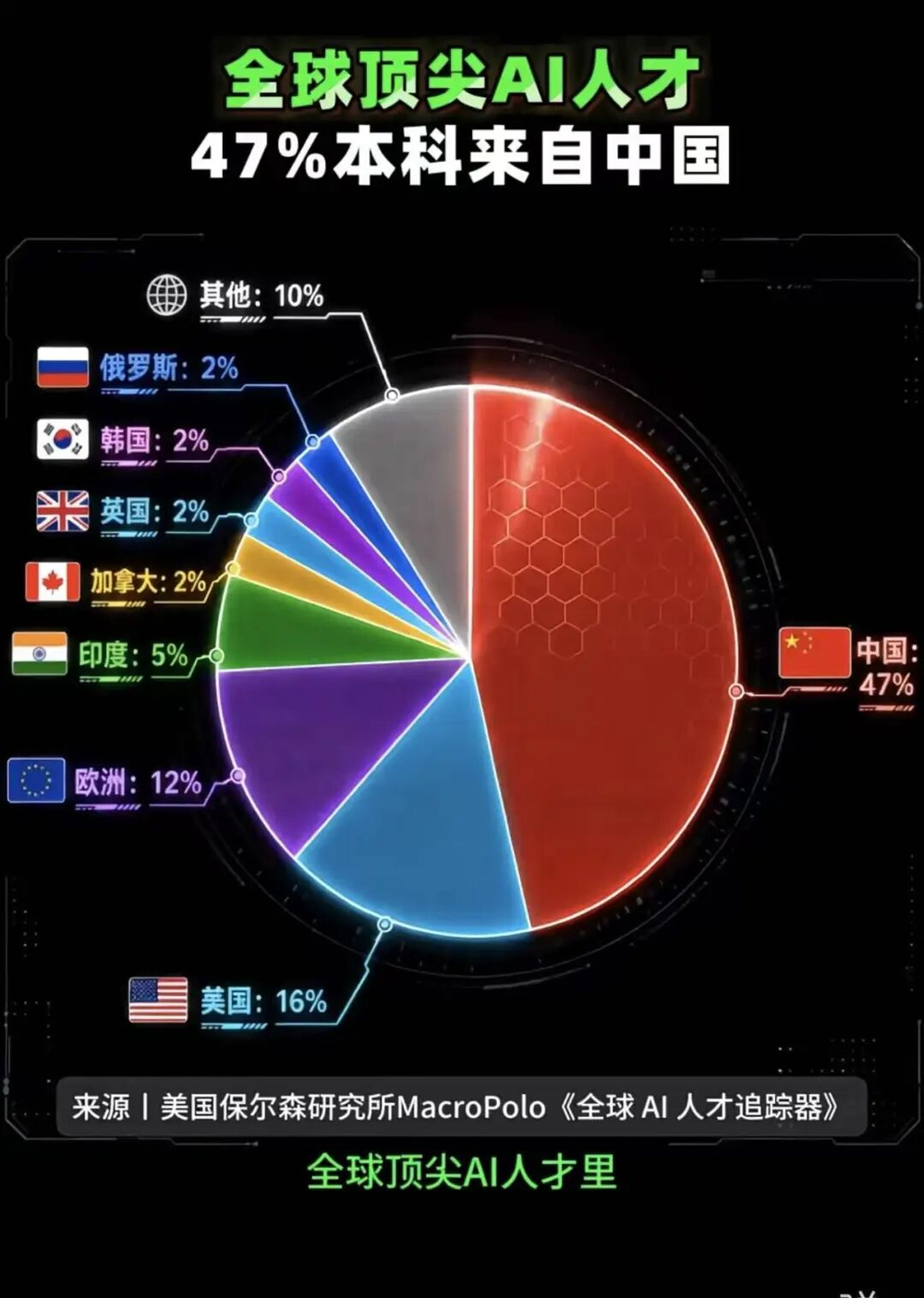
China produces 47% of top-tier AI researchers, but the US remains the primary destination for global talent.
Why It Matters
Understanding these systemic differences helps AI founders and researchers identify where to focus their efforts—whether in pure research or rapid industrial deployment.
What To Do Next
Evaluate your organization's position in the AI value chain: are you focusing on talent acquisition, compute infrastructure, or rapid industrial application?
Key Points
- •China produces 47% of top-tier AI researchers, but the US remains the primary destination for global talent.
- •AI competition has shifted from simple talent counts to systemic competitiveness (compute, energy, policy, innovation).
- •China's strength lies in engineering, industrial application, and large-scale market integration.
- •Future competition will likely move from one-way talent flow to a more balanced, bi-directional global exchange.
🧠 Deep Insight
AI-generated analysis for this event — not the original article.
🔑 Enhanced Key Takeaways
- •The 'compute divide' is widening as US-led export controls on high-end GPUs (like H100/B200 series) force Chinese firms to pivot toward heterogeneous computing architectures and domestic chip interconnect standards.
- •Data scarcity for high-quality Chinese-language training sets is driving a shift toward synthetic data generation and multimodal data synthesis to maintain model performance parity.
- •Energy infrastructure has become a primary bottleneck, with both nations aggressively pursuing modular nuclear reactors and localized microgrids to power massive AI data center clusters.
- •Policy divergence is evident in the US focus on 'safety-first' regulatory frameworks (e.g., NIST AI Risk Management Framework) versus China's focus on 'algorithmic governance' and content alignment with state-defined social values.
- •Investment patterns show a shift from broad-spectrum AI startups to 'AI-for-Science' and industrial automation, where China leverages its massive manufacturing base to achieve faster ROI on AI integration.
🛠️ Technical Deep Dive
- Chinese AI development is increasingly reliant on CXL (Compute Express Link) and proprietary interconnects like Huawei's Ascend series to mitigate the lack of NVLink-equivalent bandwidth.
- Training methodologies in China have shifted toward 'Mixture-of-Experts' (MoE) architectures to reduce the computational cost per inference token, compensating for limited access to top-tier training hardware.
- Implementation of 'Model Distillation' is more prevalent in Chinese industrial AI, where large foundational models are compressed into smaller, edge-deployable models to bypass cloud-compute dependencies.
🔮 Future ImplicationsAI analysis grounded in cited sources
⏳ Timeline
Weekly AI Recap
Read this week's curated digest of top AI events →
👉Related Updates


AI-curated news aggregator. All content rights belong to original publishers.
Original source: 虎嗅 ↗
This is a summary, not the original. Read the source, or get the weekly briefing.
The weekly digest
One email a week. Unsubscribe anytime.