China unveils 'Yuan Yan No. 1' AI-powered electron microscope
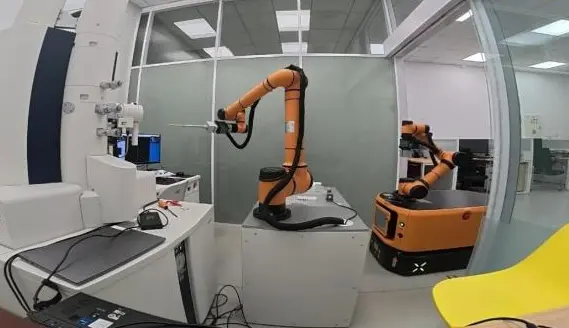
💡First-of-its-kind AI-driven electron microscope that automates complex scientific workflows.
⚡ 30-Second TL;DR
What Changed
World's first intelligent transmission electron microscope
Why It Matters
The automation of complex scientific instrumentation via AI significantly accelerates materials science research. This reduces human error and increases throughput in high-precision imaging.
What To Do Next
Explore how autonomous laboratory systems can be integrated into your data pipeline to automate high-throughput experimental analysis.
Key Points
- •World's first intelligent transmission electron microscope
- •Enables fully autonomous operation from sample to data
- •Significant advancement for micro-scale research and AI integration
🧠 Deep Insight
Web-grounded analysis with 15 cited sources.
🔑 Enhanced Key Takeaways
- •The 'Yuan Yan No. 1' demonstrates significant efficiency gains, achieving image acquisition speeds 56 times faster and analysis efficiency approximately 300 times higher than manual operation.
- •The system can process 200 samples and capture 5,000 images in a single day for catalyst microstructure analysis, quantitatively analyzing 500,000 particles and automatically generating detailed professional reports.
- •It successfully overcame five major technical challenges: high-vacuum sample transfer, autonomous adjustment of electron optical imaging, intelligent nanoscale sample positioning, automated image acquisition and real-time analysis, and full-system status perception and coordinated scheduling.
- •The data generated by 'Yuan Yan No. 1' in just two weeks is equivalent to approximately one year of work using traditional transmission electron microscopes.
- •The intelligent TEM passed a scientific and technological achievement evaluation, where it was unanimously concluded to be highly innovative, the first of its kind globally, and internationally leading.
🛠️ Technical Deep Dive
- The 'Yuan Yan No. 1' enables a fully automated workflow that encompasses sample transfer, imaging, and data analysis.
- Its intelligent operation addresses five key technical hurdles: high-vacuum sample transfer, autonomous electron optical imaging adjustments, intelligent nanoscale sample positioning, automated image acquisition with real-time analysis, and comprehensive system status perception and coordinated scheduling.
- The system is capable of quantitatively analyzing up to 500,000 particles and automatically generating professional reports that include statistical information on particle size, dispersion, and crystal structure.
- The Dalian Institute of Chemical Physics (DICP) contributes expertise in 'Electron microscopy data quantification through AI-assisted image analysis' and 'Methodology and instrument development for operando electron microscopy on catalysis,' indicating the integration of AI for advanced data processing and real-time experimental control.
- The involvement of the Shenyang Institute of Automation (SIA) suggests contributions in robotics, automation, and intelligent control systems, likely for the physical manipulation and coordinated scheduling aspects of the microscope.
🔮 Future ImplicationsAI analysis grounded in cited sources
⏳ Timeline
📎 Sources (15)
Factual claims are grounded in the sources below. Forward-looking analysis is AI-generated interpretation.
Weekly AI Recap
Read this week's curated digest of top AI events →
👉Related Updates



AI-curated news aggregator. All content rights belong to original publishers.
Original source: cnBeta (Full RSS) ↗