China Telecom's $1.7bn server deal favors Huawei ecosystem
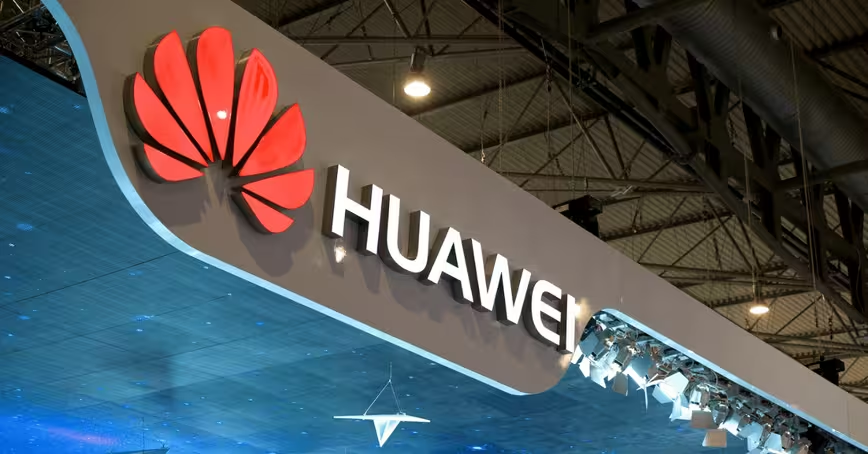
Insight into how state-backed procurement is shaping the future of AI infrastructure in China.
30-Second TL;DR
What Changed
China Telecom ordered 40,000 servers totaling $1.7 billion.
Why It Matters
This signals a continued consolidation of the Chinese domestic server market around Huawei-compatible hardware, impacting global supply chains.
What To Do Next
Analyze the hardware specifications of the winning servers to assess the performance gap between domestic and international AI infrastructure.
Key Points
- •China Telecom ordered 40,000 servers totaling $1.7 billion.
- •Huawei ecosystem partners won the bulk of the contract despite Huawei not bidding.
- •The deal reflects a template for state-owned enterprises to favor domestic tech ecosystems.
Deep Insight
AI-generated analysis for this event — not the original article.
Enhanced Key Takeaways
- •The procurement specifically focuses on servers utilizing the Kunpeng and Ascend architectures, which are central to Huawei's proprietary computing ecosystem.
- •This contract is part of a broader 'Xinchuang' (IT innovation) initiative by the Chinese government to replace foreign hardware with domestic alternatives in critical infrastructure.
- •The bidding process saw significant participation from companies like H3C, Sugon, and various provincial-level state-owned system integrators that license Huawei's underlying technology.
- •Industry analysts note that this procurement strategy effectively bypasses potential US export controls by utilizing domestic chip manufacturing and design ecosystems.
- •The servers are intended to bolster China Telecom's 'Cloud-Network Integration' strategy, specifically enhancing AI training and inference capabilities for state-backed large language models.
Competitor Analysis
- Huawei (Kunpeng/Ascend)
- ARM-based (Kunpeng)
- Intel/AMD (x86)
- x86-64
- NVIDIA (GPU)
- Proprietary GPU
- Huawei (Kunpeng/Ascend)
- Domestic/Closed
- Intel/AMD (x86)
- Global/Open
- NVIDIA (GPU)
- Global/Open
- Huawei (Kunpeng/Ascend)
- Ascend (NPU)
- Intel/AMD (x86)
- CPU-focused
- NVIDIA (GPU)
- High-end GPU (H100/B200)
- Huawei (Kunpeng/Ascend)
- Domestic (China)
- Intel/AMD (x86)
- Global (US-led)
- NVIDIA (GPU)
- Global (US-led)
| Feature | Huawei (Kunpeng/Ascend) | Intel/AMD (x86) | NVIDIA (GPU) |
|---|---|---|---|
| Architecture | ARM-based (Kunpeng) | x86-64 | Proprietary GPU |
| Ecosystem | Domestic/Closed | Global/Open | Global/Open |
| AI Capability | Ascend (NPU) | CPU-focused | High-end GPU (H100/B200) |
| Supply Chain | Domestic (China) | Global (US-led) | Global (US-led) |
Technical Deep Dive
- Servers are primarily configured with Kunpeng 920 processors, which utilize the ARMv8 architecture optimized for high-density data center workloads.
- AI-specific nodes within the order incorporate Ascend 910B NPUs, designed for large-scale model training and inference tasks.
- The hardware supports the openEuler operating system, a domestic Linux distribution backed by Huawei, ensuring full-stack compatibility within the ecosystem.
- Implementation involves high-speed interconnects (HCCS) to facilitate cluster-level computing performance, mimicking the scalability of Western high-performance computing clusters.
Future ImplicationsAI analysis grounded in cited sources
Timeline
- 2019-05US Department of Commerce adds Huawei to the Entity List, restricting access to US-origin technology.
- 2020-09Huawei officially launches the openEuler operating system to provide a domestic foundation for its server ecosystem.
- 2023-04China Telecom announces a major shift toward 'Cloud-Network Integration' as a core corporate strategy.
- 2024-12China Telecom completes a pilot phase of server procurement focusing exclusively on domestic chip architectures.
- 2026-05China Telecom finalizes the $1.7 billion server procurement contract favoring the Huawei-aligned ecosystem.
Weekly AI Recap
Read this week's curated digest of top AI events →
Related Updates


AI-curated news aggregator. All content rights belong to original publishers.
Original source: The Next Web (TNW) ↗
This is a summary, not the original. Read the source, or get the weekly briefing.
The weekly digest
One email a week. Unsubscribe anytime.